Introduction
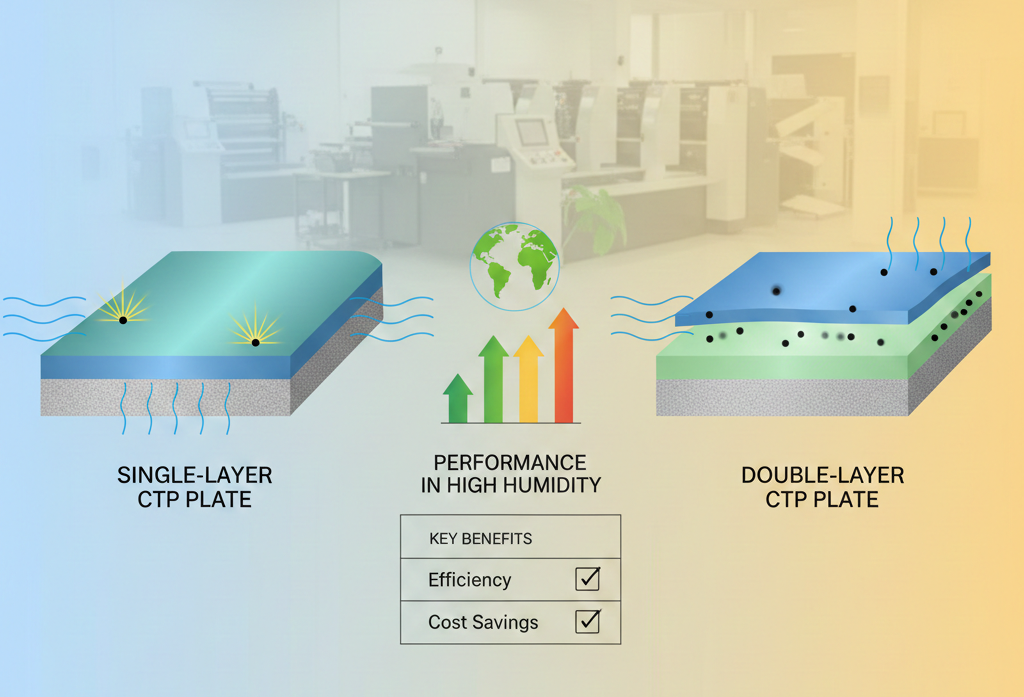
Humidity has always been one of the hidden enemies of offset printing. From fluctuating dot sharpness to unstable development and inconsistent ink–water balance, high-moisture environments can disrupt plate performance dramatically.
This is especially true for print shops in tropical regions, coastal areas, rainy climates, or factories without full HVAC control. Over the past decade, plate technology has evolved to address environmental instability, and single-layer thermal CTP plates have emerged as one of the most reliable solutions.
This article explains why single-layer plates perform better in high-humidity environments, what makes them more stable, and how print shops can optimize plate usage to improve overall production efficiency.
1. Why Humidity is a Critical Issue in Offset Plate Performance
Humidity affects printing plates at three major stages:
1. Storage & Handling
High moisture levels can cause:
coating softening
moisture absorption
coating surface tackiness
early oxidation
reduced photosensitivity
2. Imaging & Development
Humidity influences:
laser energy absorption
dot shape
chemical reaction consistency
developer life & stability
3. On-Press Performance
Excess moisture may cause:
inconsistent ink–water balance
background toning
dot gain fluctuation
shorter run length
In many print shops—especially in Southeast Asia, China’s southern provinces, Middle East coastal factories, India, Africa, and Latin America—humidity can reach 65–90%, significantly stressing plate coatings.
2. What Makes Single-Layer Plates Different?
Single-layer thermal plates use a simplified coating structure where the imaging layer and hydrophilic base interact with less complexity.
Key technical characteristics:
Only one functional coating layer
Simpler exposure reaction
Fewer components that can absorb moisture
More stable chemistry interaction
Faster and more tolerant developing performance
These features give single-layer plates a natural advantage in unstable or humid environments.
3. Technical Reasons Single-Layer Plates Perform Better in High-Humidity Environments
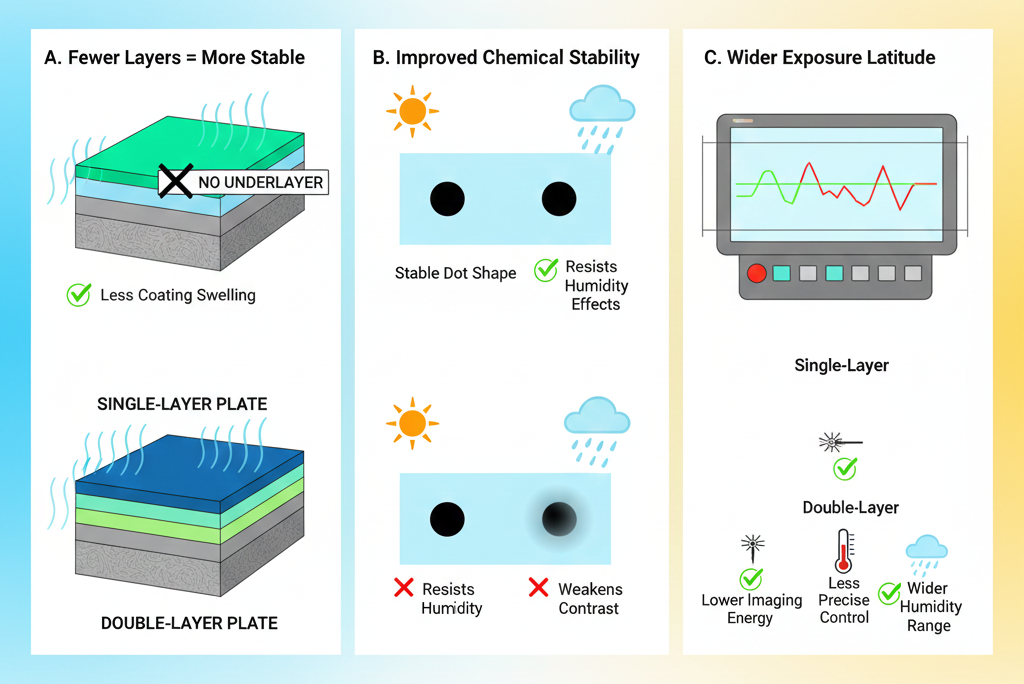
A. Fewer Layers = Fewer Points of Failure
Double-layer plates contain:
an upper imaging layer
a hydrophilic underlayer
aluminum grain & anodized base
More layers = more components affected by moisture.
Single-layer plates eliminate the underlayer, reducing the total moisture-sensitive surface area.
Benefits:
Less coating swelling
Reduced sensitivity to air humidity
More predictable imaging performance
B. Improved Chemical Stability
Humidity weakens the contrast between hydrophilic and oleophilic areas on the plate.
Single-layer plates maintain:
stable non-image area hydrophilicity
consistent dot shape
controlled exposure response
This is especially noticeable when humidity drops and rises throughout the day—a common situation in non-climate-controlled print shops.
C. Wider Exposure Latitude
Because the reaction layer is simpler, single-layer plates require:
lower imaging energy
less precise temperature control
wider acceptable humidity range
This makes them more forgiving when:
laser power fluctuates
processor chemistry weakens slightly
environmental conditions shift
D. Superior Development Consistency
Single-layer plates are easier to develop because:
coating dissolves more uniformly
developers last longer
results stay consistent even as humidity rises
Lower humidity sensitivity = fewer remakes
This directly reduces production costs.
E. Better On-Press Stability in Moisture-Rich Air
In humid environments:
the non-image area can accept too much water
emulsification becomes unstable
background toning appears
Single-layer plates resist over-hydration more effectively due to their:
cleaner surface
lower porosity
stronger hydrophilic stability
This results in quicker startup and steadier ink–water balance.
4. Performance Comparison Table
Below is a simplified comparison between single-layer and double-layer thermal plates under high-humidity operating conditions:
| Feature | Single-Layer Plates | Double-Layer Plates |
|---|---|---|
| Humidity resistance | ★★★★★ | ★★★★ |
| Storage stability | High | Medium |
| Imaging consistency | High | Medium–High |
| Development tolerance | Excellent | Medium |
| Chemistry sensitivity | Low | Medium |
| Ink–water balance (on press) | Very stable | Stable |
| Risk of background toning | Low | Medium |
| Run length | Medium–High | High |
| Cost efficiency | Higher | Medium |
5. Ideal Applications for Single-Layer Plates
Single-layer plates are particularly valuable when printers face challenging climate conditions.
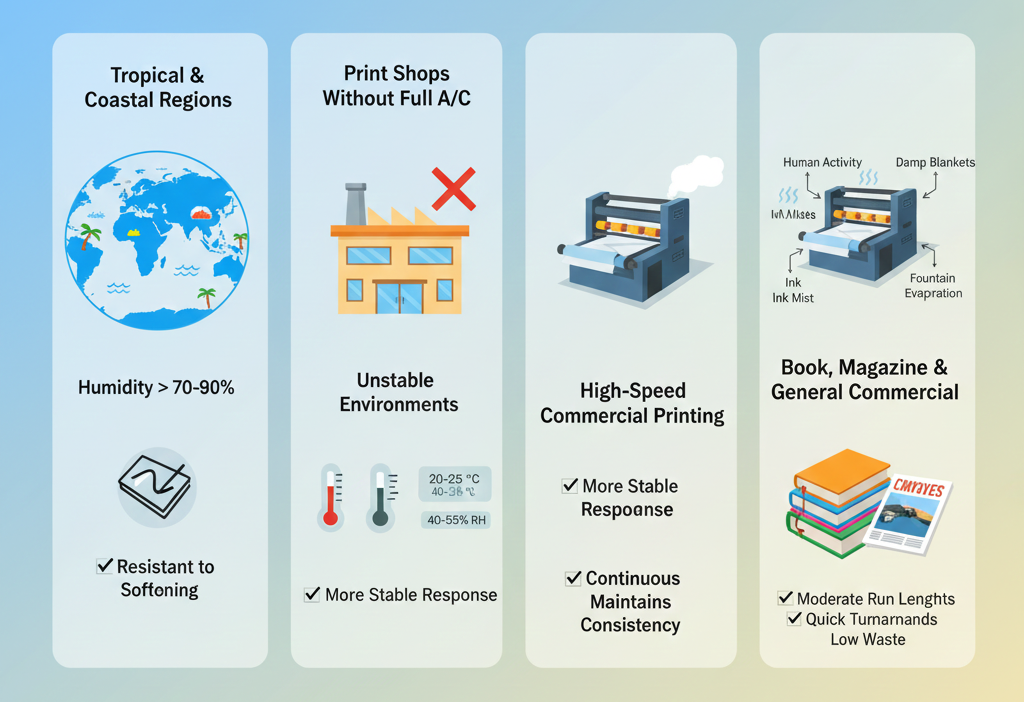
A. Tropical & Coastal Regions
Countries such as:
Indonesia
Malaysia
Thailand
Vietnam
Philippines
Coastal India
South China (Guangdong, Fujian, Guangxi, Hainan)
Humidity often exceeds 70–90%, making double-layer plates prone to coating softening.
B. Print Shops Without Full Air-Conditioning
Many medium-sized printers cannot maintain ideal 20–25 °C and 40–55% RH. Single-layer plates offer a more stable response.
C. High-Speed Commercial Printing
When multiple shifts run continuously, humidity rises from:
human activity
damp blankets
ink mist
fountain solution evaporation
Single-layer plates maintain consistency throughout long shifts.
D. Book, Magazine, and General Commercial Printers
Jobs requiring:
moderate run lengths
quick turnarounds
low waste
benefit strongly from single-layer stability.
6. Why Many Printers Are Switching to Single-Layer Plates
Industry trends show a strong shift toward single-layer thermal plates because they offer:
✔ More stable performance in humid climates
✔ Lower chemistry consumption
✔ Faster imaging & developing response
✔ High consistency on long shifts
✔ Lower total cost of ownership
This does not mean double-layer plates are obsolete. They are still superior for:
extremely long run lengths
highly abrasive inks
high-end packaging
But for day-to-day commercial printing, especially in humid regions, single-layer plates provide the best balanced performance.
7. How We Support High-Humidity Printing Operations
We supply high-stability single-layer thermal CTP plates designed specifically for:
tropical climates
high-moisture workshops
long production shifts
Our plates feature:
moisture-resistant coating technology
wide exposure latitude
strong dot sharpness
excellent hydrophilicity
low chemistry consumption
If your print shop experiences humidity-related issues, uneven imaging, or high remake rates, feel free to contact us for:
sample testing
technical advice
printroom humidity audits
workflow optimization
Why Does a CTP Plate Scum on Press ? 9 Common Causes and Proven Solutions
Learn why CTP plates scum on press, the most common causes, troubleshooting methods, and practical solutions to improve offset printing quality and reduce downtime.

Which Offset Machine Is Best ? A Practical Guide for Commercial Printing
Which offset machine is best? Learn how to choose the right offset printing machine based on format, volume, cost, and CTP technology.

Where to Buy Thermal CTP Plates for Offset Printing | Best Supplier Guide & Expert Tips
Looking for reliable thermal CTP plates for offset printing? This expert guide explains how to choose a trustworthy supplier, compares global and Chinese manufacturers, and shares key quality criteria.