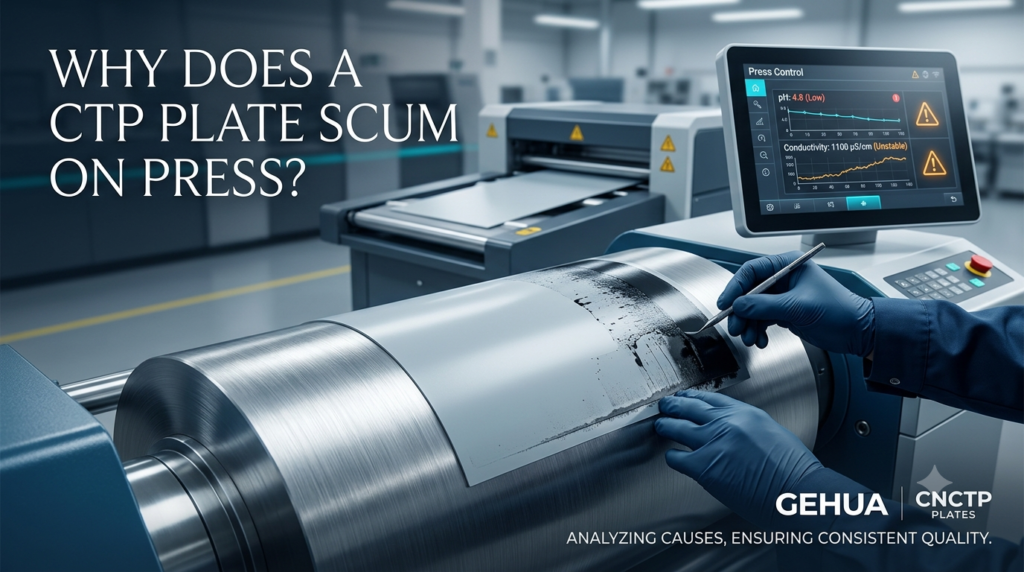
Why Does a CTP Plate Scum on Press?
CTP plate scumming is one of the most common problems in offset printing. It occurs when ink begins to adhere to non-image areas of the printing plate, creating an unwanted gray background, dirty prints, reduced contrast, and unstable color reproduction.
Although scumming often appears to be a plate defect, the root cause may involve several factors, including plate quality, fountain solution, ink balance, press settings, water quality, or improper plate processing.
Understanding why a CTP plate scums on press is the first step toward solving the problem efficiently and preventing recurring production losses.
What Is Plate Scumming?
Plate scumming refers to the unintended acceptance of ink by the non-image areas of an offset printing plate.
Under normal conditions:
- Image areas should attract ink.
- Non-image areas should remain clean by holding a thin water film.
When this balance is disrupted, the background begins to accept ink, resulting in:
- Gray haze
- Dirty backgrounds
- Loss of highlight details
- Reduced print sharpness
- Increased waste sheets
Unlike ghosting or toning, scumming typically becomes more severe as the print run continues if the underlying issue is not corrected.
1. Poor Fountain Solution Balance
The most common cause of plate scumming is an incorrect fountain solution.
If the fountain solution loses its ability to protect the non-image areas, those areas gradually become ink receptive.
Common issues include:
- Incorrect pH level
- Low conductivity
- Improper fountain concentrate ratio
- Contaminated circulation system
- Excessive alcohol replacement additives
Recommended Actions
- Check pH regularly.
- Maintain stable conductivity.
- Replace contaminated solution.
- Clean the circulation system periodically.
2. Incorrect Ink-Water Balance
Offset printing relies on a delicate balance between ink and water.
Too little water allows ink to spread into non-image areas.
Too much water can emulsify ink, reducing print stability and eventually causing scumming.
Typical symptoms include:
- Background tint
- Ink instability
- Poor color consistency
- Roller glazing
Best Practice
Operators should adjust water gradually rather than making large corrections, allowing the press to stabilize after each adjustment.
3. Low-Quality or Damaged CTP Plates
Not all thermal CTP plates offer the same coating quality or durability.
A poor-quality plate may exhibit:
- Weak hydrophilic performance
- Uneven coating thickness
- Reduced chemical resistance
- Premature wear
- Inconsistent imaging
As production continues, the non-image coating may lose its water-retaining capability, making scumming increasingly likely.
When selecting CTP plates, evaluate:
- Coating consistency
- Aluminum substrate quality
- Dot reproduction accuracy
- Press run durability
- Manufacturing quality control
4. Improper Plate Processing
For conventional thermal CTP plates, improper developing conditions can leave residual coating on the plate or damage the hydrophilic layer.
Common processing problems include:
- Exhausted developer
- Incorrect developer temperature
- Excessive developing time
- Insufficient washing
- Processor contamination
Routine maintenance of the plate processor is essential for consistent plate performance.
5. Excessive Roller Pressure
Incorrect roller settings can mechanically damage the plate surface.
Over time this may:
- Wear away the hydrophilic coating
- Increase background sensitivity
- Accelerate plate wear
- Promote ink pickup in non-image areas
Regular roller calibration should be part of preventive maintenance.
6. Poor Water Quality
Water quality is frequently overlooked.
Hard water, high mineral content, excessive chloride, or contaminated water may reduce fountain solution performance.
Ideal water management includes:
- Filtration
- Controlled hardness
- Stable temperature
- Regular laboratory testing
Using untreated water often results in inconsistent printing performance across different seasons.
7. Plate Oxidation Before Printing
If CTP plates are stored improperly before use, oxidation may occur on the aluminum surface.
Possible causes include:
- High humidity
- Direct sunlight
- Long-term storage
- Damaged packaging
- Large temperature fluctuations
Oxidized plates generally require more water during startup and are more likely to scum during long print runs.
Proper storage should include:
- Temperature-controlled rooms
- Low humidity
- Original sealed packaging
- FIFO inventory management
8. Press Contamination
Ink residue, paper dust, calcium deposits, and coating debris gradually accumulate inside the press.
These contaminants reduce the effectiveness of the dampening system and rollers, eventually contributing to scumming.
Critical maintenance areas include:
- Dampening rollers
- Ink rollers
- Blankets
- Fountain circulation system
- Plate cylinder
Preventive cleaning schedules are significantly less expensive than production downtime.
9. Incorrect Plate Selection
Different printing jobs require different CTP plate specifications.
For example:
| Printing Application | Recommended Plate Type |
|---|---|
| Commercial Printing | Standard Thermal CTP Plate |
| Long Run Printing | High Durability Thermal Plate |
| UV Printing | UV-Compatible CTP Plate |
| Eco Printing | Process-Free Thermal Plate |
Selecting an unsuitable plate often results in reduced press life and unstable printing performance.

Quick Troubleshooting Checklist
Before replacing the plate, verify the following:
✅ Fountain solution pH
✅ Fountain conductivity
✅ Water temperature
✅ Ink-water balance
✅ Roller pressure
✅ Plate processor condition
✅ Plate storage environment
✅ Developer chemistry
✅ Plate coating condition
In many cases, correcting one of these variables resolves the issue without replacing the plate.
How to Prevent CTP Plate Scumming
Prevention is more cost-effective than troubleshooting after production has started.
The following practices can significantly reduce the risk of scumming:
- Use high-quality thermal CTP plates from a reliable manufacturer.
- Monitor fountain solution daily.
- Maintain proper ink-water balance throughout the print run.
- Clean rollers and dampening systems regularly.
- Replace exhausted developer on schedule.
- Store plates in a cool, dry environment.
- Perform routine press calibration.
- Train operators to recognize early signs of scumming before defects become severe.
A combination of consistent maintenance and premium consumables delivers the most stable printing results.
Frequently Asked Questions
Why is my CTP plate scumming only after several thousand impressions?
This usually indicates gradual degradation of the ink-water balance, roller contamination, plate wear, or reduced hydrophilic performance rather than an immediate imaging defect.
Can a bad fountain solution cause plate scumming?
Yes. Incorrect pH, conductivity, contamination, or improper mixing ratios are among the leading causes of scumming in offset printing.
Are thermal CTP plates less likely to scum than conventional PS plates?
In general, high-quality thermal CTP plates provide more stable imaging, better coating consistency, and improved resistance to scumming when used under proper press conditions.
Should I replace the plate immediately when scumming occurs?
Not necessarily. Operators should first inspect the fountain solution, roller settings, water quality, processor condition, and plate storage before assuming the plate is defective.
Why Choose GEHUA Thermal CTP Plates?
At CNCTP Plates, we manufacture high-performance thermal CTP plates engineered for stable ink-water balance, precise imaging, and long press runs. Our production process emphasizes coating consistency, premium aluminum substrates, and strict quality control to help commercial printers reduce common press issues such as scumming, background tinting, and premature plate wear.
Whether you operate a commercial print shop, packaging facility, or publishing press, our thermal CTP solutions are designed to improve print quality while lowering production costs.
Explore our complete range of thermal CTP plates and contact our technical team for expert recommendations tailored to your printing workflow.
Conclusion
CTP plate scumming is rarely caused by a single factor. In most cases, it results from the interaction of plate quality, fountain solution, ink-water balance, press settings, processing conditions, and maintenance practices. By following a structured troubleshooting approach and selecting reliable thermal CTP plates, printers can minimize downtime, reduce waste, and maintain consistently high print quality.
Why Does a CTP Plate Scum on Press ? 9 Common Causes and Proven Solutions
Learn why CTP plates scum on press, the most common causes, troubleshooting methods, and practical solutions to improve offset printing quality and reduce downtime.

Which Offset Machine Is Best ? A Practical Guide for Commercial Printing
Which offset machine is best? Learn how to choose the right offset printing machine based on format, volume, cost, and CTP technology.

Where to Buy Thermal CTP Plates for Offset Printing | Best Supplier Guide & Expert Tips
Looking for reliable thermal CTP plates for offset printing? This expert guide explains how to choose a trustworthy supplier, compares global and Chinese manufacturers, and shares key quality criteria.