Introduction
Rubber blankets are one of the most essential yet often overlooked components in offset printing. While inks, plates, and press speed receive much of the attention, the rubber blanket quietly determines print sharpness, ink transfer consistency, dot stability, and paper adaptability. Whether you operate a sheetfed press, web offset line, newspaper press, or packaging workflow, the performance of your rubber blanket directly influences productivity and print quality.
This article provides a comprehensive, easy-to-understand, and professionally detailed guide to what rubber blankets are used for, how they work, and why they remain indispensable across printing industries.
1. What Is a Rubber Blanket?
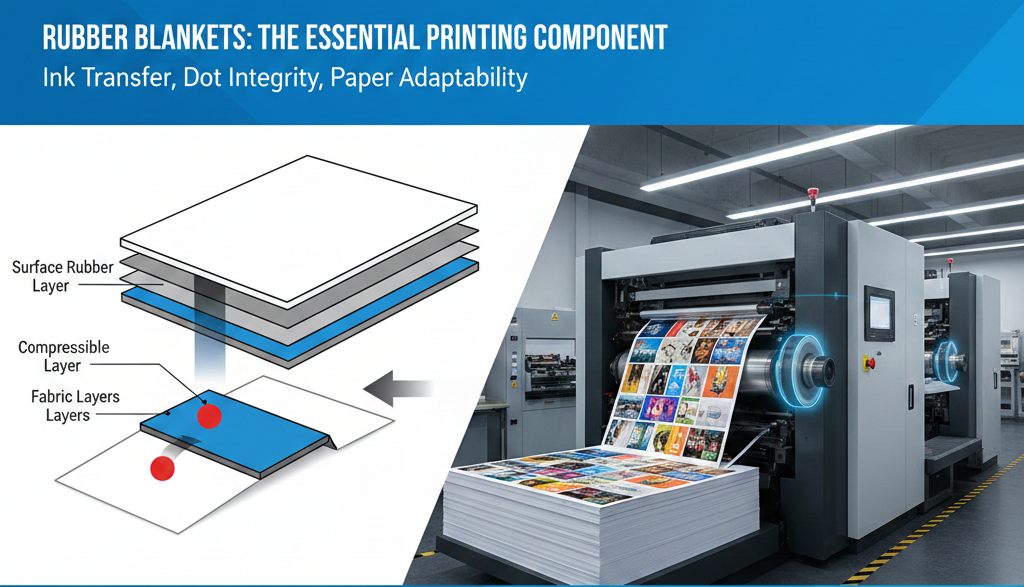
A rubber blanket is a multilayer composite material mounted on the blanket cylinder of an offset press.
Its structure typically includes:
Surface rubber layer – comes in various hardness levels and textures
Compressible layer – absorbs pressure, prevents plate wear
Fabric layers – provide dimensional stability and durability
Unlike printing plates, which carry the image, the blanket serves as the intermediary that transfers the inked image onto paper. This indirect process is what gives “offset” printing its name—the ink is offset from plate to blanket, then blanket to substrate.
2. Primary Uses of Rubber Blankets in Printing
Rubber blankets serve multiple critical purposes across offset printing processes. Their primary uses include:
A. Image Transfer in Offset Printing
The blanket’s most essential function is to accept ink from the plate and transfer it cleanly to paper.
Rubber provides:
flexibility
controlled compression
strong ink affinity
resistance to solvents
This ensures that halftone dots, solids, fine lines, and gradients are accurately reproduced without distortion.
B. Maintaining Dot Integrity
Rubber blankets preserve the shape, size, and sharpness of halftone dots.
This makes them crucial for:
high-resolution images
color-intensive graphics
packaging artwork
fine typography
A high-quality blanket prevents dot gain and ensures stable tonal reproduction.
C. Adapting to Different Paper Types
Unlike rigid plates, blankets can conform to a wide range of substrates:
coated & uncoated paper
recycled paper
cardboard & folding carton
newsprint
thin or uneven materials
This adaptability is one reason offset printing remains so versatile today.
D. Reducing Plate Wear
By acting as a “pressure cushion,” the rubber blanket minimizes mechanical contact between the printing plate and the substrate.
This reduces:
plate scratching
premature aging
need for plate replacement
Result: lower production cost and longer plate life.
E. Absorbing Press Vibration & Pressure Variation
The compressible layer inside the blanket stabilizes the printing pressure even when:
paper thickness changes
cylinders have minor surface variations
operators increase printing speed
This stability improves registration and reduces banding.
3. Specialized Uses of Rubber Blankets
Beyond standard sheetfed or web offset work, blankets are used in many specialized applications.
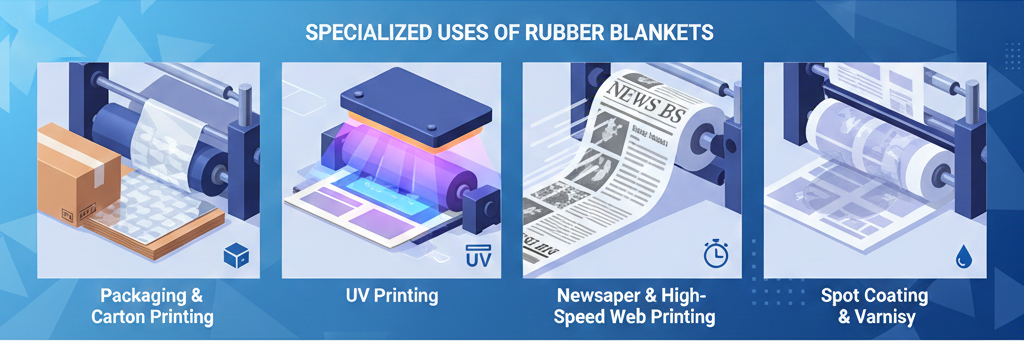
A. Packaging & Carton Printing
Packaging materials often require:
higher pressure
stronger ink transfer
greater surface conformity
Rubber blankets with deeper compressible layers help presses handle:
duplex carton
SBS paperboard
micro-flute corrugated
foil-laminated boards
Without a suitable blanket, achieving uniform solids in packaging is nearly impossible.
B. UV Printing
UV inks require blankets that can resist:
photoinitiators
high-energy UV light exposure
aggressive solvents
Special UV-compatible blankets retain elasticity and prevent swelling.
C. Newspaper & High-Speed Web Printing
In pressrooms running 30,000–80,000 impressions per hour, blankets must maintain:
stability
quick release
low heat buildup
This ensures consistent ink density across thousands of meters of newsprint.
D. Spot Coating, Varnish & Hybrid Applications
In coating units, rubber blankets are used to:
carry aqueous or UV varnish
apply spot coating patterns
ensure smooth surface finishing
Coating blankets are engineered differently from printing blankets but operate on the same principle.
E. ConPlate for Specialty Printing Systems
Rubber blankets are also used in:
security printing
banknote presses
adhesive transfer
metal decorating
can printing
label press systems
Each requires custom blanket formulations for unique substrate demands.
4. How Rubber Blankets Improve Printing Quality
1. Better Ink Distribution
The surface layer’s micro-texture ensures consistent ink laydown, reducing issues like:
mottling
pinholes
uneven density
2. Smooth Solid Areas
A well-engineered blanket enhances the appearance of:
large color blocks
gradients
backgrounds
3. Improved Registration
Dimensional stability in the fabric layers keeps colors aligned even during long runs.
4. Minimized Ghosting
High-end blankets control surface rebound behavior, reducing mechanical and chemical ghosting.
5. Factors to Consider When Choosing a Rubber Blanket
Professional printers select blankets based on several key performance parameters.
A. Surface Hardness (Shore A)
Softer blankets = better adaptability
Harder blankets = better dot sharpness
B. Compressibility
A well-designed compressible layer provides:
stable printing pressure
longer blanket life
better solids
C. Surface Roughness
The correct texture improves:
ink transfer
release behavior
density uniformity
D. Ink Resistance
Different inks require specific blanket resistances:
UV
conventional
metallic
food-grade inks
E. Durability & Wash Resistance
Blankets must withstand:
thousands of wash cycles
operator handling
continuous pressure
F. Paper Type & Press Type
A newspaper press requires a completely different blanket compared to a sheetfed packaging press.
6. Benefits of High-Quality Rubber Blankets
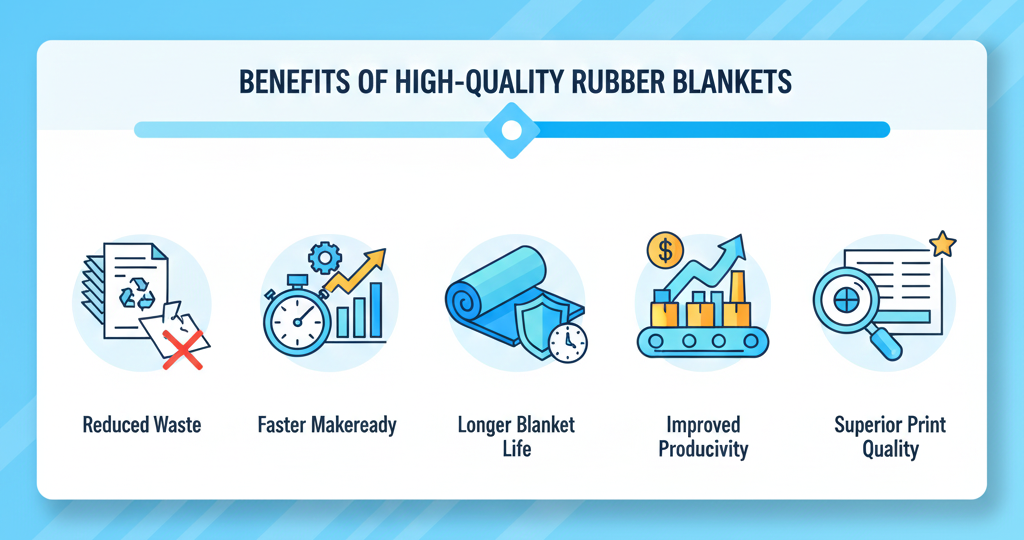
1. Reduced Waste
Better ink transfer reduces sheet waste during startup and long runs.
2. Faster Makeready
A consistent blanket surface achieves color faster.
3. Longer Blanket Life
High-quality materials withstand compression and solvent exposure.
4. Improved Productivity
Less downtime → more jobs completed → higher profit.
5. Superior Print Quality
Sharper dots, smoother solids, and better overall consistency.
7. Common Problems Caused by Poor-Quality Blankets
• Dot distortion
Occurs when the blanket surface is too soft or uneven.
• Slurring & doubling
Caused by improper blanket tension or low rebound elasticity.
• Excessive piling
Poor ink release causes accumulation on the blanket surface.
• Ghosting
Due to uneven ink acceptance or rebound issues.
• Premature wear
Low-quality fabric layers or poor compressibility lead to early failure.
8. How Our Rubber Blankets Help Printers
We supply premium rubber blankets designed for:
sheetfed offset
web offset
newspaper printing
UV and hybrid printing
packaging & carton production
spot coating units
Our blankets offer:
precise ink transfer
long life span
excellent compressibility
easy installation
consistent print results
If you need samples, technical recommendations, or a quotation, feel free to reach out—our technical team can recommend the perfect blanket for your press.

Why Does a CTP Plate Scum on Press ? 9 Common Causes and Proven Solutions
Learn why CTP plates scum on press, the most common causes, troubleshooting methods, and practical solutions to improve offset printing quality and reduce downtime.

Which Offset Machine Is Best ? A Practical Guide for Commercial Printing
Which offset machine is best? Learn how to choose the right offset printing machine based on format, volume, cost, and CTP technology.

Where to Buy Thermal CTP Plates for Offset Printing | Best Supplier Guide & Expert Tips
Looking for reliable thermal CTP plates for offset printing? This expert guide explains how to choose a trustworthy supplier, compares global and Chinese manufacturers, and shares key quality criteria.