Introduction: Why This Comparison Matters
In offset printing, the choice of printing plate has a direct impact on production efficiency, operating cost, print quality, and environmental compliance. Among today’s mainstream technologies, Process Free CTP Plates and Thermal CTP Plates are the two most commonly discussed options.
Although both are exposed on thermal CTP systems, they differ significantly in workflow, chemistry usage, cost structure, and operational requirements. For printing companies planning equipment upgrades or material changes, understanding the differences between Process Free CTP Plate vs Thermal CTP Plate is essential for making the right investment decision.
This article provides a professional, practical comparison based on real production experience.
What Is a Thermal CTP Plate?
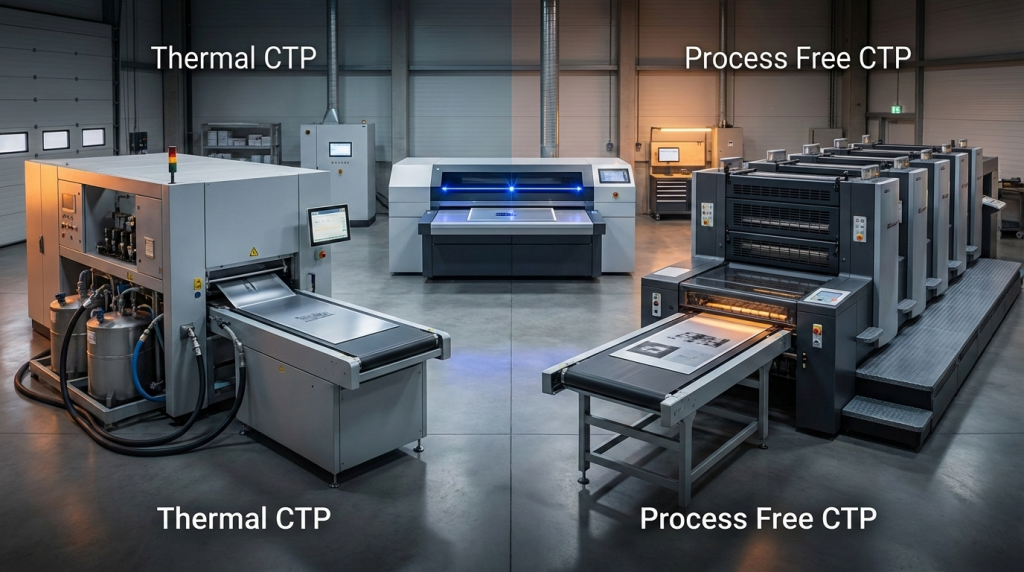
A Thermal CTP Plate is an offset printing plate that is imaged using a thermal laser (typically 830 nm wavelength) and requires chemical processing after exposure.
Typical Workflow:
Plate exposure on a thermal CTP machine
Chemical developing (developer, replenisher, water rinse)
Drying
Plate mounting on the press
Key Features:
High imaging stability
Wide compatibility with thermal CTP devices
Mature and widely adopted technology
Requires a plate processor and chemicals
Thermal CTP plates have been the industry standard for many years, especially for high-volume commercial and packaging printing.
What Is a Process Free CTP Plate?
A Process Free CTP Plate (also called processless or chemistry-free plate) is also exposed on a thermal CTP machine but does not require chemical development.
Typical Workflow:
Plate exposure on thermal CTP
Plate mounted directly on the printing press
Non-image areas are removed during press start-up
Key Features:
No developer or processing chemicals
No processor equipment required
Reduced environmental impact
Faster plate-to-press time
Process free technology is designed to simplify prepress operations and support sustainable printing practices.
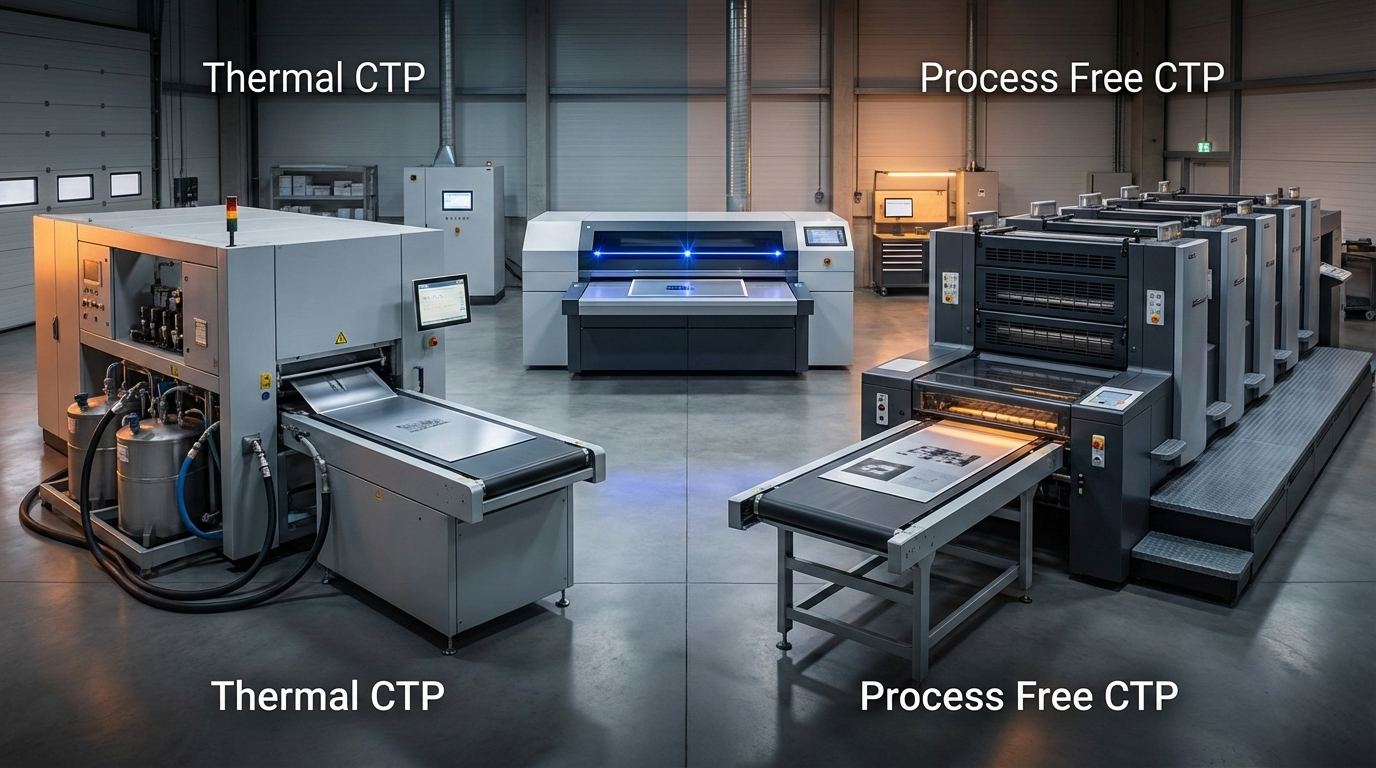
Process Free CTP Plate vs Thermal CTP Plate: Side-by-Side Comparison
1. Processing & Workflow
Thermal CTP Plate:
Requires a dedicated plate processor, chemical management, and regular maintenance.
Process Free CTP Plate:
Eliminates chemical processing completely, resulting in a shorter and cleaner workflow.
Winner: Process Free CTP Plate
2. Environmental Impact
Thermal CTP Plate:
Uses developer and cleaning chemicals
Generates wastewater and chemical waste
Requires proper disposal systems
Process Free CTP Plate:
Zero chemical discharge
No wastewater treatment
Lower carbon footprint
Winner: Process Free CTP Plate
3. Operating Cost
Thermal CTP Plate Costs Include:
Chemicals and replenishment
Processor electricity and water
Maintenance and spare parts
Labor for chemical handling
Process Free CTP Plate Costs Include:
Slightly higher plate unit price
No chemical or processor costs
When evaluating total cost of ownership, process free plates often result in lower long-term operating expenses.
Winner: Process Free CTP Plate
4. Imaging Stability & Quality
Thermal CTP Plate:
Very stable imaging
Wide imaging latitude
Proven dot reproduction
Process Free CTP Plate:
Modern coatings provide excellent dot accuracy
Stable performance under correct press settings
For most commercial printing applications, print quality differences are minimal.
Winner: Tie (application dependent)
5. Run Length Performance
Thermal CTP Plate:
Traditionally offers longer run lengths, making it suitable for high-volume jobs.
Process Free CTP Plate:
Modern process free plates can reach run lengths suitable for short to medium runs, which dominate today’s market.
Winner: Thermal CTP Plate (for very long runs)
6. Press Setup & Ink-Water Balance
Thermal CTP Plate:
Familiar press behavior with predictable ink-water balance.
Process Free CTP Plate:
Requires proper start-up procedures; once optimized, press stability is consistent.
Winner: Thermal CTP Plate (ease of transition)
Which Plate Should You Choose?
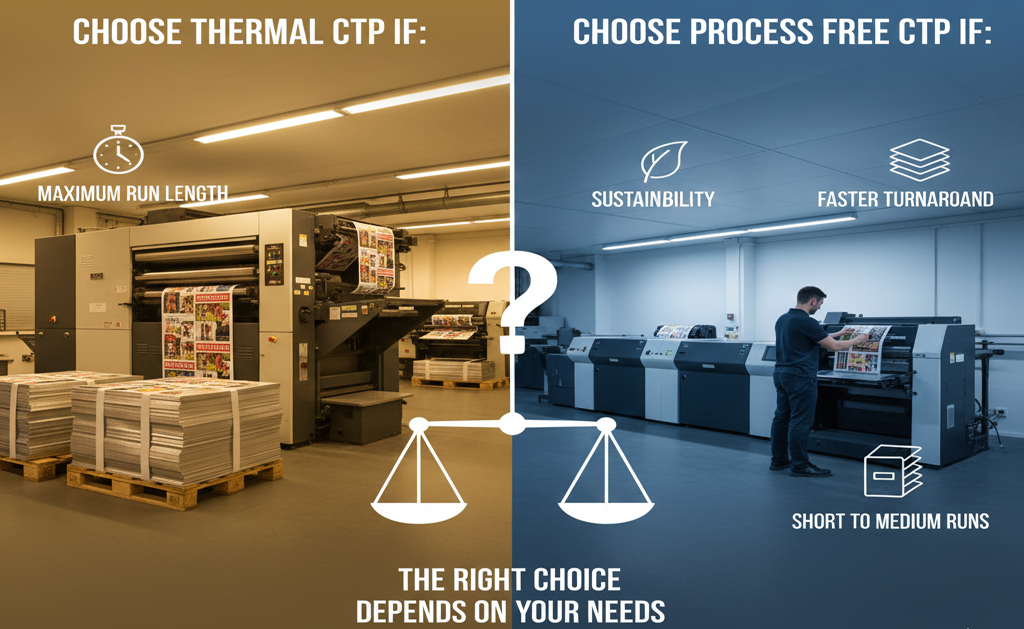
Choose Thermal CTP Plates If:
You run long, high-volume print jobs
You already have a stable processing line
Maximum run length is critical
Environmental regulations are less strict
Choose Process Free CTP Plates If:
You want to eliminate chemicals and processors
You focus on short to medium print runs
You want faster turnaround and simpler workflow
Environmental compliance is a priority
In many modern printing plants, process free CTP plates are gradually replacing traditional thermal plates due to operational simplicity and sustainability benefits.
Market Trend: Why Process Free Plates Are Growing Fast
The global printing industry is moving toward:
Cleaner production
Reduced operating complexity
Lower labor dependency
Higher workflow efficiency
As a result, the Process Free CTP Plate market is expanding rapidly, especially in regions with strict environmental regulations and rising labor costs.
The Role of a Reliable CTP Plate Manufacturer
Whether choosing process free or thermal CTP plates, working with a professional manufacturer is essential. A reliable supplier ensures:
Consistent coating quality
Stable batch performance
Compatibility with major CTP brands
Technical support during testing and production
Choosing the right manufacturer minimizes risk and ensures smooth production.
Conclusion: Process Free CTP Plate vs Thermal CTP Plate
Both Process Free CTP Plates and Thermal CTP Plates have their place in modern offset printing. The right choice depends on production volume, environmental goals, cost structure, and operational preferences.
For printers seeking simplicity, sustainability, and lower long-term costs, process free CTP plates are increasingly becoming the preferred solution. For applications requiring extreme run length and maximum stability, traditional thermal plates remain relevant.
👉 We are a professional manufacturer of both Process Free CTP Plates and Thermal CTP Plates, offering stable quality, reliable supply, and technical support for global customers.
If you are evaluating or testing process free or thermal CTP plates, feel free to contact us — we are ready to help you choose the best solution for your printing operation.
Why Does a CTP Plate Scum on Press ? 9 Common Causes and Proven Solutions
Learn why CTP plates scum on press, the most common causes, troubleshooting methods, and practical solutions to improve offset printing quality and reduce downtime.

Which Offset Machine Is Best ? A Practical Guide for Commercial Printing
Which offset machine is best? Learn how to choose the right offset printing machine based on format, volume, cost, and CTP technology.
Where to Buy Thermal CTP Plates for Offset Printing | Best Supplier Guide & Expert Tips
Looking for reliable thermal CTP plates for offset printing? This expert guide explains how to choose a trustworthy supplier, compares global and Chinese manufacturers, and shares key quality criteria.