A Complete Guide to Its Structure, Uses, and Advantages in Modern Printing
In today’s printing industry, flexibility, precision, and efficiency are more important than ever. As printing technologies continue to evolve, Flexible Resin Plates have become a critical component in applications where adaptability and fine detail reproduction are required.
This article provides a comprehensive overview of Flexible Resin Plates—what they are, how they work, where they are used, and why they remain an essential material in modern printing workflows.
1. What Is a Flexible Resin Plate?
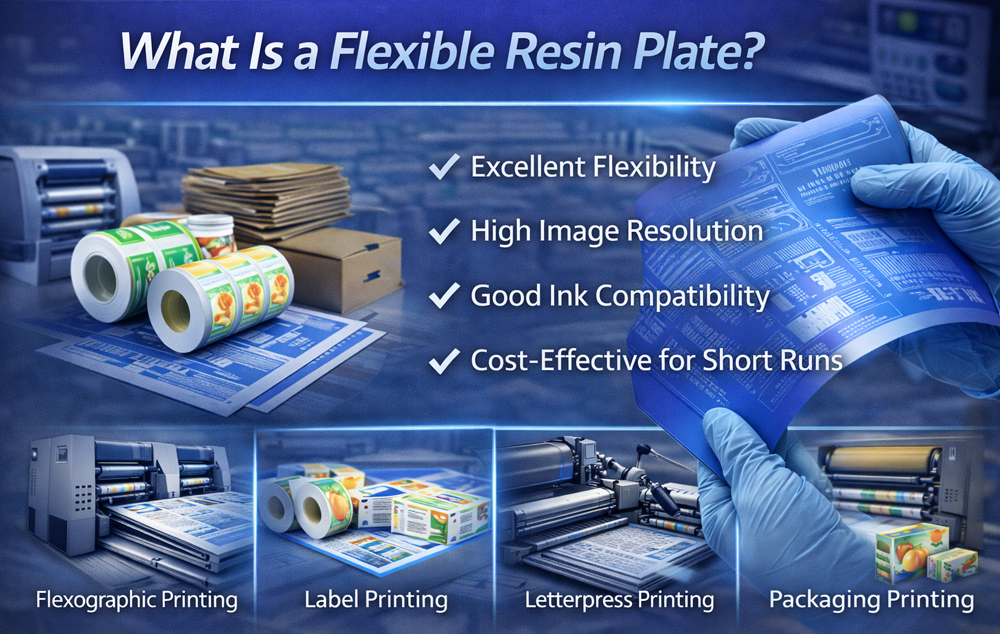
A Flexible Resin Plate is a printing plate made primarily from photosensitive resin materials. Unlike traditional rigid metal plates, resin plates offer elasticity, conformability, and excellent ink transfer, making them ideal for printing on uneven or curved substrates.
These plates are widely used in flexographic printing, letterpress printing, label production, packaging, and specialty printing applications where flexibility is required to maintain consistent print quality.
Flexible resin plates are typically image-bearing plates that harden upon exposure to UV light. After processing, the non-image areas are removed, leaving a raised image surface that transfers ink to the substrate.
2. Basic Structure of a Flexible Resin Plate
A standard flexible resin plate consists of several functional layers:
Photosensitive Resin Layer
This is the core image-forming layer. It reacts to UV exposure, hardening in image areas while remaining soluble in non-image regions.
Support Base Layer
Usually made of polyester (PET) or similar flexible materials, this layer provides mechanical strength while maintaining overall plate flexibility.
Protective Cover Film
Applied during manufacturing and storage, this layer protects the resin surface from scratches, dust, and premature exposure.
This layered structure allows flexible resin plates to bend slightly during printing without cracking or losing registration accuracy.
3. How Flexible Resin Plates Work
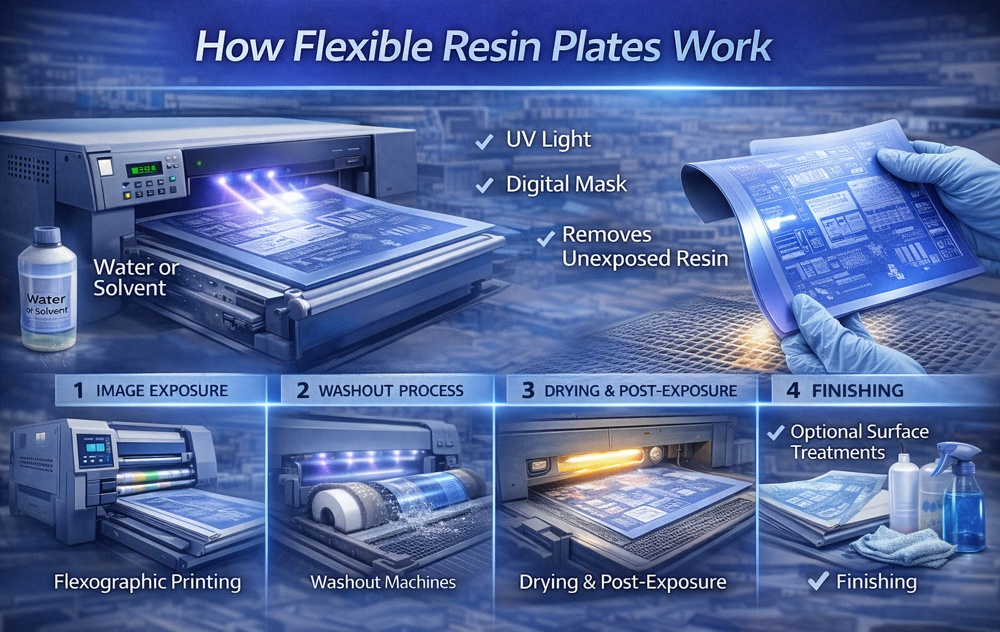
The production process of a flexible resin plate typically includes:
- Image Exposure
The plate is exposed to UV light through a film negative or digital mask. Image areas harden during exposure. - Washout Process
Unexposed resin is removed using water or solvent, depending on plate type. - Drying and Post-Exposure
The plate is dried and further exposed to stabilize the image and improve durability. - Finishing
Optional surface treatments enhance ink transfer and printing consistency.
The result is a flexible, durable printing plate with high image fidelity.
4. Types of Flexible Resin Plates
Flexible resin plates can be classified based on application and processing method:
Water-Wash Resin Plates
Eco-friendly and easy to process, widely used in small to medium printing operations.
Solvent-Wash Resin Plates
Offer higher durability and longer press life, suitable for high-volume printing.
Digital Resin Plates
Used with computer-to-plate (CTP) systems, eliminating film and improving registration accuracy.
Each type offers unique benefits depending on production scale and quality requirements.
5. Key Advantages of Flexible Resin Plates
Flexible resin plates provide several significant advantages over traditional rigid plates:
✔ Excellent Flexibility
They conform easily to curved or uneven surfaces, ensuring consistent ink transfer.
✔ High Image Resolution
Capable of reproducing fine text, sharp lines, and detailed graphics.
✔ Good Ink Compatibility
Compatible with water-based, solvent-based, and UV inks.
✔ Reduced Plate Damage
Less prone to cracking or permanent deformation during installation and printing.
✔ Cost-Effective for Short and Medium Runs
Lower tooling and replacement costs compared to metal plates.
6. Common Applications of Flexible Resin Plates
Flexible resin plates are widely used across multiple printing sectors:
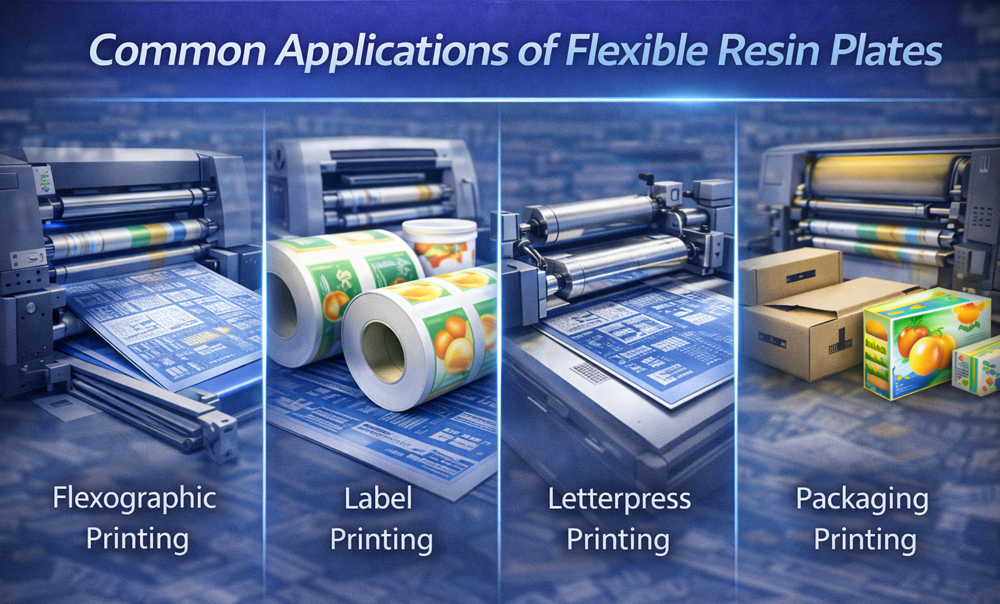
Flexographic Printing
The most common application, especially for packaging films, paper bags, cartons, and labels.
Label Printing
Ideal for pressure-sensitive labels requiring consistent impression on rolls.
Letterpress Printing
Used in specialty printing such as invitations, business cards, and decorative products.
Packaging Printing
Suitable for corrugated board, flexible packaging, and food packaging materials.
Their versatility makes them indispensable in both industrial and commercial printing.
7. Flexible Resin Plates vs. Metal Printing Plates
Compared to traditional aluminum or steel plates, flexible resin plates offer:
| Feature | Flexible Resin Plate | Metal Plate |
|---|---|---|
| Flexibility | High | None |
| Weight | Lightweight | Heavy |
| Image Detail | High | Very High |
| Installation | Easy | Complex |
| Cost | Lower | Higher |
While metal plates excel in long runs, flexible resin plates are preferred for adaptability and cost efficiency.
8. The Future of Flexible Resin Plates
With increasing demand for short runs, customization, and sustainable printing, flexible resin plates continue to evolve. Advances in resin chemistry and digital imaging technologies are improving durability, resolution, and environmental performance.
As packaging and label markets grow, flexible resin plates remain a key technology supporting efficient, high-quality printing.
Conclusion: Your Reliable Flexible Resin Plate Manufacturer
Flexible Resin Plates play a vital role in modern printing by combining precision, adaptability, and cost efficiency. Their ability to deliver consistent quality across diverse substrates makes them an essential solution for today’s printers.
We are also a professional manufacturer of Flexible Resin Plates, offering stable quality, reliable performance, and customized solutions for different printing needs.
If you are looking for a dependable supplier or technical support, feel free to contact us—we’re ready to help.
Why Does a CTP Plate Scum on Press ? 9 Common Causes and Proven Solutions
Learn why CTP plates scum on press, the most common causes, troubleshooting methods, and practical solutions to improve offset printing quality and reduce downtime.

Which Offset Machine Is Best ? A Practical Guide for Commercial Printing
Which offset machine is best? Learn how to choose the right offset printing machine based on format, volume, cost, and CTP technology.
Where to Buy Thermal CTP Plates for Offset Printing | Best Supplier Guide & Expert Tips
Looking for reliable thermal CTP plates for offset printing? This expert guide explains how to choose a trustworthy supplier, compares global and Chinese manufacturers, and shares key quality criteria.