Introduction
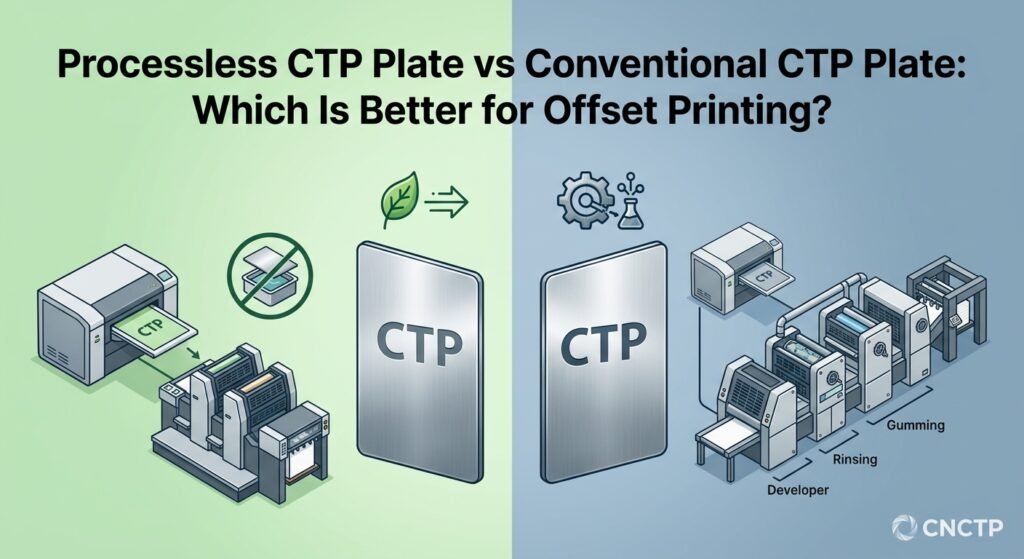
Choosing between a processless CTP plate and a conventional CTP plate affects more than plate purchasing costs. It influences prepress workflow, processing equipment requirements, chemical consumption, production efficiency, waste management, and the overall cost of preparing plates for offset printing.
Both technologies convert digital files into printing plates, but they differ in how the image becomes ready for printing. Conventional CTP plates generally require an external processing step after imaging, while processless CTP plates are designed to eliminate conventional off-press chemical processing.
For commercial printers, newspaper publishers, packaging printers, and printing material distributors, the right choice depends on production volume, existing equipment, plate specifications, and total operating costs.
1. What Is a Processless CTP Plate?
A processless CTP plate is a computer-to-plate printing plate designed to eliminate the conventional chemical processing stage after laser imaging.
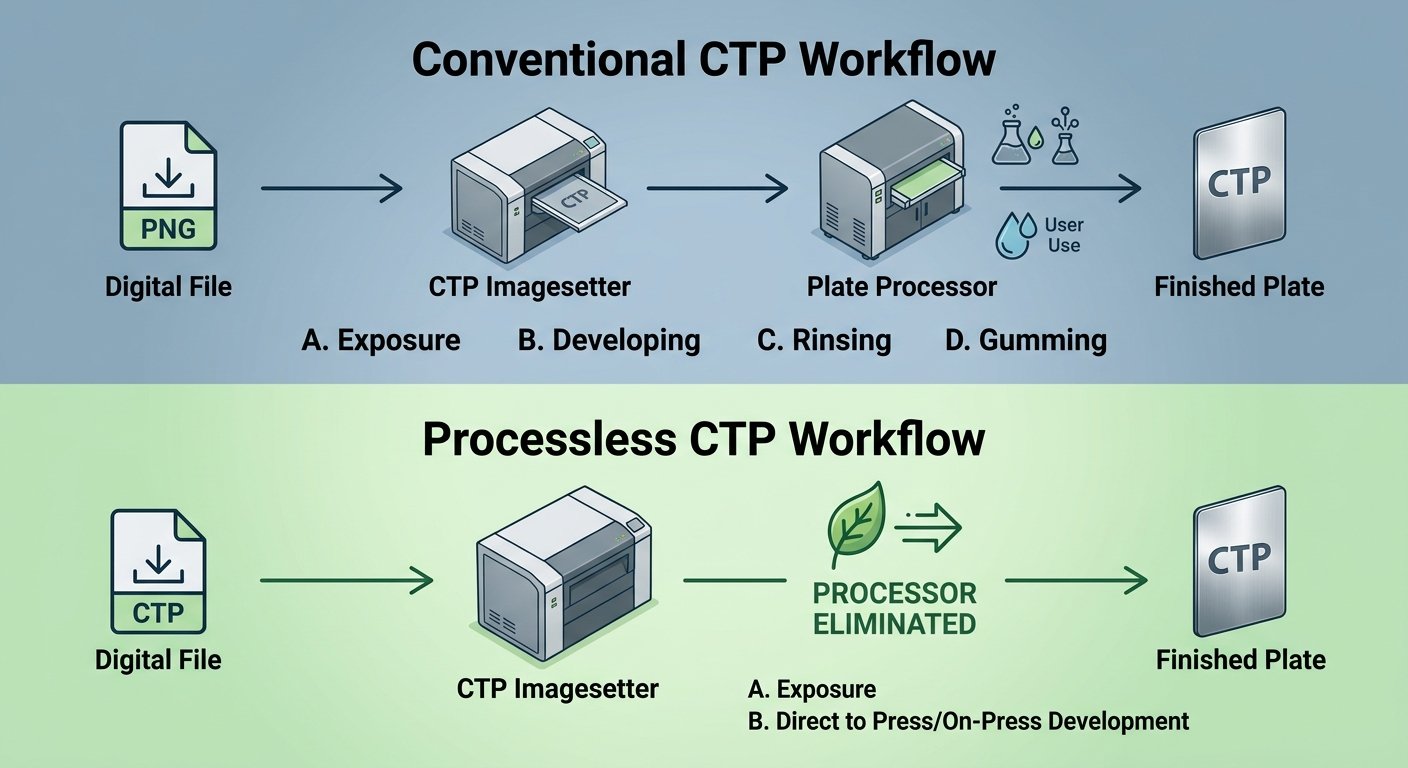
After the plate is exposed in a compatible CTP imagesetter, it can generally proceed directly to press. Depending on the plate technology, the image may be developed during the initial press run or through another manufacturer-specified mechanism.
The main advantage is a simplified prepress workflow. Printers can reduce their dependence on conventional plate processors, processing chemicals, wash water, and associated waste handling.
However, processless does not mean that every production step is eliminated. Plate handling, imaging, quality control, and the prescribed press-startup procedure remain important. Different processless products may also have different exposure requirements and operating conditions.
2. What Is a Conventional CTP Plate?
A conventional CTP plate is imaged directly from digital data but requires a separate processing stage before it is ready for printing.
For example, a conventional thermal CTP plate typically undergoes laser exposure followed by chemical processing, washing, and, where required, gumming or other finishing steps. The exact sequence depends on the plate model and processor system.
Conventional CTP technology is widely used because it offers established workflows and a broad range of plate options. Printing companies may already have compatible processors, trained operators, and standardized quality-control procedures.
For high-volume facilities with optimized processing lines, conventional CTP plates can remain a practical and cost-effective solution.
3. Processless CTP Plate vs Conventional CTP Plate: Key Differences
| Comparison Factor | Processless CTP Plate | Conventional CTP Plate |
|---|---|---|
| Off-press chemical processing | Generally eliminated | Normally required |
| Plate processor | Often unnecessary for plate development | Usually required |
| Processing chemicals | Conventional developer is generally not required | Developer and other processing materials may be required |
| Wastewater from plate processing | Can be substantially reduced | Generated according to the processing system |
| Prepress workflow | Fewer processing steps | Imaging followed by processing |
| Initial equipment investment | Potentially lower if a processor is unnecessary | May include processor and related equipment |
| Plate purchase price | Product-dependent; may be higher | Product-dependent |
| Press startup | May require a product-specific startup procedure | Usually follows an established plate and press workflow |
| Existing equipment compatibility | Must be verified | Often easier to integrate into an established conventional workflow |
| Best-fit applications | Printers prioritizing simplified processing and reduced chemical use | Printers seeking established workflows and broad product selection |
Important: These are general technology differences, not universal performance guarantees. Actual results depend on the plate formulation, CTP imagesetter, press conditions, consumables, and manufacturer specifications.
4. Cost Comparison: Which Technology Is More Economical?
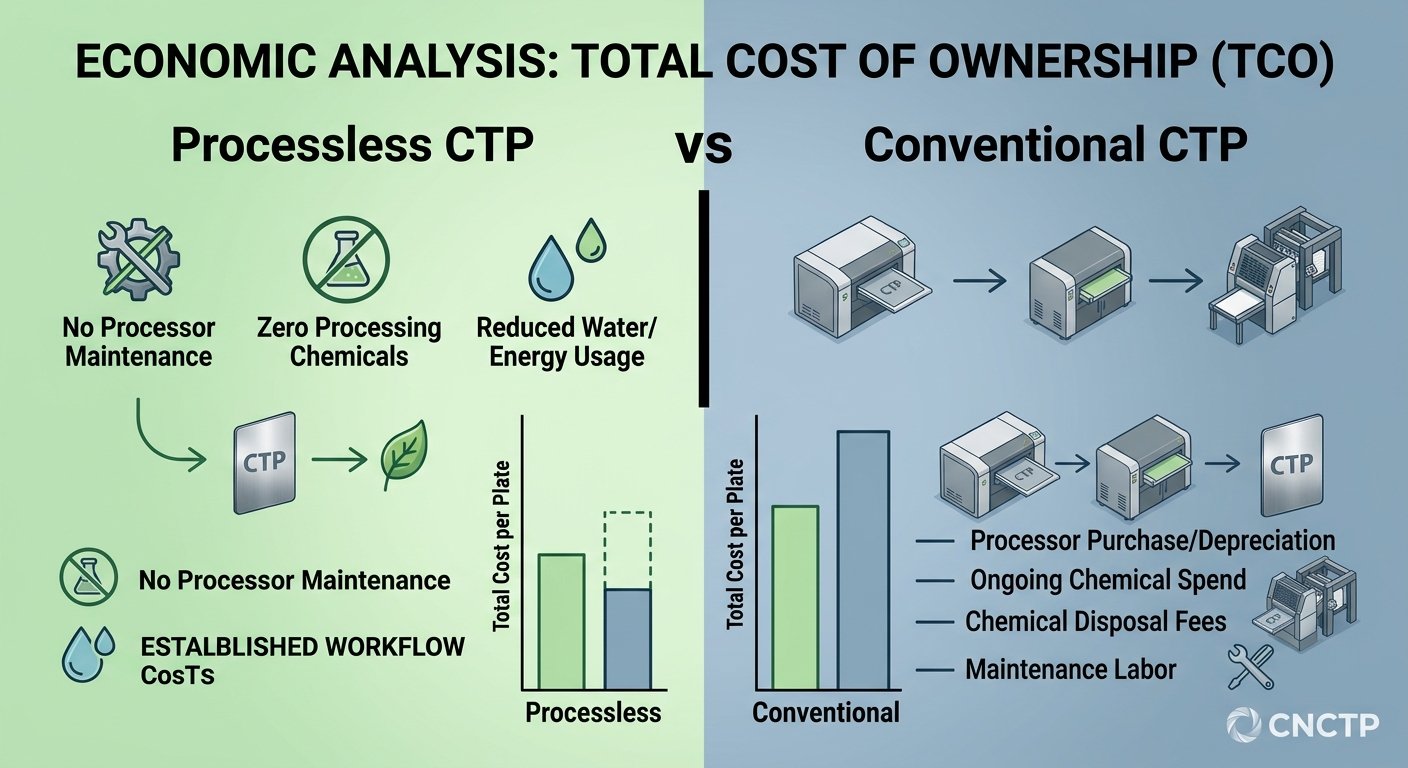
Comparing only the purchase price per plate can lead to the wrong decision. A more useful approach is to calculate the total cost of producing usable plates.
Main cost factors
For conventional CTP plates, consider:
- Plate purchase price and freight.
- Developer, replenisher, gum, and other required processing materials.
- Processor purchase, maintenance, electricity, and cleaning.
- Waste treatment and chemical disposal.
- Labor and quality-control costs.
For processless CTP plates, consider:
- Plate purchase price and freight.
- Compatibility with the existing CTP imagesetter.
- Any required changes to prepress or press-startup procedures.
- Additional paper, ink, and setup time associated with initial on-press development, where applicable.
- Plate waste, reprints, and ongoing quality-control costs.
A simplified comparison is:
Conventional total cost per usable plate = Plate cost + Processing cost + Equipment cost allocation + Labor and waste costs.
Processless total cost per usable plate = Plate cost + Workflow and startup costs + Equipment cost allocation + Labor and waste costs.
To compare fairly, use the same production period, plate format, plate quantity, and quality requirements. Include processor depreciation or maintenance only where relevant to your operation.
A processless plate may offer a strong economic advantage where processing costs are significant or a new processor would otherwise be required. A conventional plate may remain more economical when an existing processor is efficient, well maintained, and already fully depreciated.
5. Print Quality and Production Performance
Neither technology should automatically be considered superior in print quality. Performance depends on the individual plate product and the printing conditions.
When evaluating a plate, review the following technical parameters:
- Resolution and screening: Confirm support for the intended screening technology, including AM or FM screening where applicable.
- Dot reproduction: Test highlight and shadow reproduction, tonal stability, and the required screen ruling.
- Run length: Verify the manufacturer’s rated run length under the specified press conditions.
- Exposure compatibility: Check the imagesetter wavelength, laser power, energy settings, and supported plate format.
- Press compatibility: Confirm compatibility with the press, fountain solution, ink, and cleaning procedures.
- Consistency: Evaluate repeatability across multiple plates and production batches.
For commercial printers, a controlled press trial is more reliable than selecting a plate based on product descriptions alone. Test the plate with representative files, normal production settings, and the intended paper and ink system.
6. Environmental Impact and Chemical Management
One of the principal reasons printers consider processless CTP plates is the reduction of conventional off-press processing.
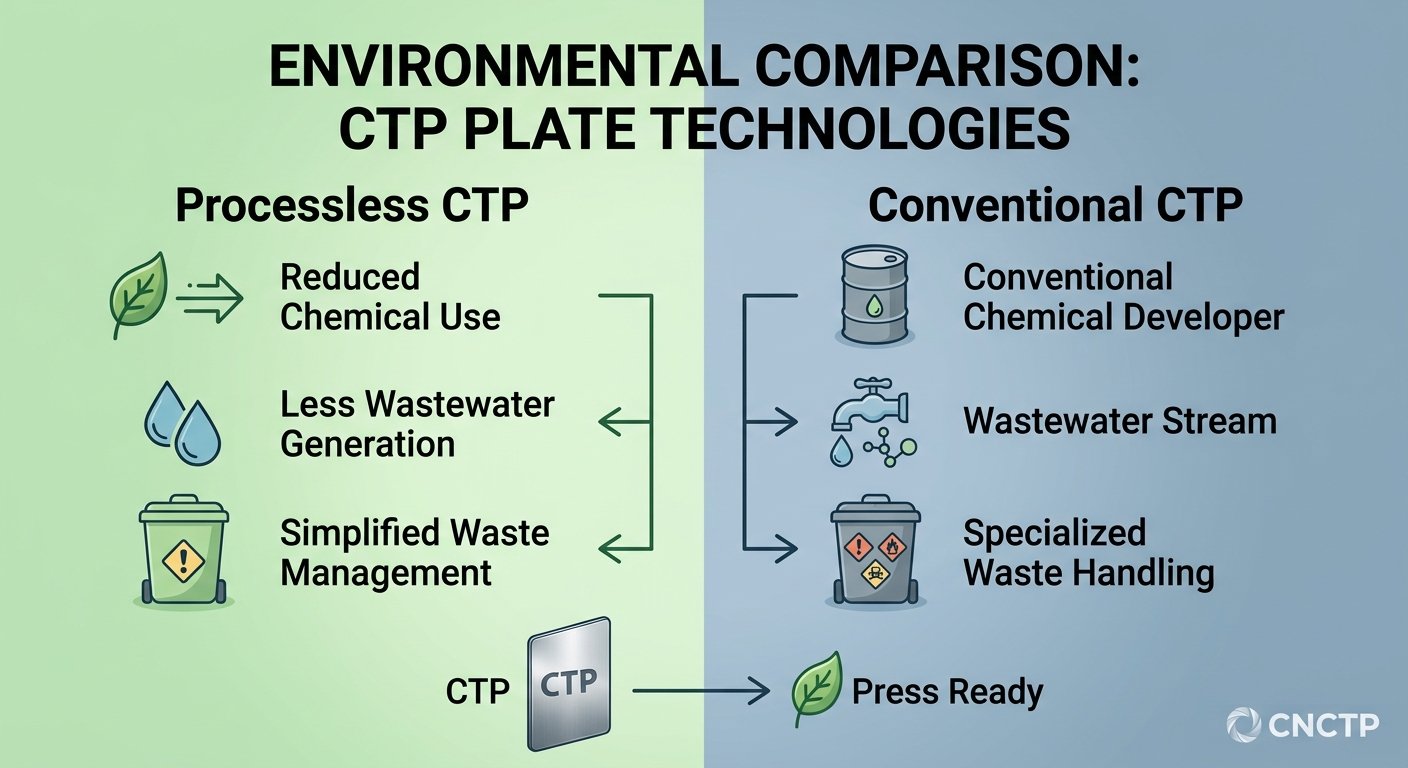
Because the technology generally eliminates conventional plate development, it can reduce the use of processing chemicals, associated wastewater, and the need to manage spent developer. It may also simplify the prepress area and reduce routine processor cleaning.
Conventional CTP systems require appropriate handling and disposal of processing materials according to local regulations and the relevant chemical safety documentation.
Nevertheless, environmental performance should be assessed across the complete workflow. Consider plate manufacturing, transportation, press-startup waste, energy consumption, plate recycling options, and the actual disposal requirements of each product. Avoid assuming that a processless plate has zero environmental impact simply because it does not require conventional chemical processing.
7. Which CTP Plate Should Your Printing Business Choose?
Choose processless CTP plates if:
- You want to eliminate conventional off-press plate processing.
- Your business aims to reduce processing chemicals and related waste.
- You want to simplify the prepress workflow.
- Your imagesetter supports a suitable processless plate.
- The total cost calculation supports the switch.
Choose conventional CTP plates if:
- Your existing processing line is reliable and cost-effective.
- Your current production workflow is already standardized around conventional plates.
- Your preferred plate specifications or production requirements are better served by a conventional product.
- Local supply availability and established technical support favor conventional plates.
- Your evaluation shows a lower total cost per usable plate.
Before switching technologies, verify plate availability, technical support, compatibility, and the cost of changing the production workflow. A supplier should be able to provide technical data sheets, storage requirements, recommended exposure settings, and trial guidance.
8. Buying Processless or Conventional CTP Plates in Bulk
For importers, printing material distributors, and high-volume printing businesses, supplier selection is as important as plate technology.
When requesting a quotation, provide the following information:
| Requirement | Information to Provide |
|---|---|
| Plate technology | Processless, conventional thermal, or another specified type |
| Plate dimensions | Width × length in millimeters |
| Plate thickness | Required thickness in millimeters |
| Monthly consumption | Number of plates by size and specification |
| Application | Commercial, newspaper, packaging, or other offset printing |
| CTP equipment | Imagesetter brand and model |
| Destination | Country and delivery port or address |
| Order requirements | Trial quantity, regular supply volume, OEM, or private label |
A qualified manufacturer or supplier should confirm compatibility before recommending a product. For recurring orders, also assess batch consistency, packaging, shelf life, technical support, lead time, and the availability of replacement stock.
CNCTP Plates supplies printing plate products for B2B customers. Buyers evaluating processless and conventional CTP plates can contact the team to discuss specifications, bulk purchasing requirements, and suitable product options.
Frequently Asked Questions
1. What is the main difference between processless CTP plates and conventional CTP plates?
The main difference is the plate preparation workflow after imaging. Processless CTP plates are designed to eliminate conventional off-press chemical processing, while conventional CTP plates generally require a processor and processing materials. This difference can affect equipment requirements, labor, chemical consumption, waste management, and operating costs. The better option depends on the specific plate, existing equipment, production volume, and total cost per usable plate.
2. Are processless CTP plates more expensive than conventional CTP plates?
The purchase price varies by manufacturer, plate technology, dimensions, order volume, and market. A processless plate may have a higher unit price in some cases, but it can reduce processing-related expenses. Conventional plates may be more economical for facilities with efficient existing processing equipment. Buyers should compare plate price, freight, labor, processing consumables, equipment maintenance, startup waste, and rejected plates over the same period before making a purchasing decision.
3. Can processless CTP plates be used with any CTP machine?
No. Compatibility depends on the imagesetter’s laser wavelength, exposure energy, supported plate dimensions, and the requirements of the particular plate. Some processless plates are designed for specific thermal imaging systems. Before placing a bulk order, provide the manufacturer with your CTP machine brand and model, plate format, and current exposure settings. Confirm the recommended configuration and, where possible, conduct a production trial before changing your regular supply.
4. Do processless CTP plates eliminate all chemicals from offset printing?
No. Processless CTP plates eliminate the conventional off-press chemical processing stage, but they do not eliminate every chemical used in printing. Ink, fountain solution, press wash, and other consumables may still be necessary. The exact materials and startup procedure depend on the plate and press system. For environmental reporting and operating-cost calculations, assess the entire printing workflow rather than treating processless technology as a completely chemical-free production method.
5. How can bulk buyers select a reliable CTP plate manufacturer?
Bulk buyers should evaluate technical compatibility, manufacturing consistency, product documentation, quality-control procedures, sample availability, lead times, packaging, and long-term supply capacity. Ask for technical data sheets and confirm the manufacturer’s recommended operating conditions. Compare quotations using equivalent specifications and delivery terms, rather than unit price alone. For OEM or private-label orders, clarify packaging requirements, minimum order quantities, batch traceability, and technical support before signing a supply agreement.
Conclusion
The choice between processless and conventional CTP plates depends on your production workflow, equipment, print quality requirements, and total operating costs.
Processless CTP plates can simplify prepress operations and reduce conventional processing-related chemical use. Conventional CTP plates can remain attractive for printers with established, efficient processing lines.
For a reliable decision, compare compatible products under your actual production conditions and calculate the cost per usable plate. If you are sourcing CTP plates in bulk, contact CNCTP Plates with your plate specifications, monthly requirements, and destination to discuss suitable options for your printing operation.
Why Does a CTP Plate Scum on Press ? 9 Common Causes and Proven Solutions
Learn why CTP plates scum on press, the most common causes, troubleshooting methods, and practical solutions to improve offset printing quality and reduce downtime.
Which Offset Machine Is Best ? A Practical Guide for Commercial Printing
Which offset machine is best? Learn how to choose the right offset printing machine based on format, volume, cost, and CTP technology.
Where to Buy Thermal CTP Plates for Offset Printing | Best Supplier Guide & Expert Tips
Looking for reliable thermal CTP plates for offset printing? This expert guide explains how to choose a trustworthy supplier, compares global and Chinese manufacturers, and shares key quality criteria.