Introduction
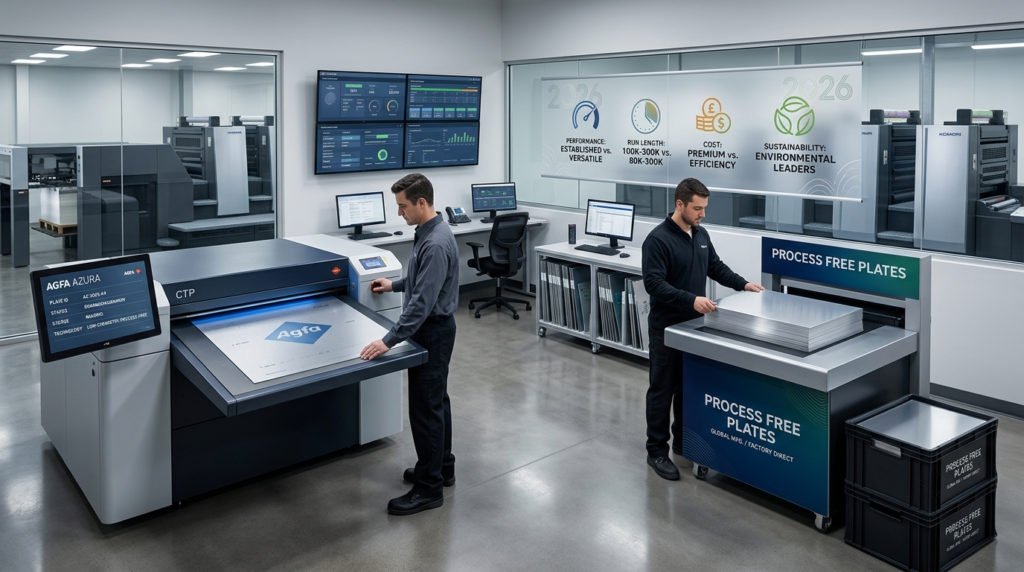
As offset printing companies continue to focus on efficiency, sustainability, and cost control, process free plate technology has become one of the fastest-growing segments in the printing industry.
Among the most recognized solutions in this category is Agfa Azura, a well-established plate technology known for reducing chemical consumption and simplifying prepress workflows.
However, today’s printing market offers a wide range of process free plates from global manufacturers, regional suppliers, and OEM producers. As a result, many printers are asking:
How does Agfa Azura compare with other process free plates?
This guide provides an in-depth comparison of Agfa Azura and modern process free plates, covering performance, cost, print quality, environmental benefits, and purchasing considerations to help printers make informed decisions.
What Is Agfa Azura?
Agfa Azura is a low-chemistry and process free offset printing plate technology developed by Agfa-Gevaert.
The system was designed to reduce or eliminate traditional plate processing requirements while maintaining high print quality and production reliability.
Key characteristics include:
- Reduced chemical consumption
- Simplified workflow
- Lower maintenance requirements
- Consistent imaging quality
- Environmental benefits
Azura technology has been widely adopted in commercial printing, publishing, and newspaper production environments.
What Are Process Free Plates?
Process free plates are offset printing plates that can be mounted directly on press after imaging without conventional chemical development.
Modern process free plate technology offers several advantages:
- Elimination of developer chemicals
- Reduced water consumption
- Lower maintenance costs
- Faster production workflow
- Improved sustainability
Today, process free plates are manufactured by various global and regional suppliers, creating a highly competitive marketplace.
Why Printers Compare Agfa Azura and Other Process Free Plates
Several factors drive this comparison:
Rising Production Costs
Printing companies are constantly seeking opportunities to reduce operational expenses.
Sustainability Goals
Environmental regulations and corporate sustainability initiatives continue to encourage adoption of process free technologies.
Supplier Diversification
Many printers want to avoid relying on a single supplier and evaluate alternative solutions.
Procurement Flexibility
OEM and factory-direct suppliers often provide pricing advantages and customization options unavailable from premium brands.
Agfa Azura vs Process Free Plates: Feature Comparison
| Feature | Agfa Azura | Modern Process Free Plates |
|---|---|---|
| Chemical Processing | Minimal or None | None |
| Developer Requirement | Low | None |
| Environmental Impact | Excellent | Excellent |
| Workflow Efficiency | High | High |
| Brand Recognition | Very High | Varies |
| OEM Availability | Limited | Common |
| Private Label Options | No | Yes |
| Procurement Flexibility | Moderate | High |
| Plate Cost | Higher | Often Lower |
Both solutions offer substantial environmental and workflow benefits compared with conventional processed plates.
Print Quality Comparison
Print quality remains a critical consideration for commercial printers.
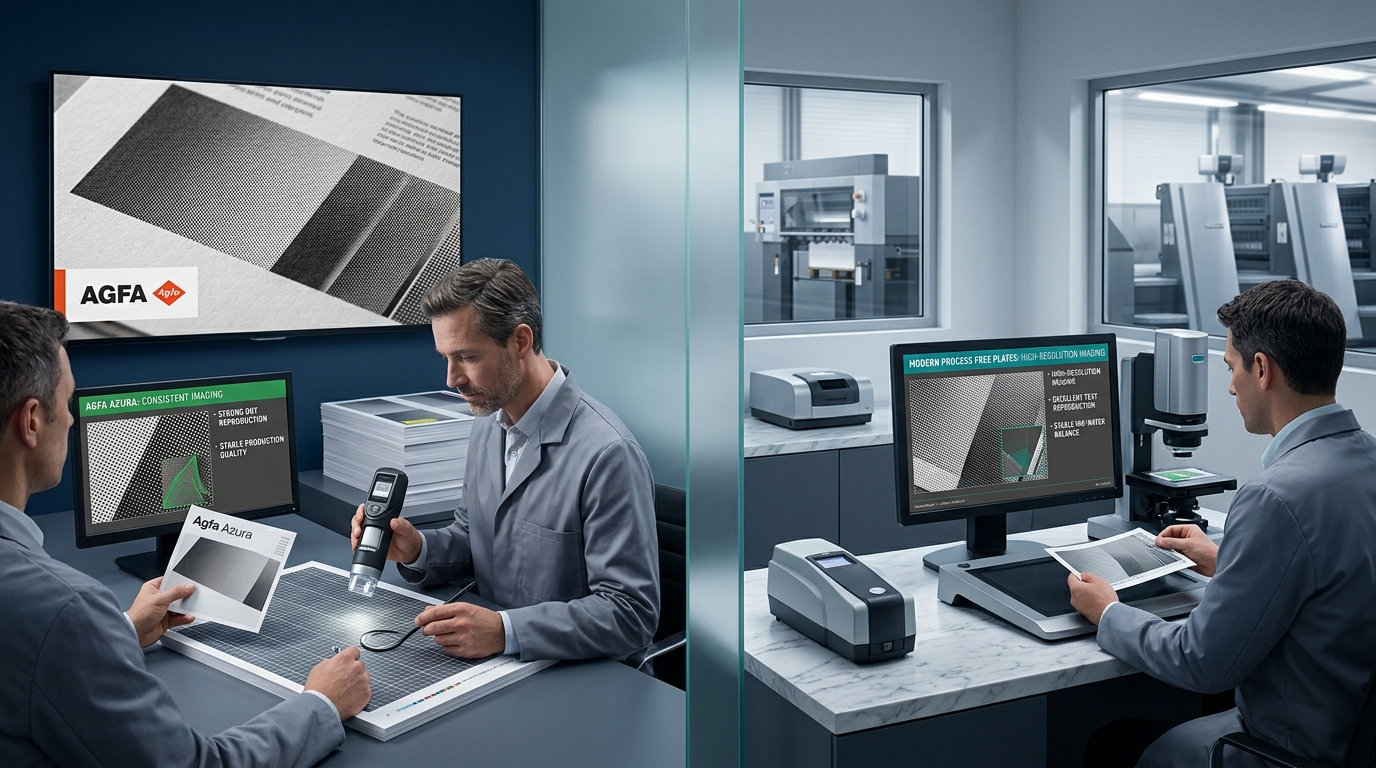
Agfa Azura
Advantages include:
- Consistent imaging performance
- Strong dot reproduction
- Stable production quality
- Proven field performance
Agfa has established a strong reputation for plate technology and imaging consistency.
Modern Process Free Plates
Recent advances in coating technology have significantly improved the performance of alternative process free plates.
Many high-quality manufacturers now offer:
- High-resolution imaging
- Excellent text reproduction
- Stable ink-water balance
- Reliable press performance
For most commercial printing applications, quality differences are often minimal when sourcing from reputable suppliers.
Run Length Comparison
Run length is an important factor in evaluating production efficiency.
Typical Performance
| Plate Type | Typical Run Length |
|---|---|
| Agfa Azura | 100,000–300,000 impressions |
| Quality Process Free Plate | 80,000–300,000 impressions |
Actual results vary depending on:
- Press conditions
- Paper type
- Ink system
- Imaging settings
- Plate handling procedures
For standard commercial printing applications, both options typically provide sufficient durability.
Cost Comparison
Cost is often the primary reason printers explore alternatives.
Agfa Azura
Benefits:
- Strong market reputation
- Proven performance
- Global technical support
Challenges:
- Premium pricing
- Higher procurement costs
Alternative Process Free Plates
Benefits:
- Factory-direct pricing
- Lower acquisition costs
- Flexible order quantities
- OEM branding opportunities
Challenges:
- Performance varies among manufacturers
- Supplier qualification becomes critical
For high-volume users, annual savings can be significant when switching to quality process free alternatives.
Environmental Impact
One of the main reasons for adopting process free technology is sustainability.
Benefits Shared by Both Solutions
Both systems help reduce:
- Chemical waste
- Water consumption
- Energy usage
- Equipment maintenance
Environmental advantages include:
- Cleaner production environments
- Reduced wastewater treatment requirements
- Improved compliance with environmental regulations
- Lower carbon footprint
As sustainability becomes increasingly important, process free technologies are expected to continue replacing conventional plate systems.
Maintenance and Workflow Efficiency
Traditional plate processing introduces several operational challenges.
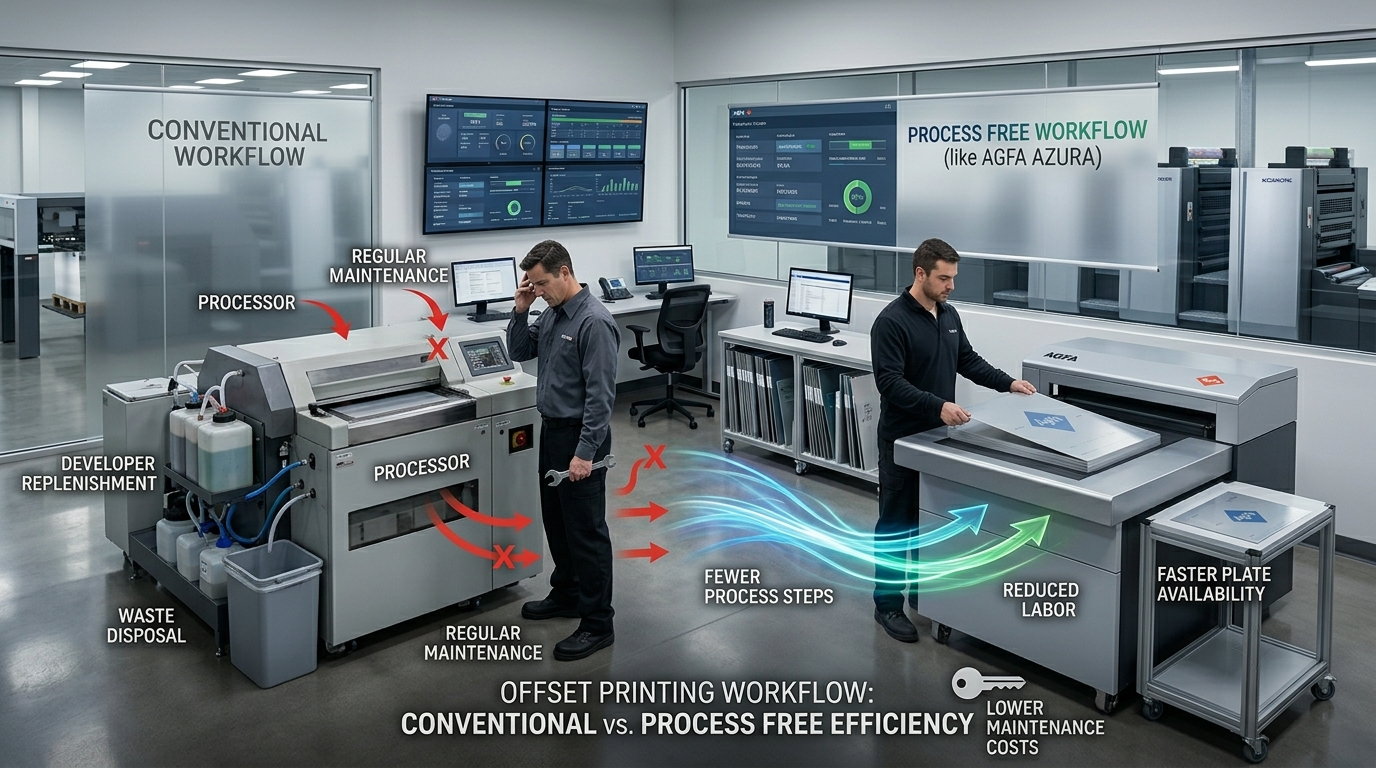
Conventional Workflow
Requires:
- Plate processors
- Developer replenishment
- Waste disposal
- Regular maintenance
Process Free Workflow
Benefits include:
- Fewer process steps
- Faster plate availability
- Reduced labor requirements
- Lower maintenance costs
Both Agfa Azura and modern process free plates provide substantial workflow improvements over conventional thermal plates.
Which Solution Is Better for Different Printing Businesses?
Large Commercial Printers
Recommended Considerations:
- Production consistency
- Technical support
- Proven reliability
Agfa Azura may appeal to printers prioritizing established brand performance.
Regional Printing Companies
Recommended Considerations:
- Cost efficiency
- Operational simplicity
- Procurement flexibility
Quality process free plates may provide a more attractive balance of performance and cost.
Printing Plate Distributors
Recommended Considerations:
- OEM opportunities
- Private labeling
- Competitive pricing
Alternative process free plate manufacturers often provide more flexibility for distributors.
Export Markets
Recommended Considerations:
- Stable supply chain
- Flexible logistics
- Competitive landed costs
Factory-direct process free plate suppliers can offer advantages in global distribution markets.
How to Evaluate a Process Free Plate Supplier
Before making a purchasing decision, printers should assess:
Manufacturing Capability
Look for:
- Automated coating lines
- Stable production capacity
- Consistent quality control
Quality Certifications
Recommended certifications include:
- ISO 9001
- ISO 14001
- RoHS Compliance
Technical Support
Professional suppliers should provide:
- Imaging recommendations
- Press compatibility guidance
- Troubleshooting assistance
- Product testing support
Export Experience
For international buyers, supplier experience in:
- Export packaging
- Customs documentation
- Shipping logistics
- Inventory planning
can significantly reduce procurement risks.
Frequently Asked Questions
Is Agfa Azura a process free plate?
Yes. Agfa Azura is designed to reduce or eliminate traditional plate processing requirements and is widely recognized as a process free or low-chemistry plate solution.
Are alternative process free plates cheaper than Agfa Azura?
In many cases, yes. Factory-direct manufacturers often offer lower pricing while providing comparable performance for standard commercial printing applications.
Do process free plates provide the same print quality as Agfa Azura?
High-quality process free plates from reputable manufacturers can deliver excellent image quality and production consistency suitable for most offset printing operations.
Which option offers better ROI?
The answer depends on production volume, procurement costs, and operational requirements. Many printers find that lower-cost process free alternatives improve overall return on investment.
Can process free plates replace conventional thermal plates?
Yes. Modern process free technologies have become a viable alternative for many commercial printing environments.
Conclusion
The comparison between Agfa Azura and other process free plates ultimately comes down to balancing performance, cost, and operational priorities.
Agfa Azura remains a respected solution with strong brand recognition, proven reliability, and global support. However, advances in process free plate manufacturing have enabled many alternative suppliers to offer competitive quality, strong run lengths, and significant cost advantages.
For commercial printers, distributors, and procurement managers seeking to improve profitability without sacrificing print performance, evaluating modern process free plate suppliers can uncover valuable opportunities for long-term savings and operational efficiency.
Why Does a CTP Plate Scum on Press ? 9 Common Causes and Proven Solutions
Learn why CTP plates scum on press, the most common causes, troubleshooting methods, and practical solutions to improve offset printing quality and reduce downtime.

Which Offset Machine Is Best ? A Practical Guide for Commercial Printing
Which offset machine is best? Learn how to choose the right offset printing machine based on format, volume, cost, and CTP technology.
Where to Buy Thermal CTP Plates for Offset Printing | Best Supplier Guide & Expert Tips
Looking for reliable thermal CTP plates for offset printing? This expert guide explains how to choose a trustworthy supplier, compares global and Chinese manufacturers, and shares key quality criteria.