Introduction
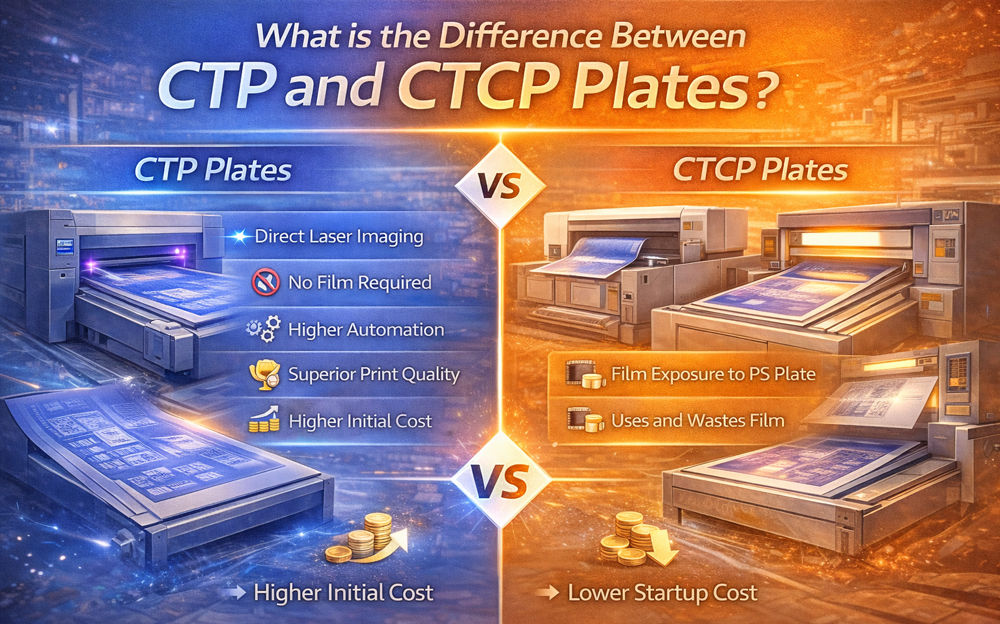
With the rapid development of prepress technology, plate-making methods have undergone a major transformation. Among them, CTP (Computer-to-Plate) and CTCP (Computer-to-Conventional Plate) technologies have become the two most widely used solutions in modern offset printing.
However, many printers, especially small and medium-sized printing houses, still ask:
What is the real difference between CTP and CTCP plates?
Which one is better for my printing business?
Are CTCP plates outdated, or are they still worth using?
How do cost, workflow, and print quality compare?
This article provides the most detailed, professional, and practical comparison available online, explaining the differences between CTP plates and CTCP plates from technology, workflow, cost, performance, applications, and future trends—in clear, easy-to-understand language.
1. What Is a CTP Plate?
CTP (Computer-to-Plate) technology uses a digital file to directly image the printing plate without using film.
Key Characteristics of CTP Plates
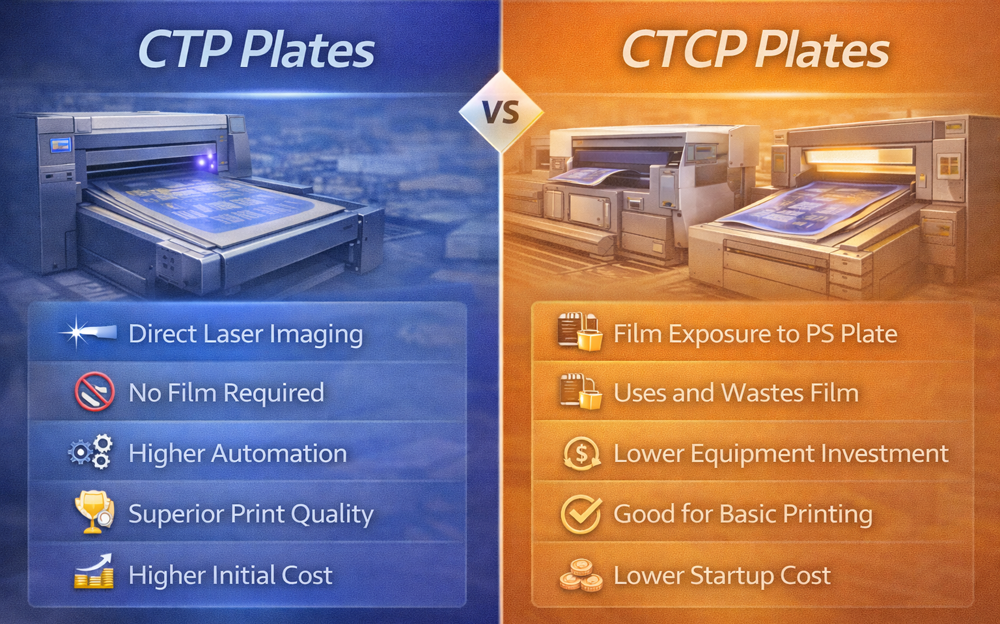
Direct laser imaging on the plate
No intermediate film output
High automation and accuracy
Common laser types: Thermal (830 nm) and Violet (405 nm)
Typical CTP Plate Types
Thermal CTP Plates
Violet CTP Plates
Process-free CTP Plates
UV-CTP Plates
CTP technology is considered the standard solution for modern, high-end offset printing.
2. What Is a CTCP Plate?
CTCP (Computer-to-Conventional Plate) technology also starts with digital files, but instead of imaging the plate directly, it first outputs a film, which is then used to expose a traditional PS plate.
Key Characteristics of CTCP Plates
Uses digital-to-film output
Requires a plate exposure unit
Based on conventional PS plate technology
Lower equipment investment
CTCP is often described as a transitional technology between traditional film-based workflows and full CTP systems.
3. Core Difference: Workflow Comparison
CTP Workflow
Digital file (PDF / RIP)
CTP imaging device
Plate processor (or process-free)
Offset printing press
CTCP Workflow
Digital file (PDF / RIP)
Imagesetter outputs film
Film inspection and alignment
Plate exposure machine
Plate development
Offset printing press
Key Difference:
👉 CTP eliminates film entirely, while CTCP still depends on film.
4. Imaging Technology Comparison
| Item | CTP Plates | CTCP Plates |
|---|---|---|
| Imaging Method | Direct laser imaging | UV exposure through film |
| Laser Precision | Very high | Limited by film quality |
| Registration Accuracy | Excellent | Good but less stable |
| Dot Reproduction | Sharp and consistent | Affected by film distortion |
CTP offers superior dot fidelity and image consistency, especially for high-resolution printing.
5. Cost Comparison: CTP vs CTCP
Initial Investment
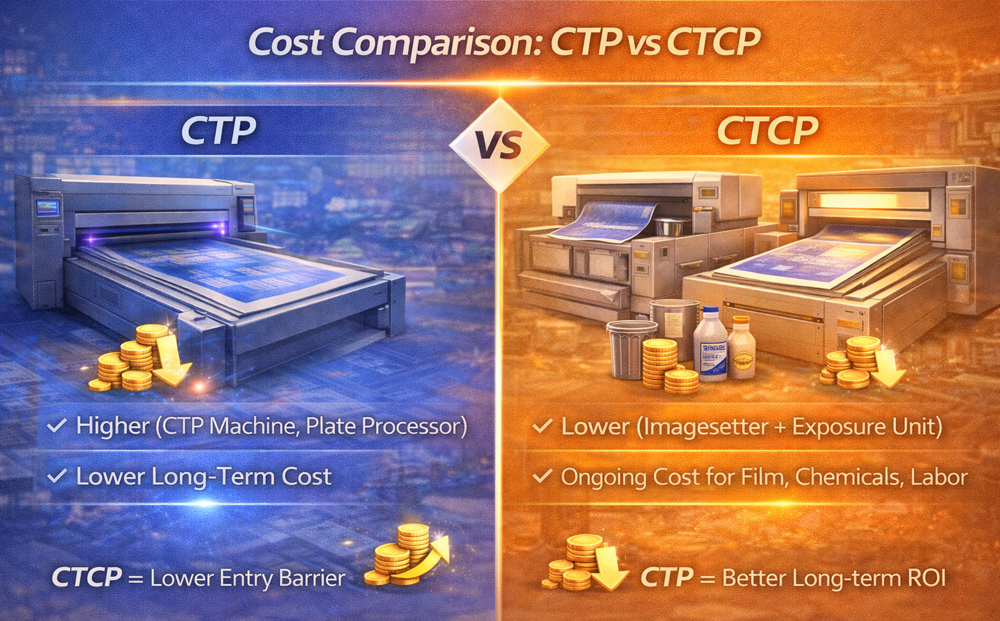
CTP: Higher (CTP machine, plate processor)
CTCP: Lower (imagesetter + exposure unit)
Running Costs
CTP: Lower long-term cost
CTCP: Ongoing cost for film, chemicals, labor
Cost Summary
CTCP = lower entry barrier
CTP = better long-term ROI
This is why CTCP remains popular in developing markets, while CTP dominates high-volume commercial printing.
6. Print Quality and Stability
CTP Plates
Excellent dot consistency
Better color stability
Ideal for fine text, gradients, and images
Stable performance in long print runs
CTCP Plates
Good quality for standard printing
Slight dot loss or variation possible
Film quality directly affects results
For premium-quality printing, CTP is clearly superior.
7. Productivity and Efficiency
| Factor | CTP | CTCP |
|---|---|---|
| Plate-making speed | Fast | Slower |
| Human intervention | Minimal | High |
| Error rate | Low | Higher |
| Automation level | High | Medium |
CTP significantly improves production efficiency, especially for tight delivery schedules.
8. Environmental Impact
CTP Plates
No film waste
Less chemical usage
Lower water consumption
More environmentally friendly
CTCP Plates
Film waste generation
Additional chemicals for film processing
Higher environmental footprint
Many printing companies choose CTP to meet green printing standards.
9. Typical Applications
CTP Plates Are Best For:
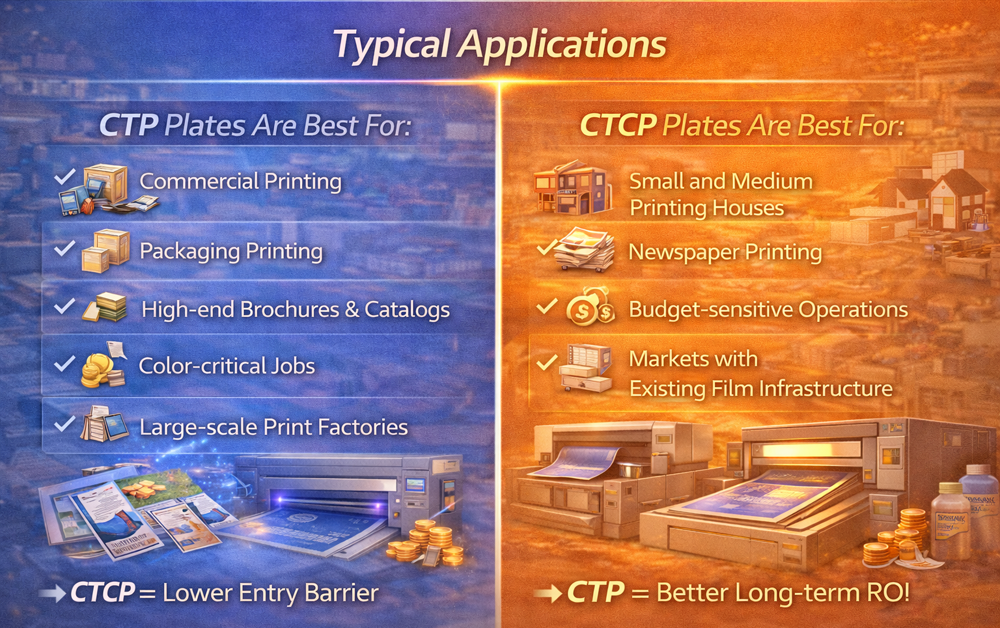
Commercial printing
Packaging printing
High-end brochures and catalogs
Color-critical jobs
Large-scale print factories
CTCP Plates Are Best For:
Small and medium printing houses
Newspaper printing
Budget-sensitive operations
Markets with existing film infrastructure
10. Which One Should You Choose?
Choose CTP Plates If:
You want high quality and efficiency
You handle large print volumes
You aim for automation and sustainability
You plan long-term business growth
Choose CTCP Plates If:
You have limited initial budget
You already use film-based systems
You serve cost-sensitive markets
You need a stable, familiar workflow
There is no “one-size-fits-all” answer—the best choice depends on your production scale and business strategy.
11. Future Trends: Is CTCP Being Replaced?
While CTP is clearly the future direction, CTCP plates are far from obsolete. In many regions, CTCP continues to be:
Cost-effective
Reliable
Easy to maintain
In reality, CTP and CTCP will coexist for many years, serving different market needs.
Conclusion
The difference between CTP plates and CTCP plates lies in technology, workflow, cost, efficiency, and application scenarios.
CTP plates represent modern, high-efficiency, and eco-friendly printing.
CTCP plates remain a practical and economical solution for many printers worldwide.
Understanding these differences allows printers to choose the right plate technology, reduce costs, and improve competitiveness.
Why Choose Us?
We are a professional manufacturer and supplier of both CTP plates and CTCP plates, offering:
Stable quality
Consistent performance
Competitive pricing
Technical support and customization
If you are looking for reliable CTP plates or CTCP plates, feel free to contact us—we are ready to support your printing business.
Why Does a CTP Plate Scum on Press ? 9 Common Causes and Proven Solutions
Learn why CTP plates scum on press, the most common causes, troubleshooting methods, and practical solutions to improve offset printing quality and reduce downtime.
Which Offset Machine Is Best ? A Practical Guide for Commercial Printing
Which offset machine is best? Learn how to choose the right offset printing machine based on format, volume, cost, and CTP technology.
Where to Buy Thermal CTP Plates for Offset Printing | Best Supplier Guide & Expert Tips
Looking for reliable thermal CTP plates for offset printing? This expert guide explains how to choose a trustworthy supplier, compares global and Chinese manufacturers, and shares key quality criteria.