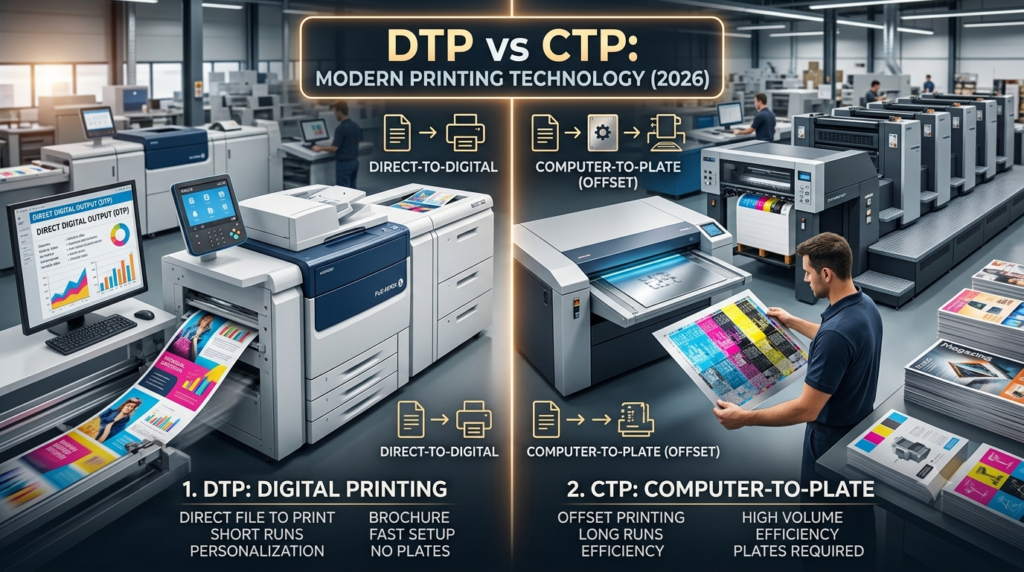
In the modern printing industry, two technologies are frequently discussed when comparing digital production workflows: DTP (Digital Printing) and CTP (Computer-to-Plate). Although both are important printing technologies, they are designed for completely different production methods, equipment systems, and business applications.
Many printing buyers, packaging companies, and even new printing professionals often ask:
What is the difference between DTP and CTP?
Understanding this difference is essential because choosing the wrong printing technology can affect:
- Production cost
- Printing speed
- Print quality
- Customization capability
- Long-run efficiency
This article provides a professional yet easy-to-understand explanation of DTP and CTP, their workflows, advantages, limitations, and how to choose the right solution for modern printing production.
1. What Is DTP (Digital Printing)?
DTP in the printing industry commonly refers to Digital Printing Technology.
Digital printing is a method where digital image files are printed directly onto substrates without using traditional printing plates.
Unlike offset printing, digital printing does not require:
- Plate making
- Chemical processing
- Long press setup procedures
The image is transferred directly from a computer file to the printer.
Common digital printing equipment includes:
- Digital toner printers
- Inkjet printing systems
- Production digital presses
Digital printing is widely used for:
- Short-run printing
- Variable data printing
- Personalized marketing materials
- Quick turnaround jobs
2. What Is CTP (Computer-to-Plate)?
CTP stands for Computer-to-Plate.
It is a prepress technology used in offset printing where digital files are directly imaged onto aluminum printing plates using laser systems.
The CTP workflow typically includes:
- Digital artwork preparation
- RIP processing
- Laser imaging onto printing plates
- Plate mounting on offset press
- Mass printing production
Unlike digital printing, CTP still requires physical printing plates and offset presses.
CTP technology is commonly used in:
- Commercial offset printing
- Packaging printing
- Book printing
- Newspaper production
3. The Core Difference Between DTP and CTP
The most important difference is:
| DTP (Digital Printing) | CTP (Computer-to-Plate) |
|---|---|
| No printing plates required | Requires printing plates |
| Direct digital output | Plate-based offset printing |
| Best for short runs | Best for medium & long runs |
| Faster setup | Better large-volume efficiency |
| Easy personalization | Higher large-scale consistency |
In simple terms:
- DTP prints directly from digital files
- CTP creates plates for offset printing
4. Workflow Comparison: DTP vs CTP
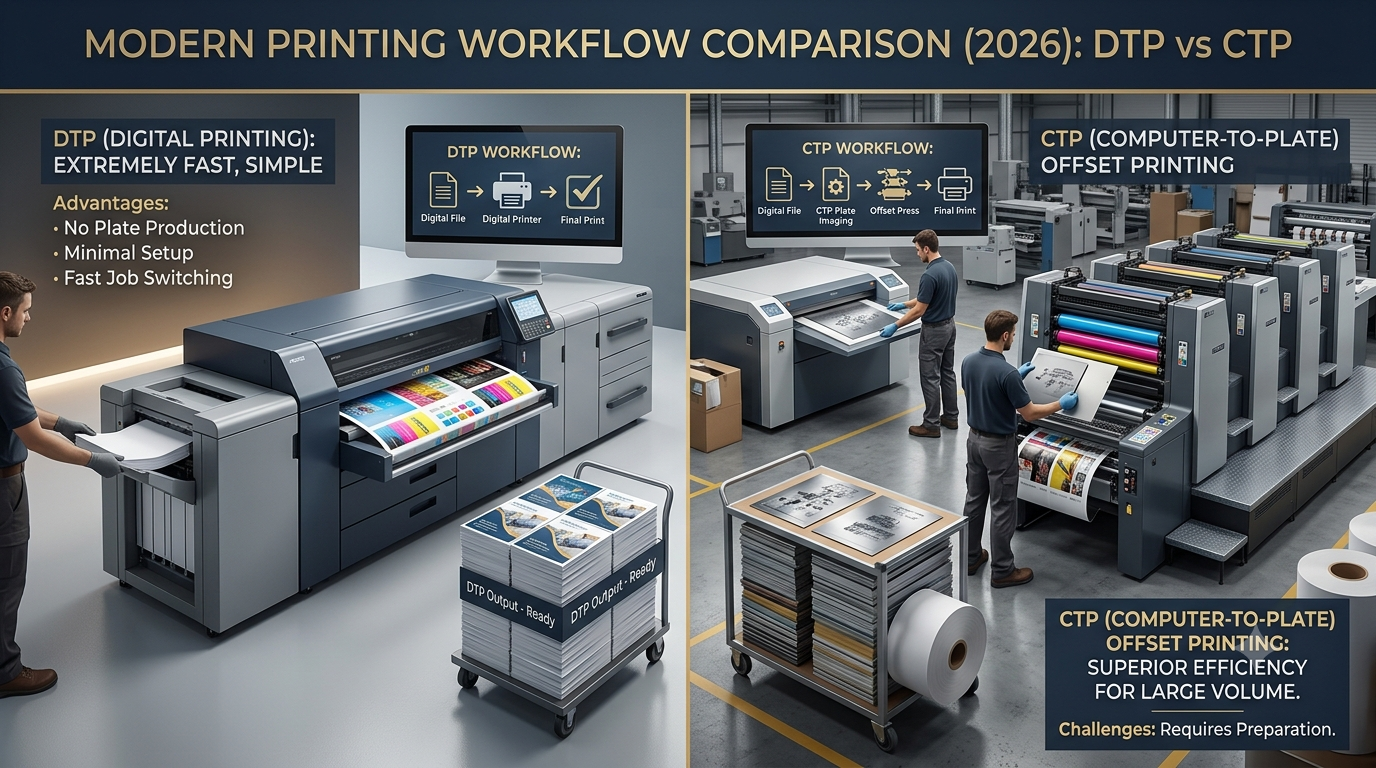
Digital Printing Workflow (DTP)
Digital File → Digital Printer → Final Print
This workflow is extremely fast and simple.
Advantages include:
- No plate production
- Minimal setup time
- Fast job switching
Offset Printing Workflow with CTP
Digital File → CTP Plate Imaging → Offset Press → Final Print
This workflow requires more preparation but delivers superior efficiency for large production volumes.
5. Print Quality Comparison
Both technologies offer excellent quality today, but their strengths differ.
Digital Printing (DTP)
Advantages:
- Sharp small-batch output
- Excellent color consistency for short runs
- Ideal for personalized printing
Limitations:
- Higher cost per sheet in large runs
- Some limitations in ultra-high-end color accuracy
CTP Offset Printing
Advantages:
- Extremely high image precision
- Better color stability in long runs
- Superior large-volume consistency
Limitations:
- Longer setup time
- Requires plate production
For premium commercial printing, offset printing with CTP is still considered the industry standard.
6. Cost Difference Between DTP and CTP
Cost structure is one of the biggest differences.
DTP (Digital Printing)
Lower initial setup cost
Because there are no plates.
Higher per-sheet cost
Ink/toner cost remains relatively high during large production.
Best for:
- Small quantities
- On-demand printing
- Personalized printing
CTP Offset Printing
Higher setup cost
Plate production and press setup are required.
Lower per-sheet cost
Very cost-efficient for high-volume jobs.
Best for:
- Large-volume production
- Packaging printing
- Book and magazine printing
7. Applications of DTP and CTP
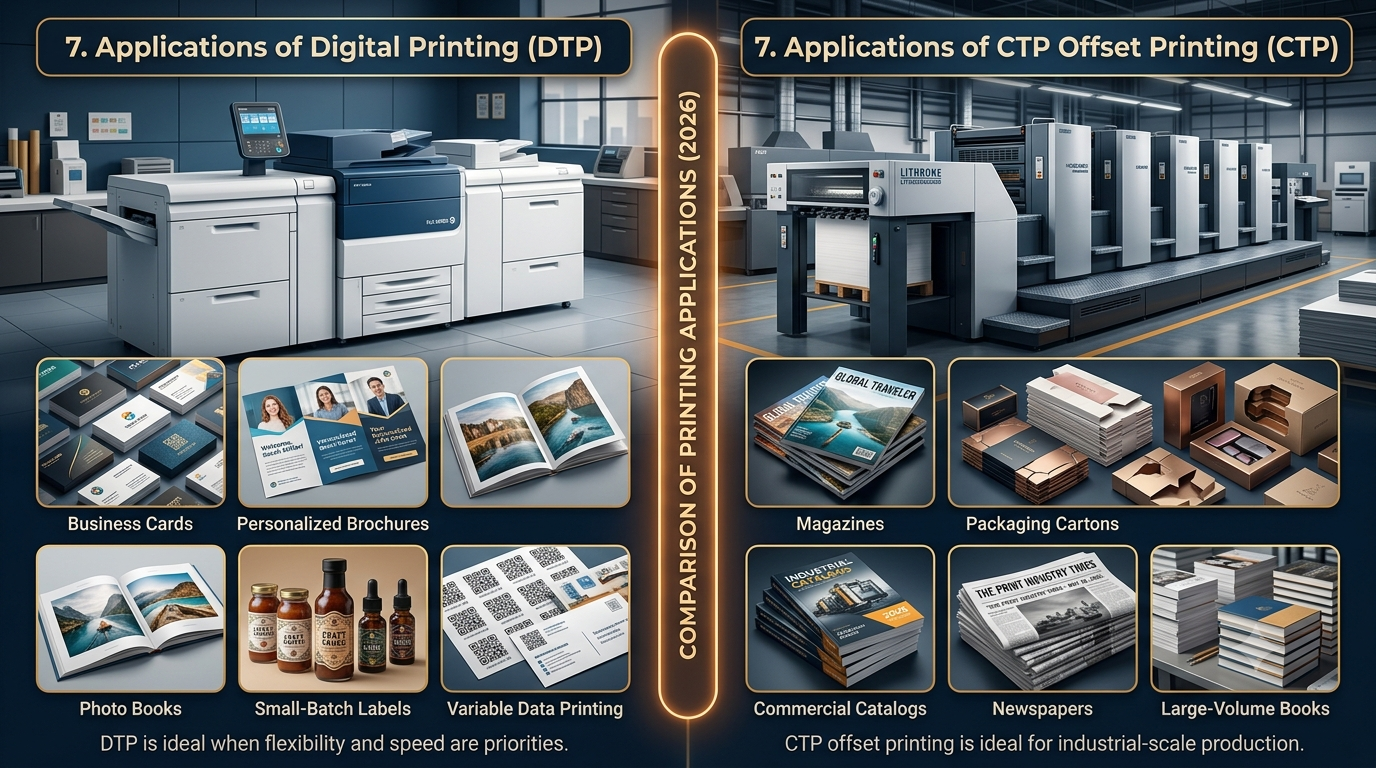
Common Applications of Digital Printing
- Business cards
- Personalized brochures
- Photo books
- Small-batch labels
- Variable data printing
Digital printing is ideal when flexibility and speed are priorities.
Common Applications of CTP Offset Printing
- Magazines
- Packaging cartons
- Commercial catalogs
- Newspapers
- Large-volume books
CTP offset printing is ideal for industrial-scale production.
8. Environmental Comparison
Environmental impact is becoming increasingly important.
Digital Printing
Advantages:
- No plate chemicals
- Less startup waste
- Lower material preparation
Challenges:
- Energy consumption may be high in some systems
CTP Offset Printing
Traditional systems require:
- Aluminum plates
- Chemicals
- Water usage
However, modern processless CTP plates now significantly reduce environmental impact.
Many printing plants are transitioning toward:
- Processless plates
- Chemistry-free systems
- Eco-friendly workflows
9. Future Trends: Will Digital Printing Replace CTP?
This is one of the most common industry questions.
The answer is: No, but both technologies will continue growing in different markets.
Digital Printing Growth Areas
- Personalized printing
- Short-run packaging
- Print-on-demand services
CTP Offset Printing Growth Areas
- Large-volume commercial printing
- Packaging production
- High-speed industrial printing
Rather than replacing each other, DTP and CTP are increasingly becoming complementary technologies.
Many modern printing factories now operate both systems simultaneously.
10. Frequently Asked Questions (FAQ)
Q1: What is the main difference between DTP and CTP?
DTP (Digital Printing) prints directly from digital files without plates, while CTP uses laser-imaged printing plates for offset printing.
Q2: Which is cheaper, DTP or CTP?
For small quantities, digital printing is usually cheaper. For large-volume production, CTP offset printing is far more cost-efficient.
Q3: Which technology provides better print quality?
Both offer high quality, but offset printing with CTP generally provides superior consistency and color precision for large runs.
Q4: Is CTP still important in 2026?
Yes. CTP remains the core technology for commercial offset printing and packaging production worldwide.
Q5: Can digital printing replace offset printing?
Digital printing is growing rapidly, but offset printing remains essential for large-scale industrial production.
Q6: Does CTP require printing plates?
Yes. CTP directly images digital files onto aluminum offset printing plates.
Q7: What industries mainly use digital printing?
Digital printing is widely used in:
- Personalized printing
- Quick printing
- Small-run labels
- Marketing materials
Q8: What industries mainly use CTP offset printing?
CTP is heavily used in:
- Commercial printing
- Packaging printing
- Publishing
- Newspaper printing
Conclusion
So, what is the difference between DTP and CTP?
The answer comes down to workflow and production goals:
- DTP (Digital Printing) focuses on flexibility, personalization, and short-run efficiency.
- CTP (Computer-to-Plate) focuses on high-volume, cost-efficient, industrial offset printing.
Both technologies are essential in modern printing, and the best choice depends on your:
- Production volume
- Budget
- Delivery speed
- Print quality requirements
As printing technology continues evolving, digital printing and CTP offset printing will continue to coexist and complement each other across global printing markets.
Why Does a CTP Plate Scum on Press ? 9 Common Causes and Proven Solutions
Learn why CTP plates scum on press, the most common causes, troubleshooting methods, and practical solutions to improve offset printing quality and reduce downtime.
Which Offset Machine Is Best ? A Practical Guide for Commercial Printing
Which offset machine is best? Learn how to choose the right offset printing machine based on format, volume, cost, and CTP technology.
Where to Buy Thermal CTP Plates for Offset Printing | Best Supplier Guide & Expert Tips
Looking for reliable thermal CTP plates for offset printing? This expert guide explains how to choose a trustworthy supplier, compares global and Chinese manufacturers, and shares key quality criteria.