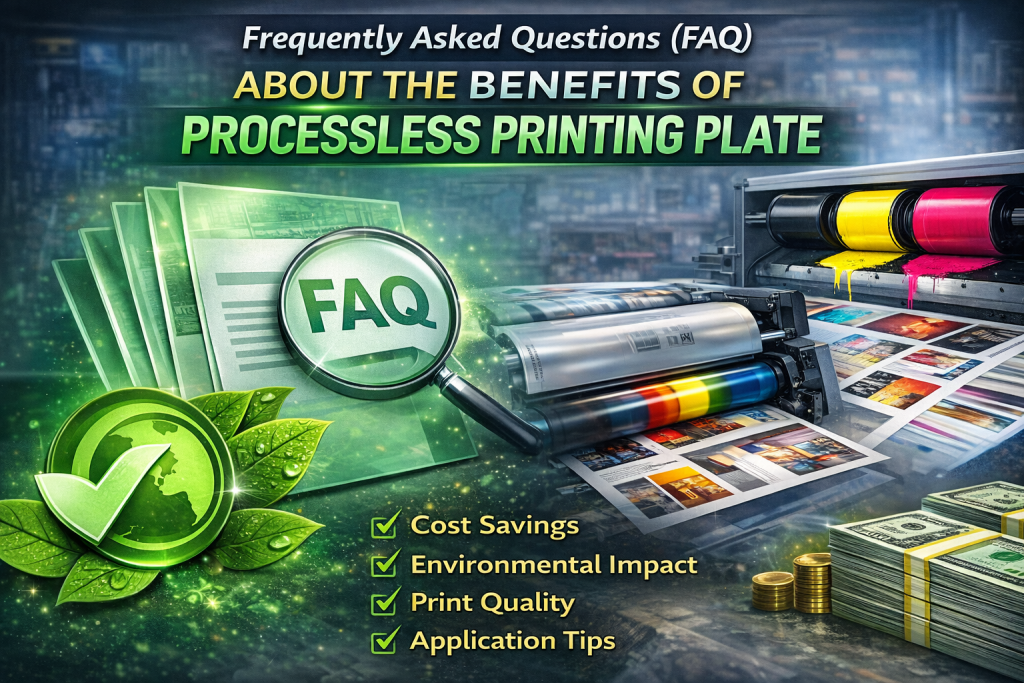
1. Are processless printing plates really stable without chemical processing?
Yes — modern thermal processless plates are engineered with advanced coating technology that allows the non-image layer to be removed cleanly during initial press rotation.
Earlier generations (10+ years ago) had contrast and sensitivity limitations, but current-generation plates offer:
High image contrast after exposure
Strong ink receptivity
Stable dot reproduction from 1–99%
Consistent on-press clean-up performance
When paired with a properly calibrated CTP system and well-maintained press, stability is fully comparable to traditional processed thermal plates.
2. What is the typical run length of a processless printing plate?
Run length depends on:
Typical performance range:
Commercial sheetfed printing: 100,000 – 200,000 impressions
Book printing: 150,000+ impressions
UV applications (special models): varies by coating design
For most commercial applications, run length fully meets daily production requirements.
3. Do processless plates increase ink consumption?
In well-optimized press conditions, no significant increase in ink consumption is observed.
However, during the first few sheets:
After stabilization (usually within 20–50 sheets), performance normalizes.
Proper press calibration ensures optimal ink efficiency.
4. Is switching to processless plates complicated?
Transition complexity depends on plant condition.
Recommended preparation checklist:
Confirm CTP laser power compatibility
Clean press ink and dampening systems thoroughly
Adjust exposure calibration curve
Conduct controlled test runs
Most mid-size printers complete the transition within 1–2 weeks of controlled testing.
The process is generally smooth when technical guidance is provided.
5. Are processless printing plates more expensive than traditional plates?
Unit plate price may be slightly higher in some markets.
However, when calculating total cost of ownership (TCO), processless plates typically reduce overall costs because they eliminate:
Developer chemistry
Water usage
Gum solution
Processor maintenance
Waste disposal fees
Equipment depreciation
In many real-world cases, total plate department cost drops 10–25% annually.
6. What about environmental certification and compliance?
One of the strongest benefits of processless printing plate systems is environmental compliance.
They help printers achieve:
Lower wastewater output
Reduced hazardous chemical storage
Easier environmental audits
Better ESG reporting metrics
For companies serving multinational brands, this sustainability advantage can influence procurement decisions.
7. Are processless plates suitable for packaging printing?
Yes — especially for:
For very long-run heavy packaging or aggressive UV environments, specific plate models should be selected after technical consultation.
8. What are the common mistakes when adopting processless plates?
Based on industry experience, common transition mistakes include:
Not recalibrating CTP exposure energy
Ignoring press cleanliness
Using outdated dampening solution
Comparing plates without standardized testing conditions
Proper testing protocol ensures accurate evaluation of the benefits of processless printing plate technology.
9. Does eliminating the processor affect image quality?
No — when exposure settings are optimized.
Modern thermal processless plates provide:
Sharp halftone reproduction
Smooth gradient transitions
Excellent small-text clarity
Stable screening compatibility (AM & FM)
In fact, eliminating processing variables often improves consistency.
10. Is processless technology the long-term direction of offset printing?
Industry data and global adoption trends strongly suggest yes.
Key drivers include:
While conventional thermal plates remain relevant in certain ultra-long-run applications, processless technology is clearly becoming the mainstream solution in commercial and book printing segments.
Final Reminder
If you are evaluating the benefits of processless printing plate systems and considering implementation in your production line, working with an experienced manufacturer is critical.
As a professional processless printing plate manufacturer, we provide:
Stable thermal sensitivity
Reliable run length performance
Technical transition support
Sample testing assistance
If you would like detailed specifications or test samples, feel free to reach out. We are ready to support your shift toward a cleaner, more efficient, and future-ready printing workflow.