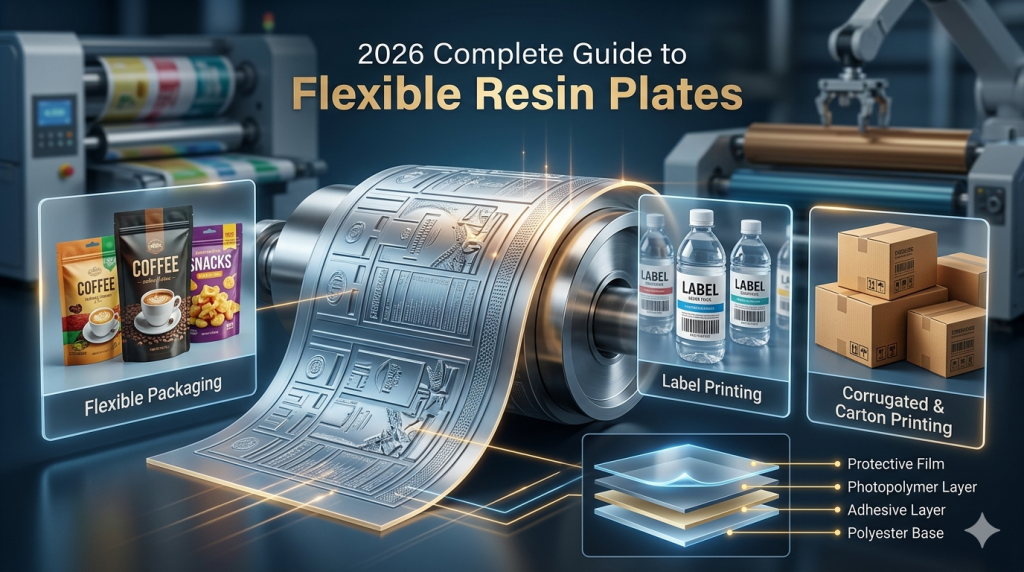
Flexible resin plates—often referred to as photopolymer plates—are a cornerstone of flexographic printing (flexo) and several specialty printing processes. If you’re evaluating plate technologies for packaging, labels, or high-speed web printing, a key question is:
What is flexible resin plate used for?
This in-depth 2026 guide explains the applications, materials, plate structures, manufacturing workflow, performance characteristics, and selection criteria—with practical insights from a production perspective. It also includes a detailed FAQ to address common buyer and operator concerns.
1. What Is a Flexible Resin Plate?
A flexible resin plate is a photopolymer printing plate made from light-sensitive resin that hardens (polymerizes) when exposed to UV light. After exposure and processing, the plate features raised image areas that transfer ink to substrates.
Unlike rigid offset plates, flexible resin plates:
- Bend easily around cylinders or sleeves
- Maintain consistent contact with uneven surfaces
- Use low-viscosity inks (water-based, UV, or solvent-based)
- Support high-speed, roll-to-roll production
They are the primary imaging carrier in flexographic printing, widely used in packaging and label industries.
2. Core Principle: Relief Printing for High-Speed Production
Flexible resin plates operate on a relief (letterpress) principle:
- Raised areas = image (inked)
- Recessed areas = non-image (no ink)
Ink is delivered via an anilox roller, which meters a precise volume onto the plate. The plate then transfers ink directly to the substrate.
This system enables:
- Consistent ink laydown
- High-speed printing (often 200–600 m/min or more)
- Compatibility with a wide range of substrates
3. What Is Flexible Resin Plate Used For? (Main Applications)
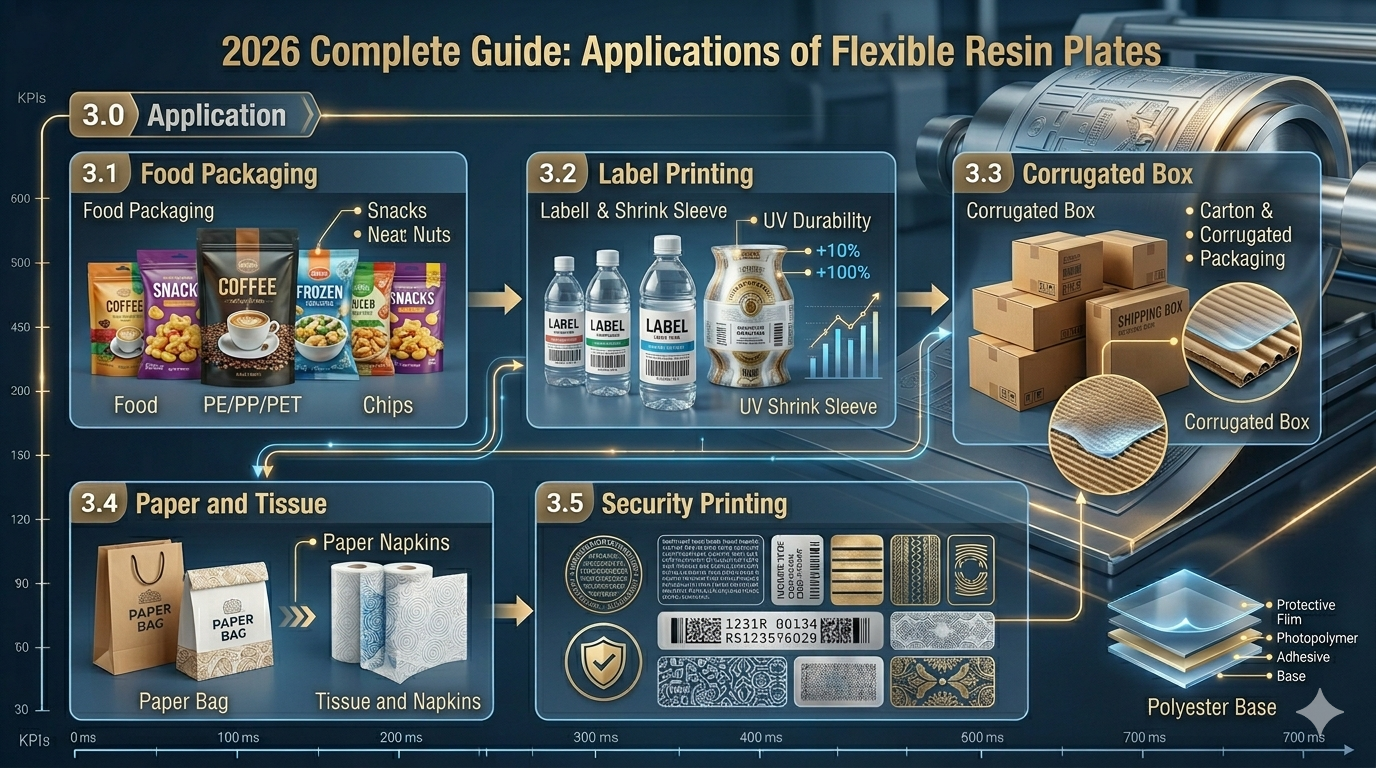
3.1 Flexible Packaging Printing
The largest application area.
Products include:
- Food packaging (snack bags, frozen foods)
- Plastic films (PE, PP, PET)
- Laminated pouches
Why flexible resin plates excel:
- Adapt well to thin, stretchable films
- Maintain image quality at high speeds
- Work with solvent-based and water-based inks
3.2 Label Printing
Used for:
- Pressure-sensitive labels
- Shrink sleeves
- Wrap-around labels
Key benefits:
- Fine text and barcode clarity
- High consistency for brand colors
- Compatibility with UV inks for durability
3.3 Corrugated & Carton Printing
Flexible resin plates are widely used for:
- Corrugated boxes
- Shipping cartons
- E-commerce packaging
Advantages:
- Ability to print on uneven surfaces
- Strong durability under pressure
- Good ink transfer on absorbent substrates
3.4 Paper & Tissue Printing
Applications include:
- Paper bags
- Tissue products
- Wrapping paper
Flexo plates provide:
- Clean image transfer
- Efficient ink usage
- Stable performance on porous materials
3.5 Security & Specialty Printing
Flexible resin plates are also used in:
- Security printing
- Industrial markings
- Decorative printing
4. Structure of Flexible Resin Plates
A typical flexible resin plate consists of multiple layers:
1. Protective Film
- Prevents damage before exposure
2. Photopolymer Layer
- Core imaging layer
- Hardens when exposed to UV
3. Adhesive Layer
- Bonds the plate to backing
4. Polyester Base (PET)
- Provides dimensional stability
5. Types of Flexible Resin Plates
5.1 Digital Photopolymer Plates
- Imaged using laser (CTP technology)
- High precision
- Excellent dot reproduction
Best for: High-quality labels and packaging
5.2 Analog Plates
- Use film exposure
- Lower cost
- Less precise
Best for: Basic printing applications
5.3 Water-Wash Plates
- Developed using water
- Eco-friendly
5.4 Solvent-Wash Plates
- Require solvent processing
- Strong durability
5.5 Thermal Plates
- No solvent or water
- Processed using heat
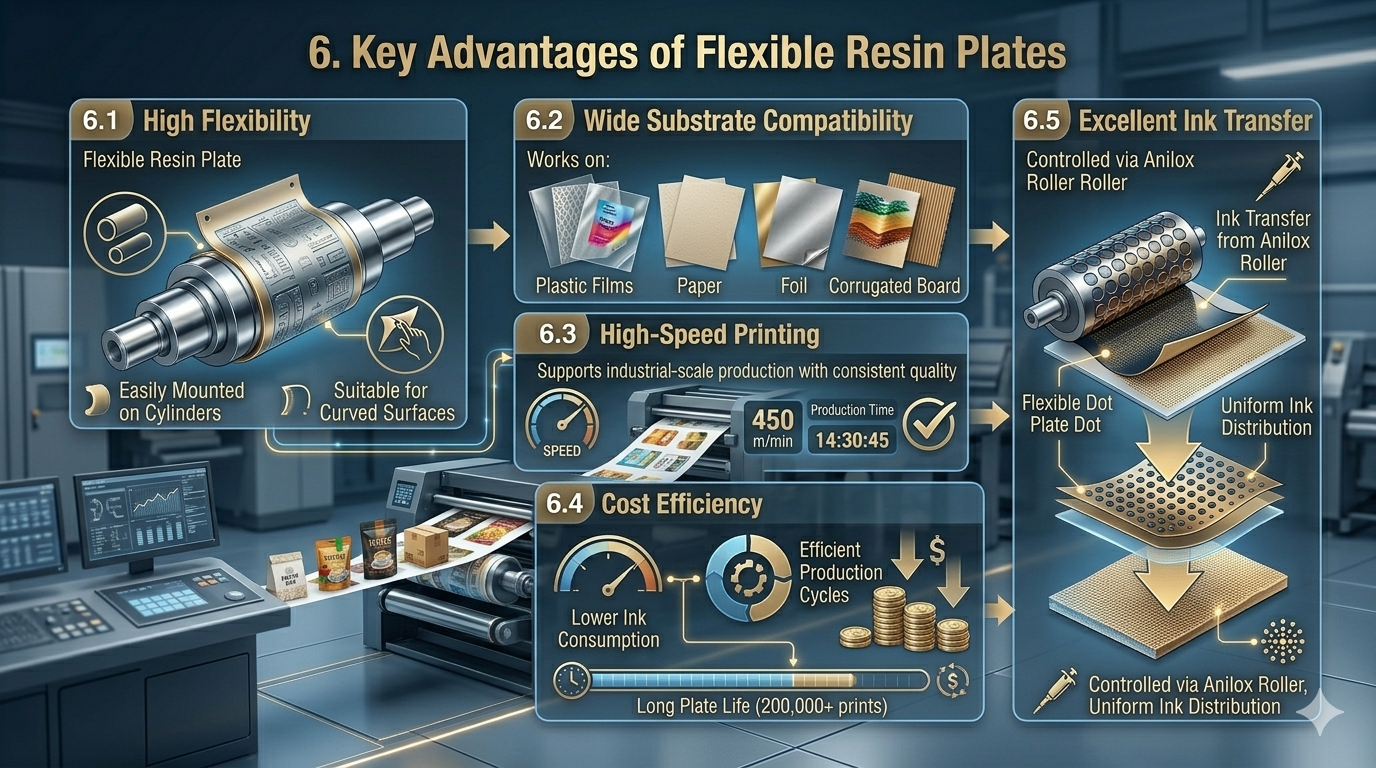
6. Key Advantages of Flexible Resin Plates
6.1 High Flexibility
- Easily mounted on cylinders
- Suitable for curved surfaces
6.2 Wide Substrate Compatibility
Works on:
- Plastic films
- Paper
- Foil
- Corrugated board
6.3 High-Speed Printing
Supports industrial-scale production with consistent quality.
6.4 Cost Efficiency
- Lower ink consumption
- Efficient production cycles
- Long plate life
6.5 Excellent Ink Transfer
- Controlled via anilox roller
- Uniform ink distribution
7. Technical Parameters That Matter
Plate Thickness
| Thickness | Application |
|---|---|
| 1.14 mm | Labels |
| 1.70 mm | Flexible packaging |
| 2.28 mm | Corrugated printing |
| 3.94 mm | Heavy-duty carton |
Shore Hardness
- Softer plates → better for uneven surfaces
- Harder plates → better for fine detail
Resolution Capability
- Up to 175–200 LPI (lines per inch)
- Advanced plates support HD flexo
8. Flexible Resin Plate vs Offset Plate
| Feature | Flexible Resin Plate | Offset Plate |
|---|---|---|
| Printing method | Relief | Planographic |
| Substrates | Flexible materials | Paper/cardboard |
| Ink type | Liquid inks | Paste inks |
| Speed | Very high | High |
| Application | Packaging | Commercial printing |
9. How to Choose the Right Flexible Resin Plate
Professional selection depends on:
1. Substrate Type
- Film → softer plate
- Corrugated → thicker plate
2. Print Quality Requirement
- High-end → digital plates
- Standard → analog plates
3. Ink Type
- UV / water-based / solvent
4. Press Type
- Central impression (CI)
- Stack press
- Inline press
10. Common Challenges and Solutions
Problem: Dot gain
→ Solution: Adjust plate hardness and exposure
Problem: Ink inconsistency
→ Solution: Optimize anilox roller
Problem: Plate wear
→ Solution: Choose higher-quality photopolymer
11. Industry Trends in 2026
- Growth of digital flexo plates
- Increased use of water-wash eco plates
- Higher resolution (HD flexo)
- Automation in plate making
- Sustainability focus
Flexible resin plates are evolving rapidly to meet modern packaging demands.
Frequently Asked Questions (FAQ)
Q1: What is flexible resin plate mainly used for?
Flexible resin plates are mainly used in flexographic printing, especially for packaging, labels, corrugated boxes, and plastic films.
Q2: Are flexible resin plates suitable for high-speed printing?
Yes. They are designed for high-speed web printing and maintain stable performance at industrial production speeds.
Q3: What is the difference between digital and analog flexo plates?
Digital plates are laser-imaged and provide higher precision, while analog plates use film and are less accurate but more affordable.
Q4: Can flexible resin plates print on plastic materials?
Yes. They are widely used for printing on plastic films such as PE, PP, and PET.
Q5: How long do flexible resin plates last?
Plate life depends on usage, but high-quality plates can handle hundreds of thousands of impressions.
Q6: Are flexible resin plates environmentally friendly?
Modern plates (especially water-wash and thermal types) are designed to reduce environmental impact.
Q7: What industries use flexible resin plates the most?
- Packaging industry
- Food and beverage
- Logistics and e-commerce
- Label printing companies
Q8: What determines print quality in flexo printing?
Key factors include:
- Plate quality
- Anilox roller
- Ink formulation
- Press calibration
Conclusion
So, what is flexible resin plate used for?
It is a versatile, high-performance printing solution used across:
- Flexible packaging
- Label printing
- Corrugated packaging
- Industrial applications
With advantages such as flexibility, speed, cost efficiency, and substrate compatibility, flexible resin plates remain a critical component in modern printing technology.
Looking for a Reliable Plate Manufacturer?
We are a professional manufacturer specializing in:
- Flexible resin (photopolymer) plates
- Processless CTP plates
- Thermal and UV CTP plates
We offer:
- Stable quality
- Competitive pricing
- Custom solutions
- Global supply support
If you are looking for high-performance printing plates, feel free to contact us for samples and technical consultation.
Why Does a CTP Plate Scum on Press ? 9 Common Causes and Proven Solutions
Learn why CTP plates scum on press, the most common causes, troubleshooting methods, and practical solutions to improve offset printing quality and reduce downtime.
Which Offset Machine Is Best ? A Practical Guide for Commercial Printing
Which offset machine is best? Learn how to choose the right offset printing machine based on format, volume, cost, and CTP technology.
Where to Buy Thermal CTP Plates for Offset Printing | Best Supplier Guide & Expert Tips
Looking for reliable thermal CTP plates for offset printing? This expert guide explains how to choose a trustworthy supplier, compares global and Chinese manufacturers, and shares key quality criteria.