
Introduction
For offset printers, distributors, and OEM buyers, choosing the correct plate size is not just a technical detail—it directly affects press setup, waste rate, lead time, and overall production cost.
In this guide, we explain the most common offset printing plate sizes in inches, how they relate to press models, and what buyers should consider when ordering plates in bulk or custom formats.
Why Offset Printing Plate Size Matters
Choosing the correct plate size helps you:
Ensure compatibility with your offset press
Reduce trimming and plate waste
Improve press setup efficiency
Control plate cost in bulk orders
Avoid delays caused by wrong sizing
Incorrect plate sizing often leads to unnecessary rework, higher scrap rates, and longer lead times.
Standard Offset Printing Plate Sizes in Inches
Offset printing plate sizes vary depending on press format and market region. Below are commonly used standard sizes, converted into inches for easier reference.
Common Offset Plate Sizes (Inches)
| Plate Size (Inches) | Approx. Metric Size (mm) | Typical Press Type |
|---|---|---|
| 20 × 25 in | 510 × 635 mm | Small format presses |
| 22 × 28 in | 560 × 710 mm | Sheet-fed presses |
| 25 × 36 in | 635 × 914 mm | Medium commercial presses |
| 28 × 40 in | 711 × 1016 mm | Large format presses |
| 40 × 51 in | 1020 × 1300 mm | Large sheet-fed presses |
| 44 × 56 in | 1120 × 1420 mm | High-capacity presses |
These sizes are widely used in North America, Europe, and international export markets.
Offset Plate Sizes vs Printing Press Brands

Most offset plate sizes are determined by the printing press model. Below is a simplified reference.
| Press Brand | Typical Plate Size (Inches) |
|---|---|
| Heidelberg | 22 × 28 / 28 × 40 |
| Komori | 25 × 36 / 28 × 40 |
| KBA (Koenig & Bauer) | 40 × 51 / 44 × 56 |
| Mitsubishi | 25 × 36 |
| Ryobi | 20 × 25 / 22 × 28 |
 Always confirm exact gripper edge and bend requirements with your supplier.
Sheet-Fed vs Web Offset Plate Sizes
Offset plate size also depends on printing method.
Sheet-Fed Offset Plates
Smaller to medium sizes
Flat plates
Common in commercial and packaging printing
Web Offset Plates
Larger formats
Often longer plate length
Used in newspaper and magazine printing
Understanding your printing process helps narrow down the correct plate dimensions.
Offset Printing Plate Thickness and Size
Plate size and thickness work together.
Common thickness options:
0.15 mm
0.20 mm
0.25 mm
0.30 mm
Larger plates often require:
Higher aluminum strength
Better graining uniformity
Stable coating adhesion
A professional manufacturer ensures size accuracy and thickness consistency.
Custom Offset Printing Plate Sizes (OEM)
Not all presses use standard sizes. Many buyers require custom plate sizes, especially for:
Modified presses
OEM branding
Regional press standards
Special applications
Custom Size Options Include:
Non-standard width or length
Special gripper margins
Customized corner cutting
OEM labeling and packaging
Custom sizing may slightly increase unit cost but improves press efficiency.
Common Buyer Mistakes When Choosing Plate Sizes
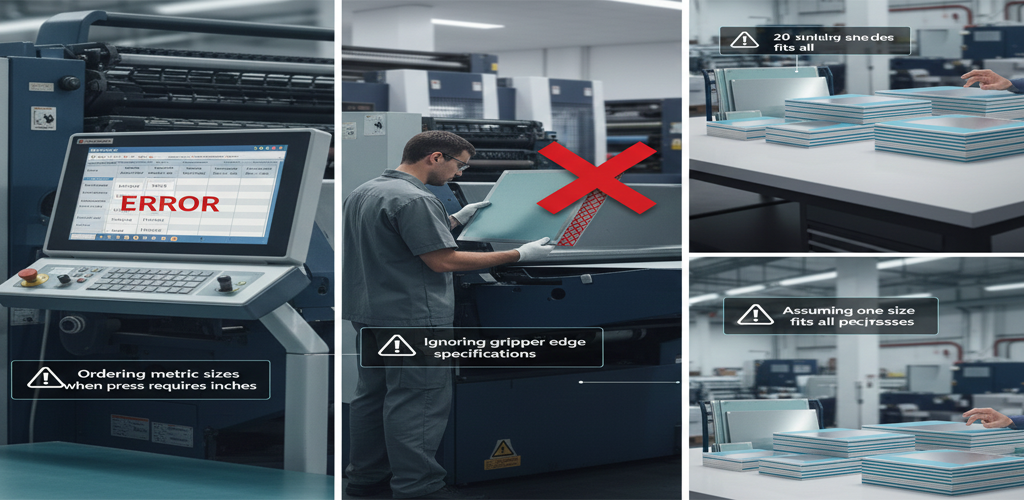
Avoid these common errors:
Ordering metric sizes when press requires inches
Ignoring gripper edge specifications
Assuming one size fits all presses
Not confirming tolerance requirements
Choosing the cheapest plate without size accuracy checks
These mistakes often lead to press issues and wasted plates.
How to Confirm the Correct Offset Plate Size

Before placing an order, buyers should provide:
Press brand and model
Plate size in inches (or mm)
Plate thickness
Gripper edge requirements
Monthly or annual consumption volume
This allows manufacturers to recommend the most suitable option.
Offset Printing Plate Sizes and Bulk Orders
For bulk buyers and distributors:
Standard sizes reduce production cost
Consistent sizing improves batch stability
Long-term contracts lock in price advantages
Bulk orders also allow:
OEM packaging
Private labeling
Stable lead times
Why Work with a Professional Offset Plate Manufacturer
A reliable manufacturer offers:
Accurate size control
Tight dimensional tolerance
Wide size range in inches
OEM customization
Export-ready packaging
Technical support for press compatibility
This reduces buyer risk and improves long-term cooperation.
Conclusion
Understanding offset printing plate sizes in inches is essential for efficient printing and cost control. The correct plate size ensures press compatibility, reduces waste, and improves overall productivity.
Whether you choose standard sizes or customized formats, working with an experienced manufacturer makes a significant difference.
 We are also a professional Offset Printing Plate manufacturer, supplying a full range of standard and custom plate sizes in inches for global markets.
If you need technical advice, size confirmation, samples, or wholesale pricing, feel free to contact us. We are ready to support your printing business.
Why Does a CTP Plate Scum on Press ? 9 Common Causes and Proven Solutions
Learn why CTP plates scum on press, the most common causes, troubleshooting methods, and practical solutions to improve offset printing quality and reduce downtime.

Which Offset Machine Is Best ? A Practical Guide for Commercial Printing
Which offset machine is best? Learn how to choose the right offset printing machine based on format, volume, cost, and CTP technology.
Where to Buy Thermal CTP Plates for Offset Printing | Best Supplier Guide & Expert Tips
Looking for reliable thermal CTP plates for offset printing? This expert guide explains how to choose a trustworthy supplier, compares global and Chinese manufacturers, and shares key quality criteria.