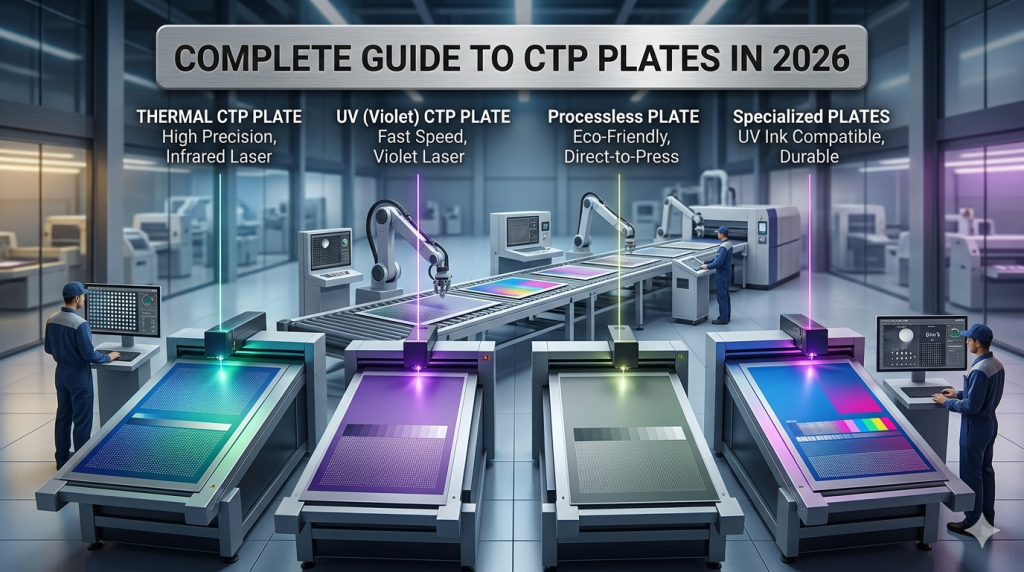
In modern offset printing, Computer-to-Plate (CTP) technology has become the industry standard. However, one of the most critical—and often misunderstood—topics is the types of CTP plates available and how to choose the right one.
Different plate types are designed for different applications, press conditions, ink systems, and production volumes. Selecting the wrong plate can lead to:
- Poor print quality
- Increased waste
- Shorter plate life
- Higher production costs
This comprehensive guide provides a deep, professional breakdown of all major types of CTP plates, including their structure, working principles, advantages, limitations, and ideal applications.
1. What Are CTP Plates?
CTP (Computer-to-Plate) plates are photosensitive printing plates used in offset printing. They are imaged directly from digital files using laser technology, eliminating the need for film.
After imaging, the plate is mounted on the printing press, where it transfers ink to the substrate via the offset process.
The key function of a CTP plate is to:
- Define image vs non-image areas
- Control ink-water balance
- Maintain consistent dot reproduction
2. Classification of Types of CTP Plates
CTP plates can be classified based on several criteria:
By Exposure Technology
- Thermal CTP plates
- UV (Violet) CTP plates
By Processing Method
- Processed plates
- Processless plates
By Application
- Commercial printing plates
- Newspaper plates
- Packaging plates
By Surface Technology
- Positive-working plates
- Negative-working plates
Understanding these categories helps printers select the most suitable plate for their production environment.
3. Thermal CTP Plates (Most Widely Used)
Overview
Thermal CTP plates are the most commonly used plates in the global printing industry. They are exposed using an 830 nm infrared laser.
Key Features
- High imaging precision
- Stable performance under different temperatures
- Strong resistance to ambient light
- Suitable for high-resolution printing
Advantages
- Excellent dot reproduction (1–99%)
- Long run length (up to 200,000 impressions)
- Consistent quality across long print runs
- Compatible with advanced screening technologies
Disadvantages
- Requires chemical processing (unless processless version)
- Higher initial equipment cost
Applications
- Commercial printing
- Book printing
- High-end packaging
4. UV (Violet) CTP Plates
Overview
UV CTP plates use violet laser technology (typically 405 nm) and are commonly used in newspaper and medium-quality printing environments.
Key Features
- Faster imaging speed
- Lower equipment cost
- Higher sensitivity to light
Advantages
- Lower investment in CTP equipment
- Suitable for high-speed plate production
- Cost-effective for medium-quality printing
Disadvantages
- More sensitive to ambient light
- Slightly lower resolution compared to thermal plates
- Shorter run length
Applications
- Newspaper printing
- Quick print shops
- Medium-volume commercial printing
5. Processed Thermal CTP Plates
Overview
These are traditional thermal plates that require chemical processing after exposure.
Workflow
- Laser imaging
- Chemical development
- Water rinse
- Gum application
- Drying
Advantages
- Proven technology
- Stable performance
- Long run length
- High compatibility
Disadvantages
- Requires chemicals
- Environmental impact
- Additional equipment maintenance
6. Processless CTP Plates (Fastest Growing Segment)
Overview
Processless plates eliminate the need for chemical processing. After imaging, they go directly to press.
How They Work
- Image areas are fixed during exposure
- Non-image coating is removed during initial press run
Advantages
- No chemical processing
- Lower environmental impact
- Reduced operating cost
- Faster workflow
Disadvantages
- Slightly higher plate cost
- Requires proper press calibration
Applications
- Commercial printing
- Book printing
- Short- to medium-run jobs
7. Chemistry-Free vs Processless Plates
These two terms are often confused.
Processless Plates
- No processing required
- Coating removed on press
Chemistry-Free Plates
- Require minimal processing
- No developer chemicals
Processless plates represent the next evolution beyond chemistry-free technology.
8. Positive vs Negative Working Plates
Positive Plates
- Image areas are removed during processing
- Non-image areas remain
Advantages:
- High detail accuracy
- Better highlight reproduction
Negative Plates
- Image areas remain after exposure
- Non-image areas are removed
Advantages:
- Higher durability
- Better for long-run printing
9. Specialized Types of CTP Plates
1. UV Ink Compatible Plates
Designed for:
- Packaging printing
- Plastic substrates
- High-chemical-resistance environments
2. Low-Chemistry Plates
Require minimal processing and reduced chemical usage.
3. Waterless CTP Plates
Use silicone layers instead of water for ink separation.
Advantages:
- No dampening system
- Superior color consistency
10. Plate Thickness and Its Impact
Different types of CTP plates are available in various thicknesses:
| Thickness | Application |
|---|---|
| 0.15 mm | Small presses |
| 0.20 mm | Commercial printing |
| 0.25 mm | Large format |
| 0.30 mm | Packaging printing |
| 0.40 mm | Heavy-duty applications |
Choosing correct thickness ensures:
- Proper plate mounting
- Stable printing pressure
- Longer plate life
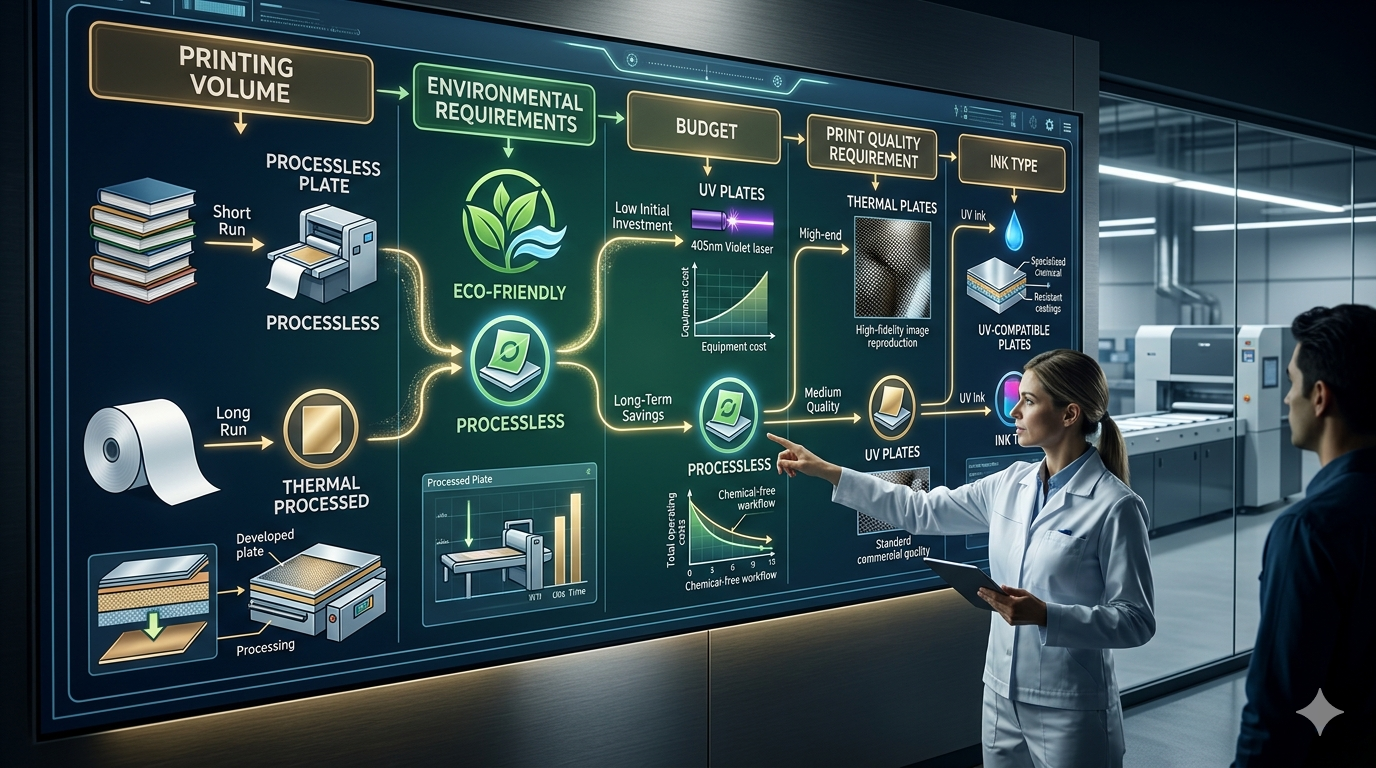
11. How to Choose the Right Type of CTP Plate
Professional selection depends on:
1. Printing Volume
- Short run → Processless
- Long run → Thermal processed
2. Environmental Requirements
- Eco-friendly → Processless
3. Budget
- Low initial investment → UV plates
- Long-term savings → Processless
4. Print Quality Requirement
- High-end → Thermal plates
- Medium quality → UV plates
5. Ink Type
- UV ink → UV-compatible plates
12. Comparison Table of Types of CTP Plates
| Plate Type | Processing | Run Length | Cost | Quality | Eco-Friendly |
|---|---|---|---|---|---|
| Thermal Processed | Yes | Very High | Medium | Excellent | Medium |
| Processless | No | High | Medium | Excellent | High |
| UV (Violet) | Yes | Medium | Low | Good | Medium |
| Waterless | No water | High | High | Excellent | High |
13. Market Trends in 2026
The CTP plate industry is evolving rapidly.
Key Trends:
- Growth of processless plates
- Reduction in chemical usage
- Increased automation
- Focus on sustainability
- Improved coating durability
Global demand is shifting toward eco-friendly, cost-efficient, and high-performance plates.
14. Common Mistakes When Choosing CTP Plates
Avoid these errors:
- Selecting plates based only on price
- Ignoring press compatibility
- Not testing before bulk purchase
- Using incorrect thickness
- Overlooking environmental requirements
A professional evaluation ensures optimal performance.
15. Future of CTP Plate Technology
The future of types of CTP plates will focus on:
- Fully chemical-free workflows
- Higher imaging sensitivity
- AI-assisted press calibration
- Smart plate coating materials
- Integration with digital printing systems
Processless technology is expected to become the mainstream solution globally.
Conclusion
Understanding the different types of CTP plates is essential for optimizing printing performance, reducing costs, and meeting environmental standards.
Each type offers unique benefits:
- Thermal plates → precision and durability
- UV plates → cost-effective production
- Processless plates → sustainability and efficiency
- Specialized plates → application-specific performance
Choosing the right plate is not just a technical decision—it is a strategic investment in your printing operation.
We Are a Professional CTP Plate Manufacturer
We specialize in:
- Thermal CTP plates
- Processless CTP plates
- UV CTP plates
- Custom sizes and thickness
- OEM solutions
If you are looking for a reliable supplier of high-quality CTP plates, feel free to contact us for samples, technical support, and competitive pricing.
We are ready to support your printing business with advanced plate solutions.
Why Does a CTP Plate Scum on Press ? 9 Common Causes and Proven Solutions
Learn why CTP plates scum on press, the most common causes, troubleshooting methods, and practical solutions to improve offset printing quality and reduce downtime.
Which Offset Machine Is Best ? A Practical Guide for Commercial Printing
Which offset machine is best? Learn how to choose the right offset printing machine based on format, volume, cost, and CTP technology.
Where to Buy Thermal CTP Plates for Offset Printing | Best Supplier Guide & Expert Tips
Looking for reliable thermal CTP plates for offset printing? This expert guide explains how to choose a trustworthy supplier, compares global and Chinese manufacturers, and shares key quality criteria.