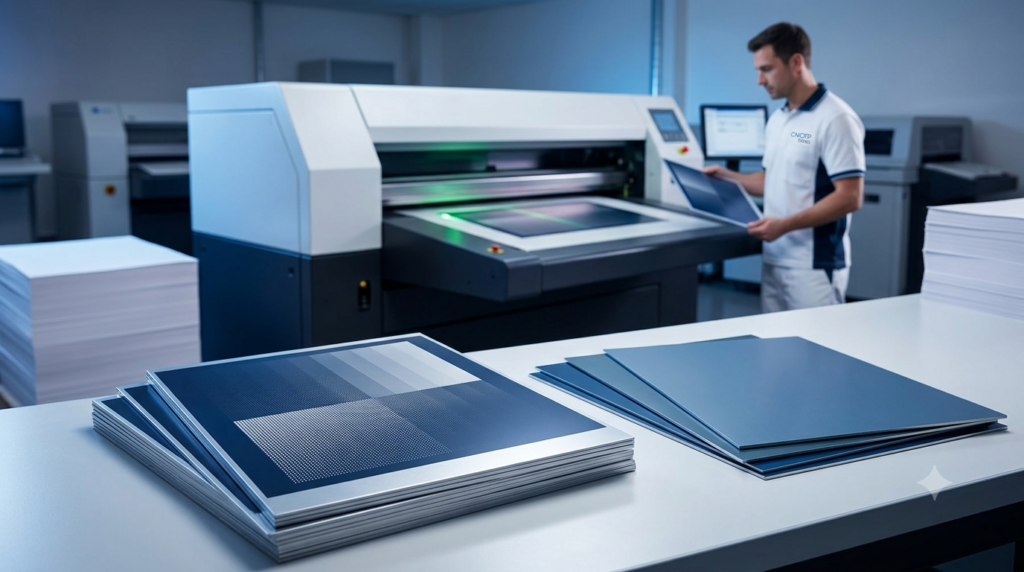
Types of Offset Printing Plates: A Complete Guide
Offset printing remains one of the most widely used printing technologies worldwide because of its excellent image quality, color accuracy, and cost efficiency for medium and high-volume production.
At the center of every offset printing process is the printing plate. The plate transfers the image from the prepared artwork to the rubber blanket and finally onto the printing substrate.
With the development of digital prepress technology, offset printing plates have evolved from traditional analog plates into advanced Computer-to-Plate (CTP) solutions.
Today, printers can choose from several types of offset printing plates, including:
- Conventional PS plates
- Thermal CTP plates
- Violet CTP plates
- Process-free CTP plates
- UV CTP plates
- Silver halide plates
- Specialty printing plates
Understanding the differences between these plate technologies helps printing companies select the most suitable solution for their equipment, production requirements, and environmental goals.
What Is an Offset Printing Plate?
An offset printing plate is a specially coated metal plate used in lithographic printing to transfer images onto paper or other substrates.
The basic principle of offset printing relies on the difference between:
- Image areas that attract ink
- Non-image areas that attract water and repel ink
Most modern offset printing plates use aluminum substrates because aluminum provides:
- Excellent dimensional stability
- Lightweight handling
- Corrosion resistance
- Consistent surface quality
The plate surface is coated with a photosensitive or thermal-sensitive layer that creates the printable image during the plate-making process.
Main Categories of Offset Printing Plates
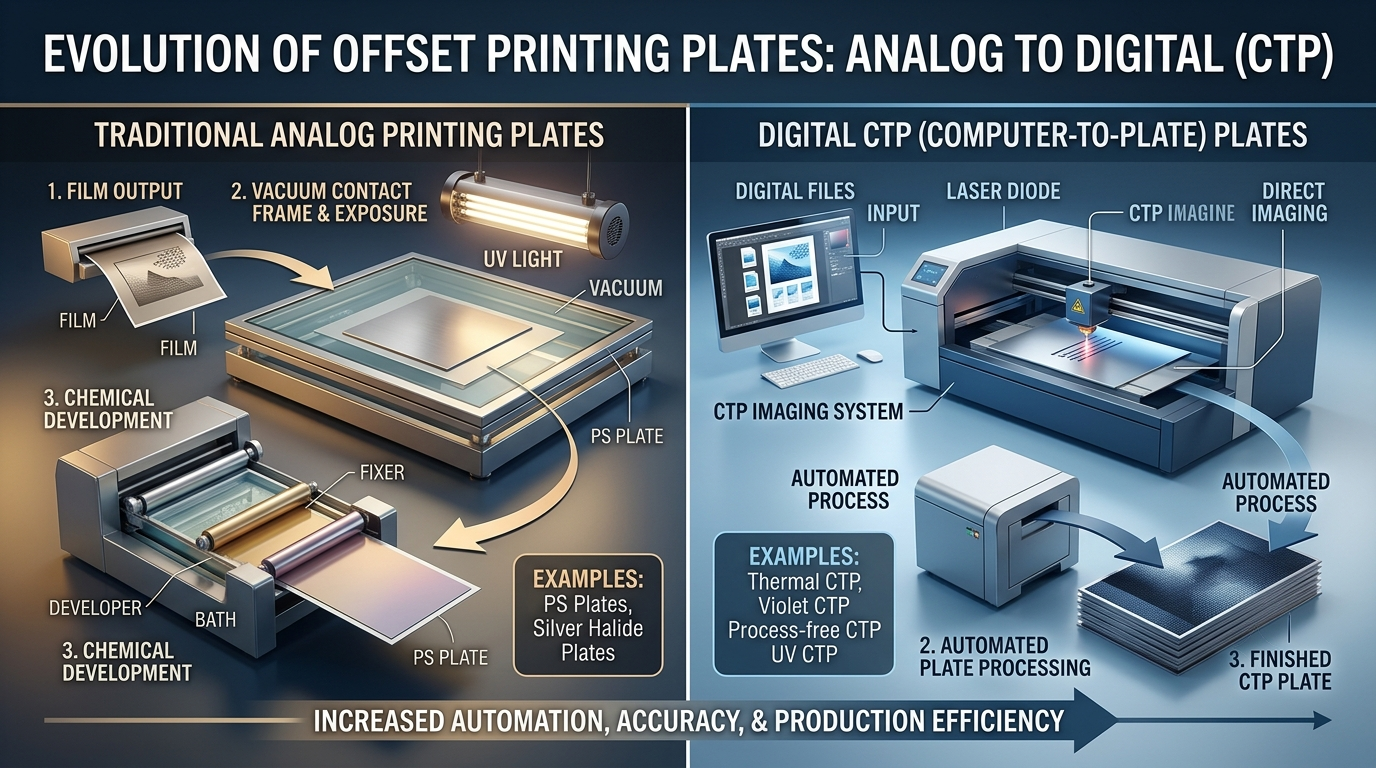
Offset printing plates can generally be divided into two major generations:
Traditional Analog Printing Plates
These plates require film-based image transfer.
Examples:
- PS plates
- Silver halide plates
Digital CTP Printing Plates
These plates receive images directly from digital files through a CTP imaging system.
Examples:
- Thermal CTP plates
- Violet CTP plates
- Process-free CTP plates
- UV CTP plates
The printing industry has increasingly moved toward CTP technology because it improves automation, accuracy, and production efficiency.
1. PS Plates (Presensitized Plates)
What Are PS Plates?
PS plates, also known as presensitized plates, are traditional offset printing plates that use photographic technology.
Before CTP systems became widely adopted, PS plates were the dominant technology in commercial printing.
The production process requires:
- Film output
- Film exposure
- Plate development
- Chemical processing
Advantages of PS Plates
PS plates offer:
- Low initial investment
- Wide availability
- Compatibility with older equipment
- Simple technology
Limitations of PS Plates
However, compared with modern CTP plates, PS plates have several disadvantages:
- Require film
- More manual operations
- Lower registration accuracy
- Higher chemical consumption
- Longer preparation time
Today, PS plates are mainly used in traditional printing environments.
2. Thermal CTP Plates
What Are Thermal CTP Plates?
Thermal CTP plates are currently one of the most widely used digital offset printing plates.
They use infrared laser technology, typically around 830nm, to create images directly from digital files.
The plate coating reacts to laser energy and forms the printable image after processing.
Advantages of Thermal CTP Plates
Thermal plates provide:
High Image Quality
Supporting:
- Fine text reproduction
- High-resolution graphics
- Stable halftone dots
Excellent Stability
Benefits include:
- Consistent imaging
- Reliable plate performance
- Good storage stability
High Productivity
Thermal CTP workflows reduce:
- Manual operations
- Production preparation time
- Plate-making errors
Common Applications
Thermal CTP plates are widely used for:
- Commercial printing
- Book printing
- Magazine production
- Packaging printing
- High-end offset applications
3. Process-Free CTP Plates
What Are Process-Free CTP Plates?
Process-free CTP plates are advanced thermal plates that eliminate traditional chemical development.
After laser imaging, the plate can be mounted directly on the printing press.
The unwanted coating is removed during the initial printing process.
Benefits of Process-Free Plates
They provide:
- No chemical developer required
- Reduced environmental impact
- Lower maintenance costs
- Simplified workflow
- Reduced wastewater
Why Are Printers Choosing Process-Free Technology?
Many printing companies are adopting process-free plates because they want:
- Sustainable production
- Lower operating costs
- Fewer workflow steps
- Easier plate management
4. Violet CTP Plates
What Are Violet CTP Plates?
Violet CTP plates use violet laser technology, usually around 405nm.
They are commonly used in:
- Newspaper printing
- High-volume commercial printing
Advantages
Violet CTP technology offers:
- Fast imaging speed
- Reliable production
- Lower equipment costs in some applications
Limitations
Compared with thermal systems:
- Plate sensitivity requirements are different
- Market adoption varies by region
- Workflow compatibility must be considered
5. UV CTP Plates
What Are UV CTP Plates?
UV CTP plates are designed for CTP systems using ultraviolet laser exposure.
They are often used where existing UV plate-making equipment is already installed.
Advantages
UV plates provide:
- Compatibility with UV imaging systems
- Flexible equipment options
- Good image quality
Applications
Common uses include:
- Commercial printing
- Packaging
- Specialty applications
6. Silver Halide Printing Plates
Silver halide plates are a traditional high-resolution plate technology.
They use silver-based photographic materials to create images.
Advantages:
- Extremely high resolution
- Excellent detail reproduction
Disadvantages:
- Higher material costs
- More complex processing
- Environmental concerns related to silver recovery
Their usage has declined as thermal and process-free technologies have improved.
Offset Printing Plate Comparison Chart
| Plate Type | Imaging Technology | Chemical Processing | Main Advantage | Typical Application |
|---|---|---|---|---|
| PS Plate | Film Exposure | Required | Low investment | Traditional printing |
| Thermal CTP | Infrared Laser | Required/Optional | Stability & quality | Commercial printing |
| Process-Free CTP | Thermal Laser | No | Sustainability | Eco-friendly printing |
| Violet CTP | Violet Laser | Required | Fast imaging | Newspaper printing |
| UV CTP | UV Laser | Depends | Equipment flexibility | Specialty printing |
| Silver Halide | Photographic | Required | High resolution | Specialty applications |
How to Choose the Right Offset Printing Plate?
Choosing an offset printing plate depends on several factors.
Printing Volume
For:
Short runs:
- Process-free plates
- Standard thermal plates
Medium runs:
- Thermal CTP plates
Long runs:
- High durability thermal plates
Existing Equipment
Consider:
- CTP machine type
- Laser wavelength
- Processor compatibility
- Plate size requirements
Environmental Requirements
Companies focusing on sustainability may prefer:
- Process-free CTP plates
- Low-chemical workflows
Print Quality Requirements
Evaluate:
- Resolution
- Dot reproduction
- Ink-water balance
- Press durability
Why Choose CNCTP Plates as Your Offset Printing Plate Supplier?
CNCTP Plates specializes in manufacturing and supplying advanced offset printing plate solutions, including:
- Thermal CTP plates
- Process-free CTP plates
- Conventional offset printing plates
As a professional printing plate manufacturer, we support global customers with:
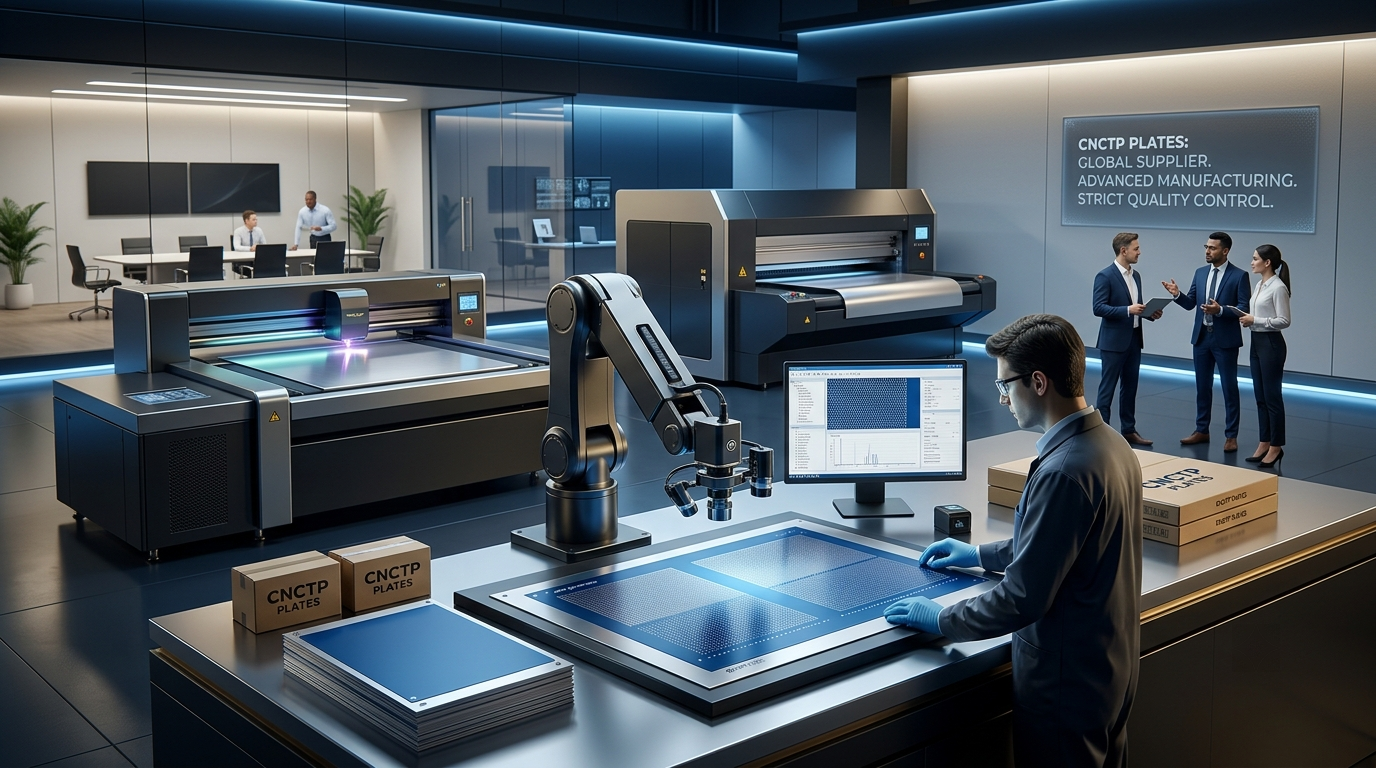
Manufacturing Expertise
- Advanced coating technology
- Stable aluminum substrate processing
- Strict quality control
OEM & Distribution Support
We provide:
- Custom specifications
- Private label solutions
- Distributor cooperation
- Export packaging
Reliable Printing Performance
Our plates are designed for:
- Stable imaging
- Consistent quality
- Excellent press performance
- Cost-effective production
Frequently Asked Questions
What are the main types of offset printing plates?
The main types include PS plates, thermal CTP plates, process-free CTP plates, violet CTP plates, UV CTP plates, and silver halide plates.
Are thermal CTP plates better than PS plates?
For most modern commercial printing applications, thermal CTP plates provide better efficiency, accuracy, and workflow automation.
Which offset printing plate is environmentally friendly?
Process-free CTP plates are considered one of the most environmentally friendly options because they eliminate traditional chemical development.
What is the most popular CTP plate technology?
Thermal CTP plates are currently among the most widely adopted technologies in commercial offset printing.
Can one printing plate work with all offset presses?
No. Plate specifications must match the CTP system, press model, plate size, and workflow requirements.
Conclusion
The evolution of offset printing plates reflects the continuous development of printing technology.
From traditional PS plates to advanced thermal and process-free CTP plates, modern printers now have more choices than ever before.
For companies seeking higher productivity, better quality, and sustainable printing operations, selecting the right offset printing plate technology is essential.
As a professional offset printing plate manufacturer and supplier, CNCTP Plates provides reliable thermal CTP and process-free CTP solutions for commercial printers, distributors, and global printing partners.
Why Does a CTP Plate Scum on Press ? 9 Common Causes and Proven Solutions
Learn why CTP plates scum on press, the most common causes, troubleshooting methods, and practical solutions to improve offset printing quality and reduce downtime.
Which Offset Machine Is Best ? A Practical Guide for Commercial Printing
Which offset machine is best? Learn how to choose the right offset printing machine based on format, volume, cost, and CTP technology.
Where to Buy Thermal CTP Plates for Offset Printing | Best Supplier Guide & Expert Tips
Looking for reliable thermal CTP plates for offset printing? This expert guide explains how to choose a trustworthy supplier, compares global and Chinese manufacturers, and shares key quality criteria.