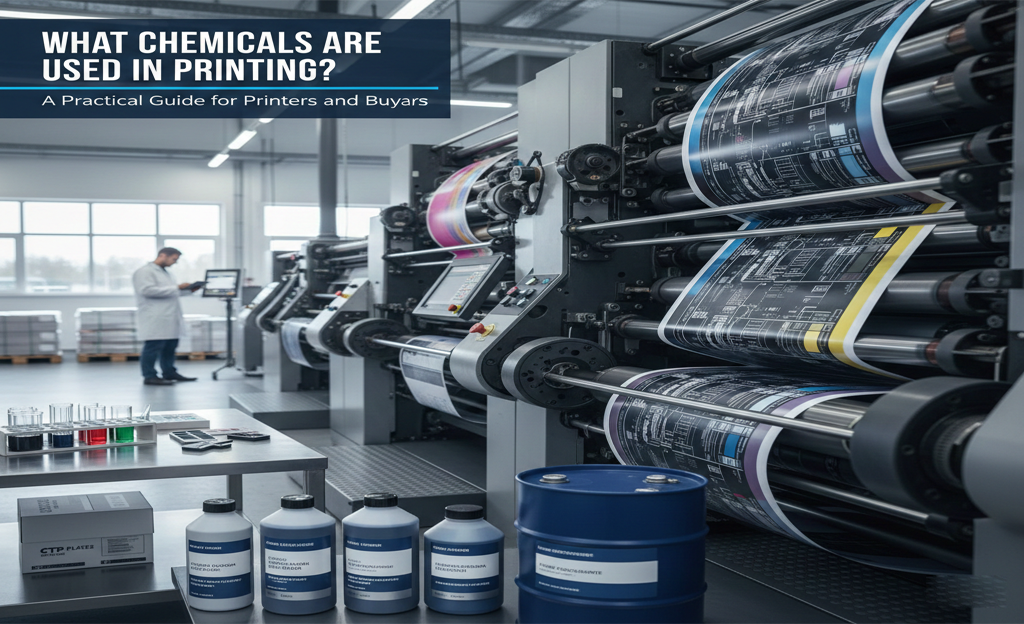
Introduction
From offset printing to digital printing, chemicals play a critical role in image formation, print quality, press stability, and production efficiency. Choosing the right printing chemicals can significantly reduce downtime, waste, and operating costs.
This article provides a clear, practical overview of the main chemicals used in the printing industry, written from a professional industry perspective.
Why Chemicals Are Essential in Printing
Printing is not just ink on paper. Chemicals are used to:
Prepare printing plates
Develop and process images
Control ink and water balance
Clean presses and components
Protect print quality and equipment
Without properly selected chemicals, even advanced printing equipment cannot perform consistently.
Main Categories of Chemicals Used in Printing
Printing chemicals can be divided into several core categories based on their function.
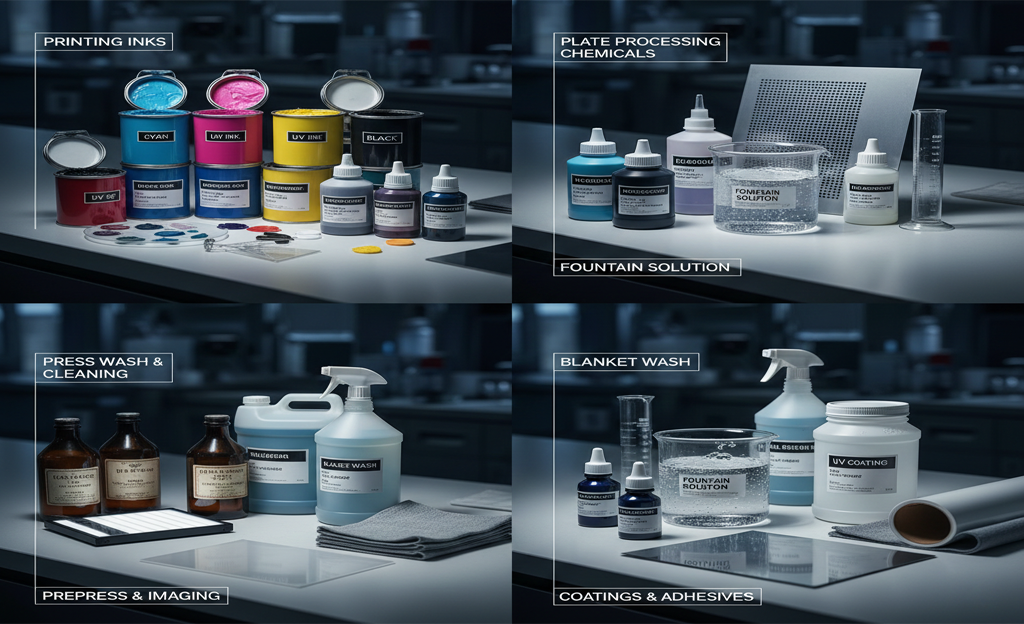
1. Printing Inks
Printing inks are the most visible chemicals in the process.
Common ink types include:
Offset printing inks
UV inks
Water-based inks
Solvent-based inks
Key chemical components of inks:
Pigments (color)
Resins (binding)
Solvents or oils
Additives (drying, flow, adhesion)
2. Plate Processing Chemicals
Plate chemicals are essential for CTP and conventional plate processing.
| Chemical Type | Function |
|---|---|
| Plate developer | Reveals image after exposure |
| Plate finisher / gum | Protects non-image areas |
| Plate cleaner | Removes residues |
| Plate desensitizer | Improves non-image stability |
These chemicals directly affect plate life, dot quality, and press performance.
3. Fountain Solution (Dampening Solution)
Fountain solution controls the balance between ink and water in offset printing.
Typical components include:
Water
Isopropyl alcohol (IPA) or alcohol substitutes
Buffers and stabilizers
Wetting agents
Biocides
Correct fountain solution chemistry prevents:
Ink emulsification
Scumming
Plate contamination
4. Press Wash and Cleaning Chemicals
Press wash chemicals are used to clean:
Ink rollers
Blankets
Plates
Press parts
| Cleaning Chemical | Application |
|---|---|
| Blanket wash | Removes ink from blankets |
| Roller wash | Cleans ink rollers |
| Plate cleaner | Maintains plate surface |
| Degreasers | Heavy ink removal |
High-quality cleaners reduce press downtime and extend equipment life.
5. Adhesives and Coating Chemicals
In packaging and finishing processes, chemicals are used for:
Laminating
Varnishing
Coating
Binding
These include:
Water-based adhesives
UV coatings
Protective varnishes
They enhance durability, appearance, and functionality of printed products.
6. Prepress and Imaging Chemicals
Used mainly in traditional workflows:
Film developers
Fixers
Cleaners
Although digital workflows reduce their use, they are still relevant in some regions.
Summary Table: Chemicals Used in Printing
| Chemical Category | Purpose | Typical Use |
|---|---|---|
| Printing inks | Color transfer | All printing |
| Plate chemicals | Image development | Offset & CTP |
| Fountain solution | Ink-water balance | Offset printing |
| Cleaning chemicals | Maintenance | Press operation |
| Coatings & adhesives | Finishing | Packaging |
| Imaging chemicals | Film processing | Traditional prepress |
Environmental and Safety Considerations
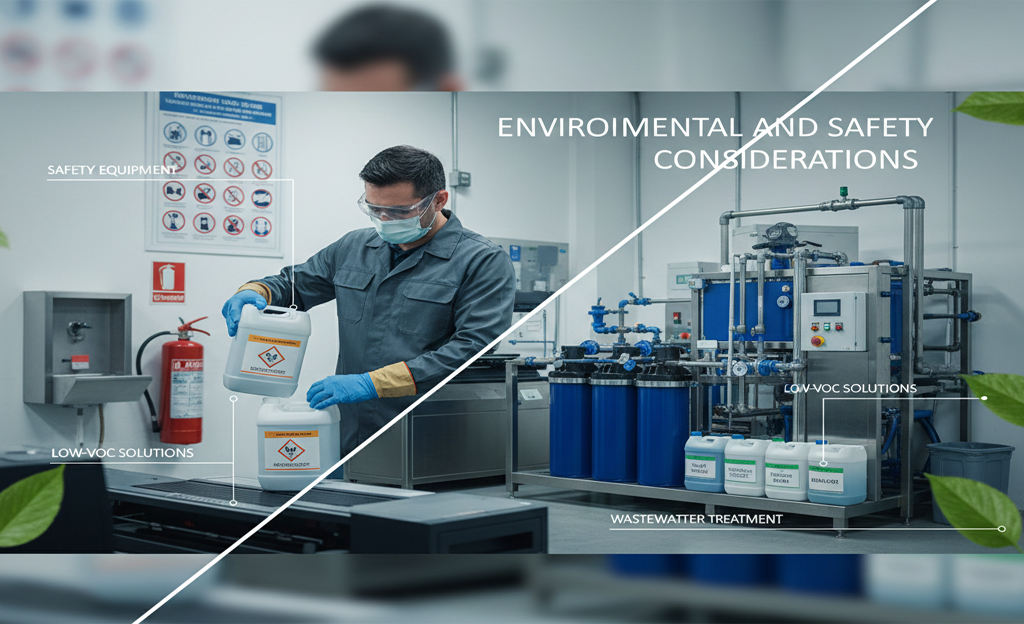
Modern printing buyers pay close attention to:
VOC emissions
Wastewater treatment
Chemical handling safety
Regulatory compliance
Many printers now prefer:
Low-VOC solutions
Alcohol-free fountain solutions
Eco-friendly plate developers
Water-based cleaners
Choosing compliant chemicals reduces environmental risk and improves brand reputation.
How Printing Chemicals Affect Production Cost
The cheapest chemical is not always the most economical.
High-quality chemicals help:
Reduce waste sheets
Extend plate and blanket life
Improve press stability
Lower total maintenance cost
This leads to lower cost per printed job over time.
Printing Chemicals for Bulk and OEM Supply
For distributors and large printing groups:
Bulk supply reduces unit cost
OEM branding strengthens market position
Stable formulas ensure repeatability
Professional manufacturers can customize:
Packaging
Labeling
Formulation (within compliance limits)
Conclusion
So, what chemicals are used in printing?
The answer includes inks, plate chemicals, fountain solutions, cleaning agents, coatings, and adhesives—each playing a vital role in print quality and production efficiency.
Choosing the right printing chemicals is not just a technical decision; it is a business decision that affects cost, quality, and reliability.
👉 We are also a professional Printing Chemicals manufacturer, supplying stable-quality products for offset and commercial printing applications.
If you are looking for reliable printing chemicals, bulk supply, or OEM cooperation, feel free to contact us. We are ready to support your printing business.
Why Does a CTP Plate Scum on Press ? 9 Common Causes and Proven Solutions
Learn why CTP plates scum on press, the most common causes, troubleshooting methods, and practical solutions to improve offset printing quality and reduce downtime.

Which Offset Machine Is Best ? A Practical Guide for Commercial Printing
Which offset machine is best? Learn how to choose the right offset printing machine based on format, volume, cost, and CTP technology.
Where to Buy Thermal CTP Plates for Offset Printing | Best Supplier Guide & Expert Tips
Looking for reliable thermal CTP plates for offset printing? This expert guide explains how to choose a trustworthy supplier, compares global and Chinese manufacturers, and shares key quality criteria.