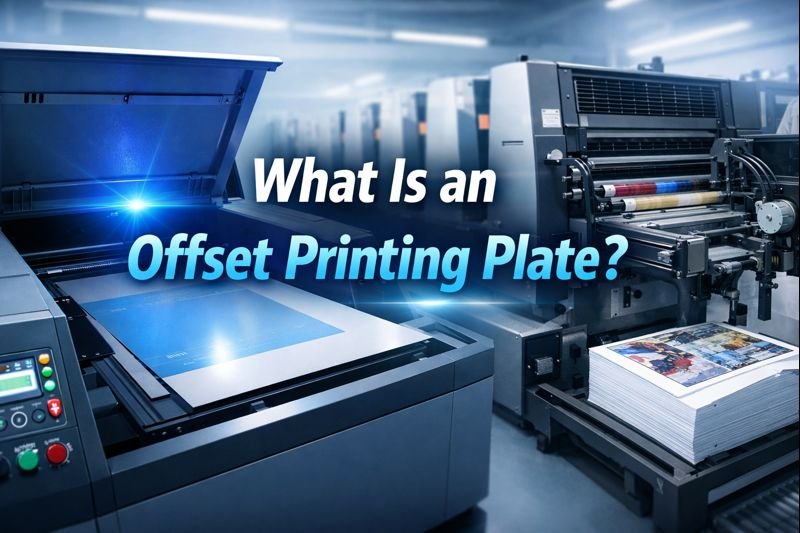
Introduction
Offset printing remains one of the most widely used and reliable printing technologies in the world. At the heart of this process lies a critical component that directly determines print quality, consistency, and efficiency—the offset printing plate.
But what is an offset printing plate, how does it work, and why is it so important in commercial printing?
This article provides a comprehensive, professional yet easy-to-understand explanation, designed for printers, purchasing managers, and printing industry professionals.
1. What Is an Offset Printing Plate?
An offset printing plate is a thin, flat plate—usually made of aluminum—that carries the image to be printed. During offset printing, the image on the plate is transferred (or “offset”) first to a rubber blanket and then onto the final printing substrate such as paper, cardboard, or packaging material.
The plate works based on a simple physical principle:
Oil and water do not mix.
Image areas attract ink (oleophilic)
Non-image areas attract water (hydrophilic)
This chemical contrast allows precise ink transfer and clean reproduction of text and images.
2. How Does an Offset Printing Plate Work?
The offset printing process involves several key steps:
Plate Imaging
The digital image is transferred to the printing plate using a CTP (Computer-to-Plate) system or traditional exposure.Dampening
A water-based solution is applied to the plate, covering non-image areas.Inking
Oil-based ink adheres only to the image areas.Offset Transfer
The inked image is transferred to a rubber blanket.Final Printing
The image is pressed from the blanket onto the paper.
This indirect printing method reduces plate wear and ensures consistent, high-quality output even during long print runs.
3. Main Types of Offset Printing Plates
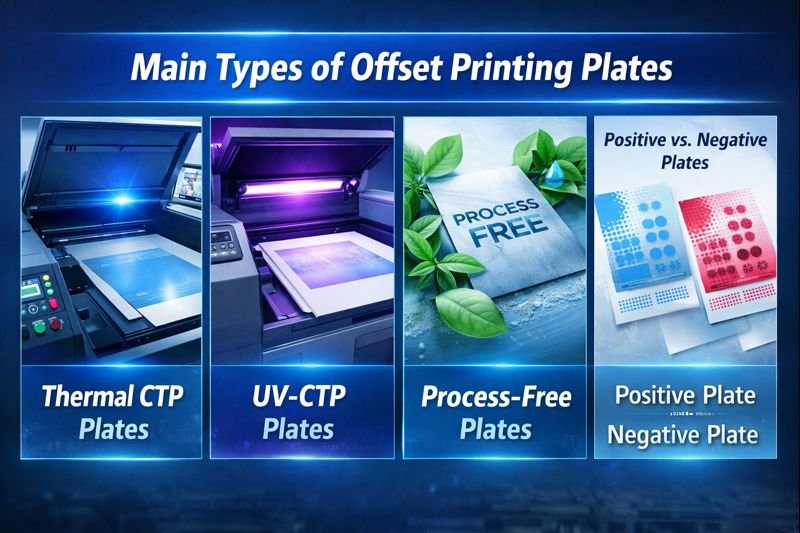
There are several types of offset printing plates, each designed for specific production needs:
3.1 Thermal CTP Plates
Exposed by thermal laser (830 nm)
Excellent stability and dot accuracy
Ideal for high-quality commercial printing
3.2 UV-CTP Plates
Exposed by UV light (405 nm)
Lower equipment cost
Faster imaging speed
3.3 Process-Free (Chemistry-Free) Plates
No chemical developer required
Environmentally friendly
Lower operating costs
Increasingly popular worldwide
3.4 Positive vs. Negative Plates
| Type | Exposure Result | Common Use |
|---|---|---|
| Positive Plate | Exposed area removed | Traditional offset |
| Negative Plate | Exposed area hardened | High-speed production |
4. Materials Used in Offset Printing Plates
Most modern offset printing plates consist of:
Aluminum substrate – Provides strength, dimensional stability, and heat resistance
Photosensitive coating – Reacts to laser or UV exposure
Protective layers – Improve durability and storage life
High-quality aluminum and uniform coating thickness are essential for:
Sharp dot reproduction
Long run length
Stable ink-water balance
5. Advantages of Offset Printing Plates
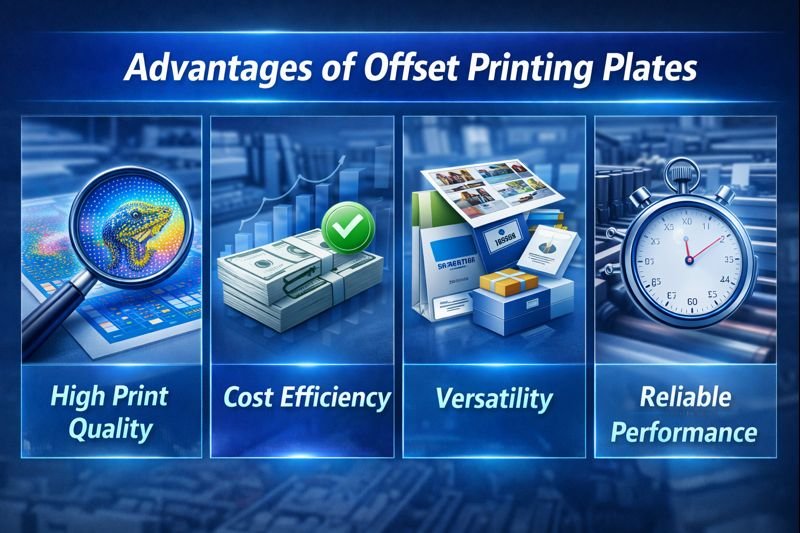
Offset printing plates remain dominant in commercial printing because they offer:
✔ High Print Quality
Sharp text and smooth gradients
Excellent color consistency
✔ Cost Efficiency for Large Runs
Low cost per print after setup
Long plate life
✔ Versatility
Suitable for paper, cardboard, labels, and packaging
Compatible with various inks
✔ Reliable Performance
Stable during long production runs
Resistant to wear and deformation
6. Offset Printing Plates vs. Digital Printing
While digital printing has grown rapidly, offset plates still hold significant advantages:
| Feature | Offset Printing Plate | Digital Printing |
|---|---|---|
| Setup Cost | Higher | Lower |
| Unit Cost (Large Runs) | Very low | Higher |
| Color Consistency | Excellent | Good |
| Print Speed | Very high | Medium |
| Best For | Mass production | Short runs |
For newspapers, magazines, packaging, and commercial catalogs, offset printing plates remain irreplaceable.
7. Key Factors When Choosing an Offset Printing Plate
When selecting the right offset printing plate, professionals should consider:
Plate sensitivity (exposure energy)
Run length requirements
Compatibility with existing CTP systems
Environmental regulations
Processing method (chemical vs. process-free)
Choosing the right plate can significantly reduce waste, downtime, and production costs.
8. Environmental Trends in Offset Printing Plates
Sustainability is becoming a major focus in the printing industry. Modern offset printing plates now emphasize:
Process-free technology
Lower water consumption
Reduced chemical waste
Longer shelf life
These innovations help printers meet environmental regulations while improving operational efficiency.
9. Common Applications of Offset Printing Plates
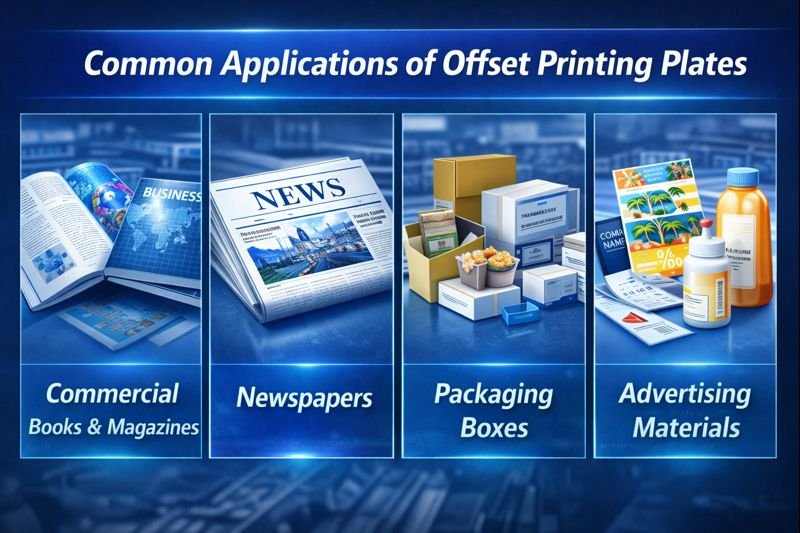
Offset printing plates are widely used in:
Commercial books and magazines
Newspapers
Packaging boxes
Advertising materials
Instruction manuals
Labels and inserts
Their reliability and scalability make them ideal for both medium and large-scale production.
Conclusion: Why Offset Printing Plates Still Matter
So, what is an offset printing plate?
It is the foundation of offset printing—a proven, cost-effective, and high-quality solution that continues to power the global printing industry.
As printing demands grow for quality, consistency, and sustainability, choosing the right offset printing plate supplier becomes more important than ever.
👉 We are a professional offset printing plate manufacturer, offering reliable, high-performance plates for commercial and industrial printing.
If you are looking for stable quality, competitive pricing, and long-term cooperation, feel free to contact us through cnctpplates.com. We are always ready to support your printing success.
Why Does a CTP Plate Scum on Press ? 9 Common Causes and Proven Solutions
Learn why CTP plates scum on press, the most common causes, troubleshooting methods, and practical solutions to improve offset printing quality and reduce downtime.

Which Offset Machine Is Best ? A Practical Guide for Commercial Printing
Which offset machine is best? Learn how to choose the right offset printing machine based on format, volume, cost, and CTP technology.
Where to Buy Thermal CTP Plates for Offset Printing | Best Supplier Guide & Expert Tips
Looking for reliable thermal CTP plates for offset printing? This expert guide explains how to choose a trustworthy supplier, compares global and Chinese manufacturers, and shares key quality criteria.