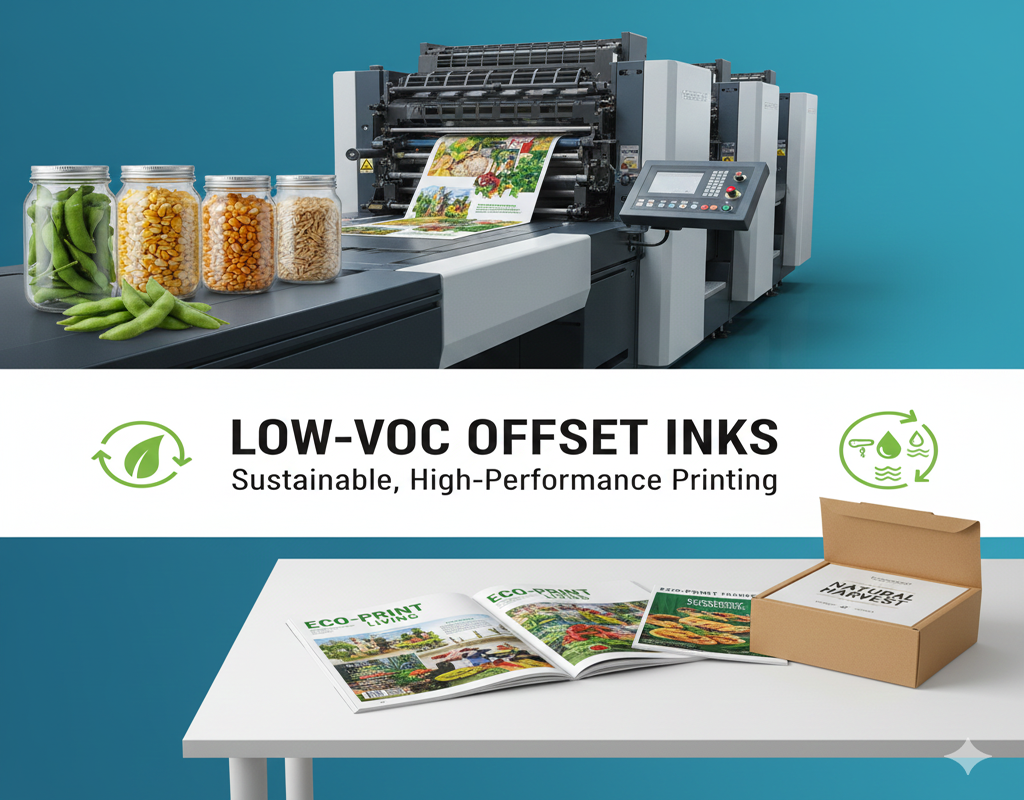
Introduction
As global environmental standards continue to tighten, the printing industry has entered a new era where sustainability, safety, and regulatory compliance are just as important as color accuracy and production efficiency. At the center of this transformation is the rise of Low-VOC Offset Inks—ink systems engineered to reduce volatile organic compound emissions while still delivering the performance modern offset printers demand.
Whether you operate a commercial sheetfed press, packaging workflow, or newspaper line, understanding the technology and benefits behind Low-VOC offset inks is essential. This article breaks down everything printers need to know, using clear explanations backed by industry experience.
1. What Are Low-VOC Offset Inks?
VOC stands for Volatile Organic Compounds, chemicals that evaporate into the air during the ink drying process. Traditional offset inks rely heavily on petroleum-based solvents, resulting in VOC emissions that contribute to:
Air pollution
Odor in the pressroom
Workplace safety concerns
Stringent environmental regulations
Low-VOC offset inks are specifically formulated to drastically reduce these emissions—often by replacing petroleum oils with renewable, low-evaporation materials such as vegetable oils or advanced binders.
Key characteristics of Low-VOC offset inks:
Significantly lower solvent evaporation during printing
Reduced odor and safer pressroom conditions
High color density and excellent dot reproduction
Compliance with environmental regulations worldwide
These formulations align with requirements from organizations such as the EU VOC Directive, EPA, REACH, and regional “green printing” programs.
2. How Low-VOC Offset Inks Work: The Technology Explained
Unlike traditional inks that rely on solvent evaporation, Low-VOC offset inks focus on oxidation and polymerization as their primary drying mechanisms.
Drying Mechanisms in Low-VOC Ink Systems
| Drying Process | How It Works | VOC Emission Level |
|---|---|---|
| Oxidative Drying | Ink reacts with oxygen and forms a solid film | Very Low |
| Absorption / Penetration | Ink penetrates into the paper fibers | Low |
| UV/LED Curing | Light exposure triggers instant ink polymerization | Near Zero |
By minimizing evaporation, Low-VOC inks reduce harmful emissions without affecting print consistency.
3. Types of Low-VOC Offset Inks
Several categories of inks fall under the Low-VOC umbrella:
| Ink Type | Description | Benefits / Best For / Advantages |
|---|---|---|
| Vegetable-Based Offset Inks | Use oils derived from soy, linseed, palm, or rapeseed. | • Made from renewable resources • Excellent gloss and ink–water balance • Lower VOC percentages compared to petroleum-based inks |
| Soy-Based Offset Inks | A subset of vegetable-based inks formulated primarily with soy oil. | Best For: • Books • Magazines • Commercial print shops focused on recyclability |
| Low-VOC Sheetfed Offset Inks | Engineered for high-speed sheetfed commercial printing. | • Low odor • Fast setting and drying • Works well on coated and uncoated paper |
| Low-VOC UV & LED-UV Offset Inks | Cure instantly under UV or LED-UV light with no evaporation needed. | Ideal For: • Food packaging (with low-migration formulas) • Plastic and synthetic substrates • High-speed, powder-free production |
4. Why Printers Are Switching to Low-VOC Inks
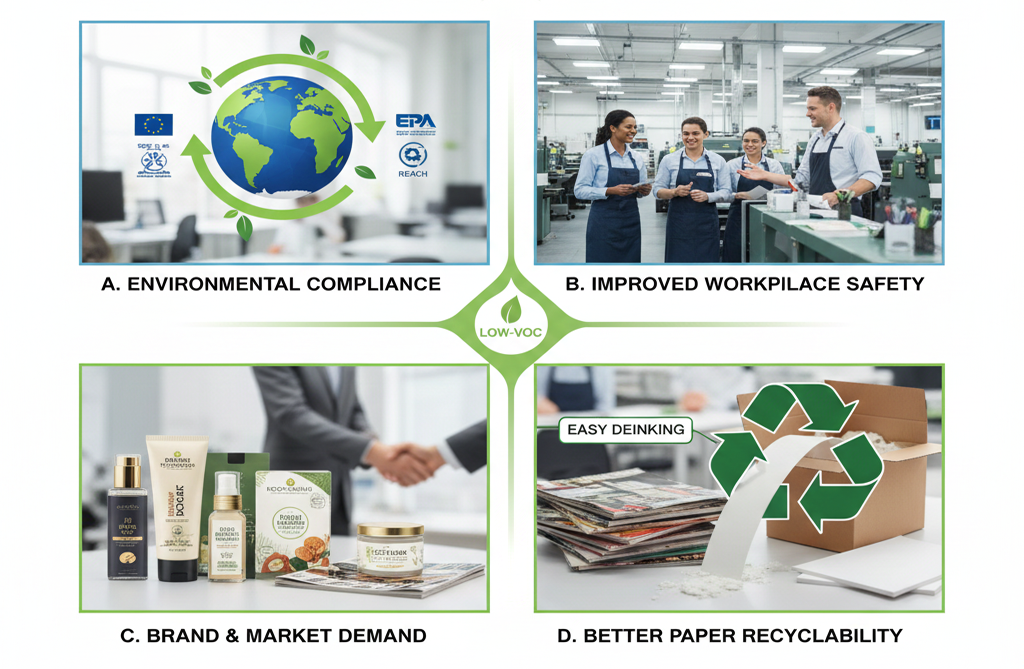
A. Environmental Compliance
Governments across Europe, North America, and Asia are enforcing VOC reduction policies. Choosing Low-VOC inks ensures long-term compliance without major equipment changes.
B. Improved Workplace Safety
Low-VOC inks produce:
Fewer odors
Reduced skin and inhalation risks
Cleaner air inside the pressroom
Operators feel more comfortable and work in a safer environment.
C. Brand & Market Demand
More companies—especially in packaging, cosmetics, food, and lifestyle products—require sustainable printing. Low-VOC inks help printers win:
Corporate sustainability contracts
Eco-friendly packaging projects
Long-term high-value customers
D. Better Paper Recyclability
Low-VOC inks allow easier deinking, improving the recyclability of printed materials, which is vital for:
Books
Catalogs
Newspapers
Folding cartons
E. Cost Savings in the Long Run
Although Low-VOC inks may cost slightly more upfront, savings appear in:
Reduced waste
Faster setting
Fewer complaints related to odor or compliance
Potential government incentives
5. Performance Advantages of Low-VOC Offset Inks
Contrary to early misconceptions, modern Low-VOC inks deliver equal or superior print results compared to traditional inks.
A. Higher Color Density
Vegetable oils produce rich, clean color and stable density.
B. Improved Dot Reproduction
Low-VOC inks achieve:
Sharper dots
Reduced dot gain
Clean shadows and highlights
C. Superior Gloss & Rub Resistance
Advanced binders increase gloss and durability—important for premium brochures, magazines, and packaging.
D. Faster Setting on Modern Presses
Especially with LED-UV systems, drying is nearly instantaneous.
6. Challenges of Low-VOC Inks (and Solutions)
1. Slightly Slower Oxidative Drying
Solution: Optimize fountain solution, humidity, and anti-setoff powder.
2. Ink-Water Balance Adjustments
Solution: Follow supplier recommendations for pH and conductivity.
3. Compatibility with UV Blankets and Rollers
Solution: Use UV-resistant consumables for LED-UV or hybrid inks.
7. Best Applications for Low-VOC Offset Inks
Low-VOC inks excel in areas requiring high print quality and sustainability.
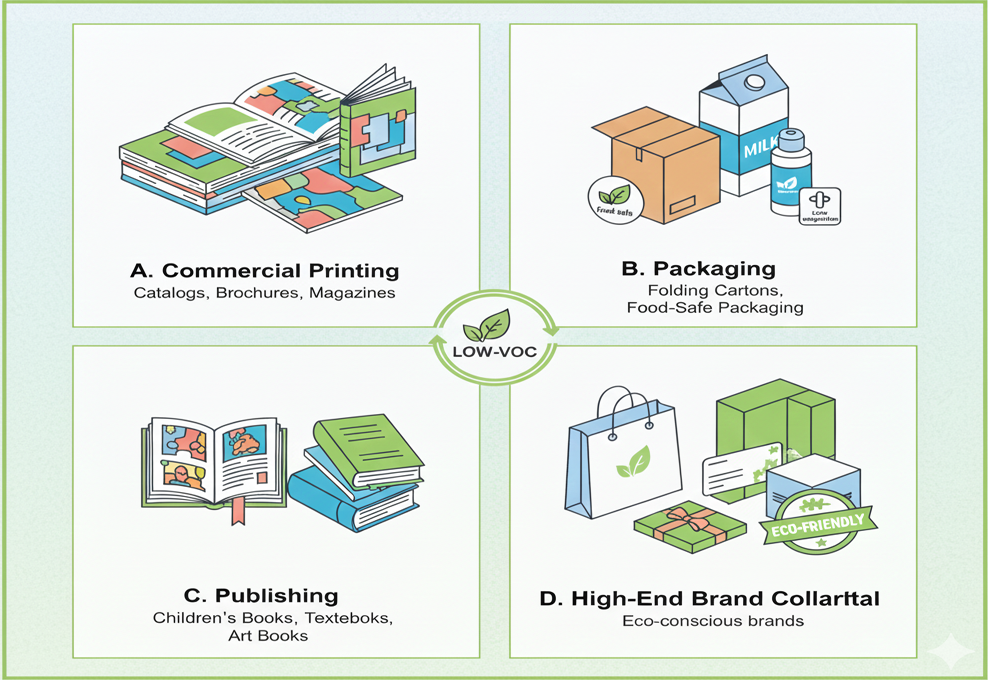
Commercial Printing
Catalogs
Brochures
Magazines
Advertising materials
Packaging
Folding cartons
Food-safe packaging (low-migration Plates available)
Sustainable retail packaging
Publishing
Children’s books
Educational materials
Textbooks
Art books
High-End Brand Collateral
Eco-conscious brands increasingly demand Low-VOC printing.
8. How Printers Can Transition Smoothly to Low-VOC Inks
Step 1: Evaluate Press Conditions
Check roller settings, fountain solution, and blanket compatibility.
Step 2: Test on Standard Jobs First
Start with commercial print or coated-paper applications.
Step 3: Train Operators
Teach ink-water balance optimization.
Step 4: Consider LED-UV or Hybrid Press Upgrades
Maximizes VOC reduction and production efficiency.
9. Our Low-VOC Offset Ink Solutions
We provide a full portfolio of Low-VOC Offset Inks, including:
Low-VOC sheetfed inks
Vegetable-based and soy-based inks
UV and LED-UV low-VOC ink systems
Low-odor and low-migration options for packaging
High-density color inks for premium applications
Our inks are engineered for:
excellent color consistency
low environmental impact
smooth ink-water balance
high-speed production compatibility
For technical recommendations or quotations, feel free to contact us anytime.
Why Does a CTP Plate Scum on Press ? 9 Common Causes and Proven Solutions
Learn why CTP plates scum on press, the most common causes, troubleshooting methods, and practical solutions to improve offset printing quality and reduce downtime.

Which Offset Machine Is Best ? A Practical Guide for Commercial Printing
Which offset machine is best? Learn how to choose the right offset printing machine based on format, volume, cost, and CTP technology.
Where to Buy Thermal CTP Plates for Offset Printing | Best Supplier Guide & Expert Tips
Looking for reliable thermal CTP plates for offset printing? This expert guide explains how to choose a trustworthy supplier, compares global and Chinese manufacturers, and shares key quality criteria.