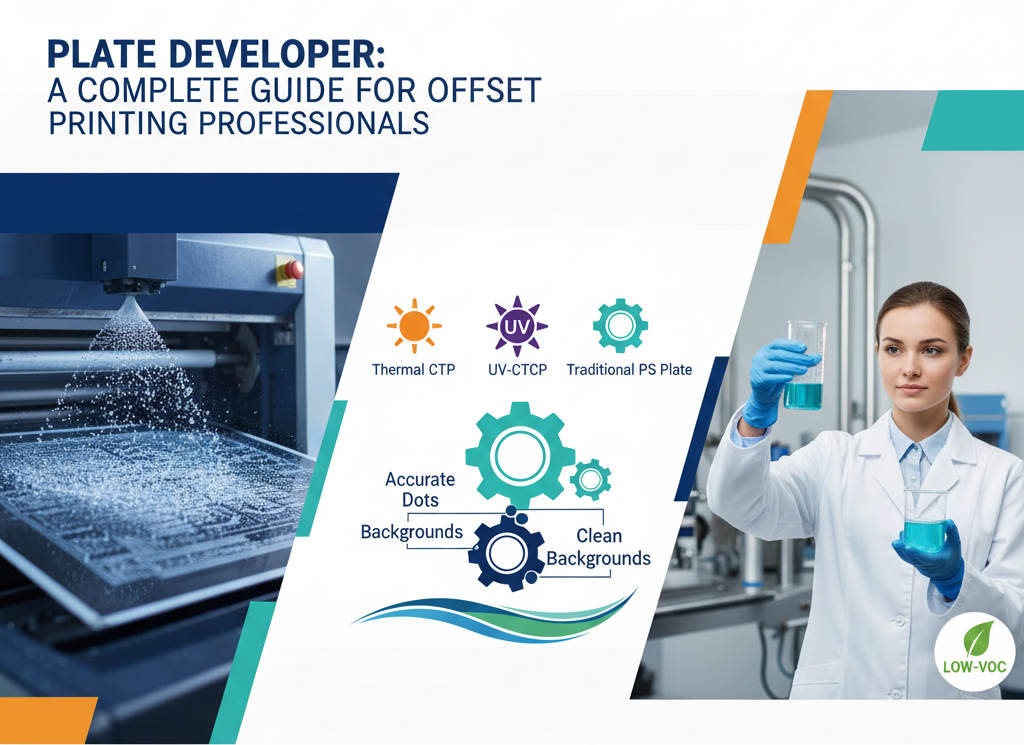
In modern offset printing, consistent imaging quality depends not only on plates and CTP equipment but also on one essential chemical: the plate developer. Whether you use thermal CTP plates, UV-CTP plates, or traditional PS plates, choosing the right developer directly affects dot sharpness, printing durability, waste rate, and production stability.
In this comprehensive guide, we explain what a plate developer is, how it works, the types available, and how to choose the best one for your printing workflow. Written from a professional industry perspective, this article is both practical and easy to understand.
1. What Is Plate Developer?
A plate developer is a specialized chemical solution used to process offset printing plates after exposure.
Its primary function is to remove unexposed (or exposed, depending on plate type) coating so the image area and non-image area can be correctly formed.
1.1 Why Developers Matter
A reliable developer ensures:
Accurate dot reproduction
Clean non-image areas
Long plate run length
Stable ink–water balance
Reduced waste plates and color fluctuations
Simply put: a good plate is only as good as the developer used to process it.
2. How Plate Developers Work
Different plate technologies require different chemical reactions, but the core principle remains the same:
the developer dissolves the coating selectively according to the exposure pattern.
2.1 Thermal CTP Developer
For thermal plates:
Exposed coating hardens.
Developer washes away unexposed coating.
Produces strong, durable dots.
2.2 UV/CTCP Developer
For UV-sensitive plates:
Exposed coating becomes soluble.
Developer removes exposed areas.
Provides high contrast and wide exposure latitude.
2.3 PS Plate Developer
Traditional plate chemistry:
Often alkaline.
Removes unexposed coating.
Requires stable temperature control.
3. Types of Plate Developers (With Advantages & Use Cases)
Below is an organized table for easy reference:
Table: Common Types of Plate Developers
| Developer Type | Used For | Key Advantages |
|---|---|---|
| Thermal Developer | Thermal CTP plates | Excellent dot stability, long run length, minimal chemical odor |
| UV/CTCP Developer | UV-CTP and CTCP plates | High sensitivity, fast processing, great for packaging printers |
| PS Plate Developer | Traditional PS plates | Economical, wide compatibility |
| Low-VOC / Eco-Friendly Developer | Most modern plates | Eco-safe, low odor, reduced waste production |
| Integrated Developer (Processless) | Processless thermal plates | No processor needed, zero chemical waste |
4. Key Properties of a High-Quality Plate Developer
When evaluating developers, printing professionals should prioritize the following characteristics:
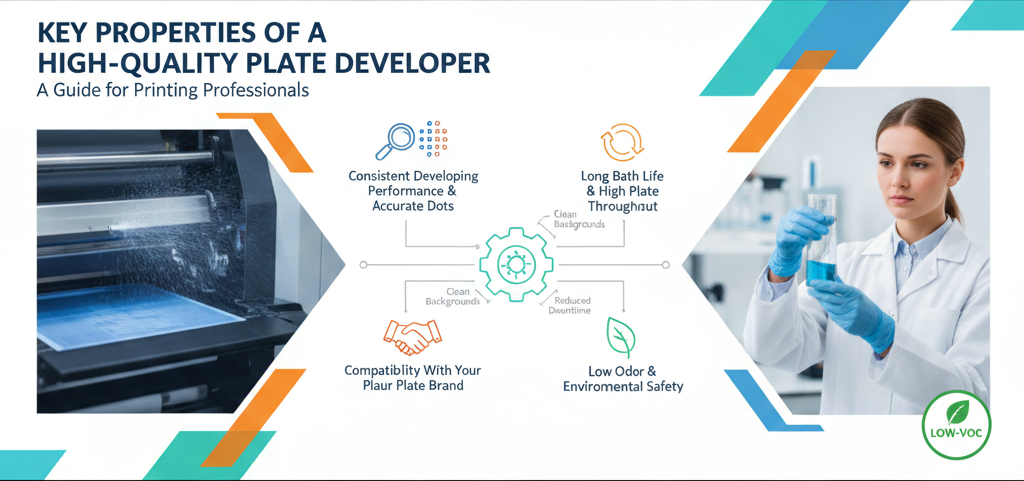
4.1 Consistent Developing Performance
The developer must maintain stable alkalinity or chemical activity throughout its lifecycle.
Signs of a good developer:
Clean, bright non-image areas
Uniform dot edge definition
Minimal sludge or residue
4.2 Long Bath Life
High-performance developers support:
High plate throughput
Low replenishment consumption
Reduced downtime
4.3 Compatibility With Your Plate Brand
Different plate manufacturers specify different chemical parameters such as:
pH
Temperature
Replenishment rate
Exposure level
Using the wrong developer may cause dot loss, scumming, or shortened plate life.
4.4 Low Odor and Environmental Safety
Modern printing focuses on health and sustainability.
Low-VOC formulas are preferred for:
Cleaner work environment
Lower emissions
Easier wastewater treatment
4.5 Ease of Maintenance
A developer must keep the processor clean:
Low foaming
Minimal crystallization
Easy filtration
This reduces downtime and improves printing efficiency.
5. How to Choose the Right Plate Developer (Step-by-Step Guide)
Choosing an appropriate developer is not simply about price—it’s about compatibility, performance, and long-term cost savings.
Step 1 — Identify Your Plate Type
Thermal CTP plates: require thermal developer
UV/CTCP plates: require UV-sensitive developer
PS plates: use alkaline developers
Processless plates: no developer needed
Step 2 — Follow Manufacturer Specifications
Never guess the chemical requirements.
Always check:
Recommended developer model
Temperature range (usually 20–26℃)
Replenishment amount
Processor settings
Step 3 — Consider Your Printing Volume
High-volume commercial printers benefit from:
Long bath life developers
Low replenishment rates
High contamination tolerance
Low-volume shops may prioritize:
Lower initial cost
Developer stability over time
Step 4 — Evaluate Environmental Requirements
Many countries require:
Low-VOC chemicals
Easier wastewater handling
Safer operator exposure
Eco-friendly developers reduce regulatory risk.
Step 5 — Test With Real Print Jobs
A good plate developer should provide:
Stable ink–water balance
Clean background during long runs
Excellent compatibility with fountain solutions
Always perform a real press test before switching brands.
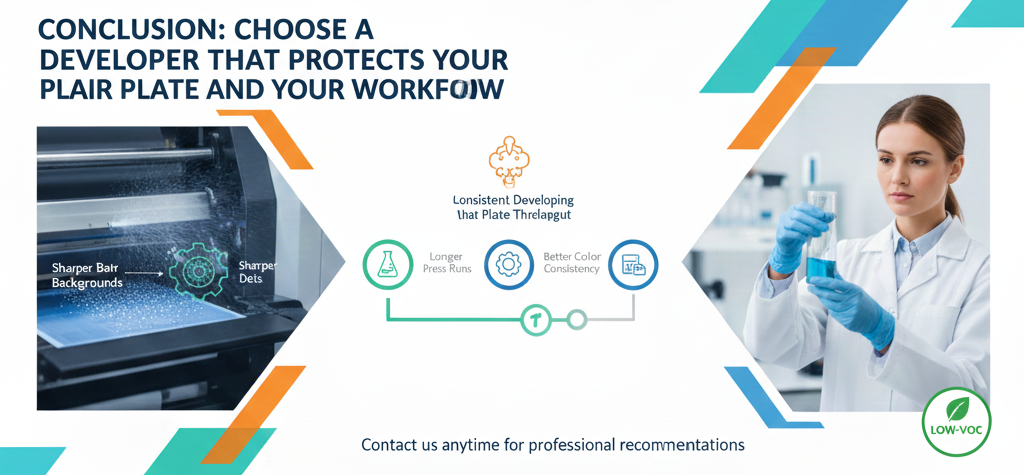
6. Conclusion: Choose a Developer That Protects Your Plate and Your Workflow
A plate developer is far more than a chemical—it is a crucial component of the prepress ecosystem.
Choosing the right developer ensures:
Sharper dots
Cleaner backgrounds
Longer press runs
Better color consistency
Lower overall production cost
If your print shop is evaluating thermal, UV-CTCP, or PS plate developers, or needs guidance selecting a low-VOC solution, our team can help you choose the most suitable option for your workflow.
Contact us anytime for professional recommendations.
Why Does a CTP Plate Scum on Press ? 9 Common Causes and Proven Solutions
Learn why CTP plates scum on press, the most common causes, troubleshooting methods, and practical solutions to improve offset printing quality and reduce downtime.

Which Offset Machine Is Best ? A Practical Guide for Commercial Printing
Which offset machine is best? Learn how to choose the right offset printing machine based on format, volume, cost, and CTP technology.
Where to Buy Thermal CTP Plates for Offset Printing | Best Supplier Guide & Expert Tips
Looking for reliable thermal CTP plates for offset printing? This expert guide explains how to choose a trustworthy supplier, compares global and Chinese manufacturers, and shares key quality criteria.