Introduction
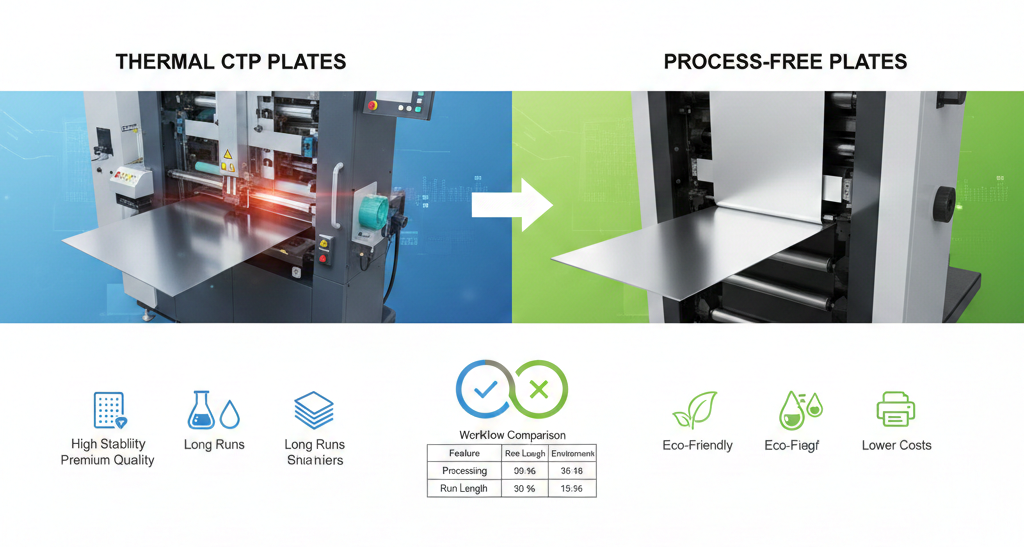
As offset printing continues to evolve toward higher efficiency and sustainability, plate technology plays a decisive role in production performance. Among today’s most widely used options, Thermal CTP Plates and Process-Free Plates stand out as the two dominant choices for modern prepress workflows.
While both are imaging plates designed for thermal CTP systems, they differ significantly in processing requirements, operating cost, environmental impact, and press behavior. Choosing the right plate is not simply a technical decision—it directly affects productivity, stability, and long-term profitability.
In this article, we compare Thermal CTP Plates vs Process-Free Plates from a professional printer’s perspective, helping you determine which solution best fits your production needs.
1. What Is a Thermal CTP Plate?
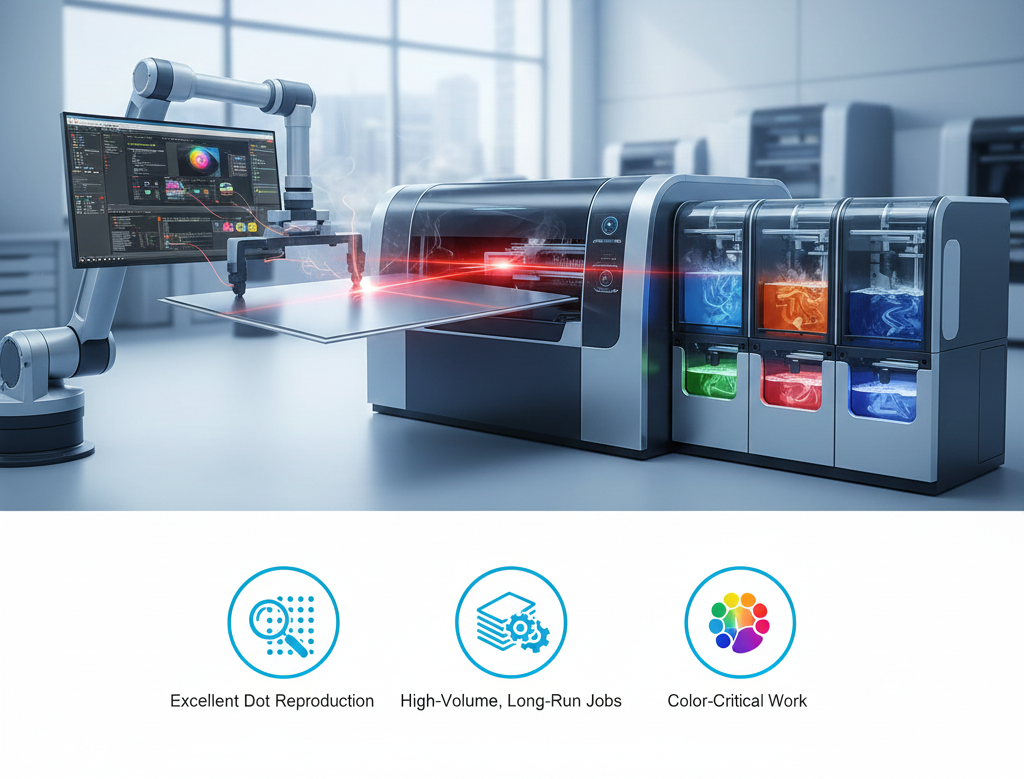
A Thermal CTP Plate is imaged using an infrared laser, typically at 830 nm, and requires chemical processing after exposure.
Key Characteristics
Requires developer and processor
High imaging stability
Wide exposure latitude
Excellent dot reproduction
Typical Applications
Commercial printing
Packaging printing
High-volume, long-run jobs
Color-critical work
Thermal CTP plates have been the industry standard for years due to their reliability and predictable performance.
2. What Is a Process-Free Plate?
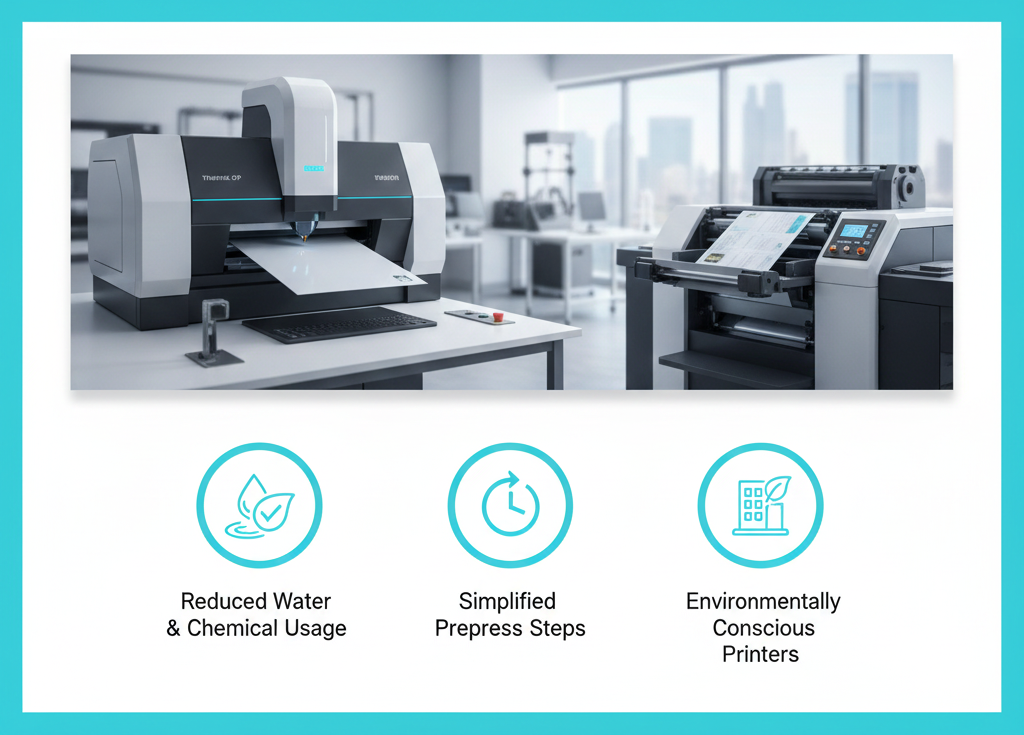
A Process-Free Plate is also imaged by a thermal CTP system but does not require chemical development. Instead, the non-image areas are removed directly on press during makeready.
Key Characteristics
No developer or processor
Reduced prepress steps
Lower water and chemical usage
Cleaner and more sustainable workflow
Typical Applications
Commercial print shops
Short-run and quick-turn jobs
Environmentally conscious printers
Facilities with limited space
Process-free plates are designed to simplify operations and reduce environmental impact.
3. Workflow Comparison: Thermal vs Process-Free
Traditional Thermal CTP Workflow
Plate imaging
Chemical development
Rinsing and gumming
Drying
Mounting on press
Process-Free Workflow
Plate imaging
Plate directly mounted on press
Image areas cleaned during makeready
Key Difference:
Process-free plates eliminate entire processing stages, reducing labor, equipment, and maintenance requirements.
4. Performance Comparison at a Glance
| Feature | Thermal CTP Plate | Process-Free Plate |
|---|---|---|
| Imaging Method | Thermal (830 nm) | Thermal (830 nm) |
| Chemical Processing | Required | Not required |
| Plate Processor | Needed | Not needed |
| Dot Reproduction | Excellent | Very good |
| Run Length | Long | Medium to long |
| Makeready Time | Standard | Slightly longer |
| Environmental Impact | Moderate | Low |
| Operating Cost | Stable | Lower long-term |
5. Print Quality and Stability
Thermal CTP Plates
Thermal plates are known for:
Sharp dot definition
Excellent highlight and shadow detail
Stable ink-water balance
High resistance to press chemicals
They are ideal for high-end printing, especially where color consistency is critical.
Process-Free Plates
Process-free plates deliver:
Consistent quality for commercial jobs
Good tonal reproduction
Slightly longer on-press clean-up during startup
For most commercial printing, the quality difference is minimal and acceptable.
6. Run Length and Durability
Thermal CTP Plates
Typically support longer runs
Better resistance to abrasion
Suitable for repetitive, high-volume production
Process-Free Plates
Improved durability compared to early generations
Ideal for short to medium runs
Long runs possible with optimized press conditions
If long run length is your top priority, traditional thermal plates still have an edge.
7. Cost Analysis: Initial vs Long-Term
Thermal CTP Plates – Cost Factors
Plate cost
Developer chemicals
Water consumption
Processor maintenance
Energy usage
Process-Free Plates – Cost Factors
Plate cost
Slightly longer makeready
Reduced consumables
While process-free plates may have a higher unit price, they often deliver lower total cost of ownership by eliminating chemicals, water, and equipment maintenance.
8. Environmental and Sustainability Considerations
Sustainability has become a key decision factor.
Thermal CTP Plates
Use chemical developers
Generate wastewater
Require proper disposal
Process-Free Plates
No chemical waste
Lower water and energy usage
Reduced carbon footprint
For printers aiming to meet environmental regulations or ESG goals, process-free plates offer a clear advantage.
9. Compatibility and Technical Requirements
Both plate types require:
Thermal CTP engine (830 nm)
Accurate exposure calibration
However:
Thermal plates require a compatible processor and chemistry
Process-free plates need optimized press settings for smooth start-up
A professional plate supplier should provide technical support for both options.
10. Why We Manufacture Both Thermal and Process-Free Plates
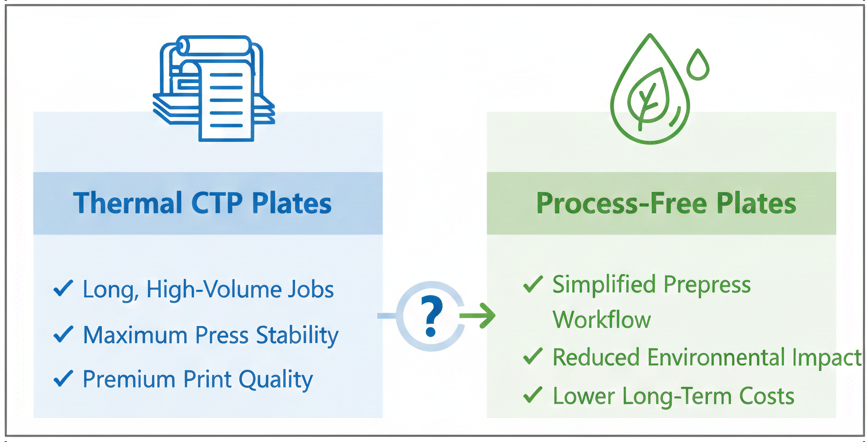
As a professional manufacturer of Thermal CTP Plates and Process-Free Plates, we understand that every printing operation is different.
We offer:
Single-layer and double-layer thermal CTP plates
High-performance process-free thermal plates
Stable batch-to-batch quality
Custom sizes and thicknesses
Technical support from prepress to press
Our plates are engineered to deliver:
Reliable imaging
Clean on-press performance
Consistent ink-water balance
Competitive total cost of ownership
If you are evaluating Thermal CTP Plates or Process-Free Plates and want professional guidance, we are ready to support you.
Feel free to contact us for samples, technical consultation, or pricing information.
Why Does a CTP Plate Scum on Press ? 9 Common Causes and Proven Solutions
Learn why CTP plates scum on press, the most common causes, troubleshooting methods, and practical solutions to improve offset printing quality and reduce downtime.

Which Offset Machine Is Best ? A Practical Guide for Commercial Printing
Which offset machine is best? Learn how to choose the right offset printing machine based on format, volume, cost, and CTP technology.
Where to Buy Thermal CTP Plates for Offset Printing | Best Supplier Guide & Expert Tips
Looking for reliable thermal CTP plates for offset printing? This expert guide explains how to choose a trustworthy supplier, compares global and Chinese manufacturers, and shares key quality criteria.