Introduction
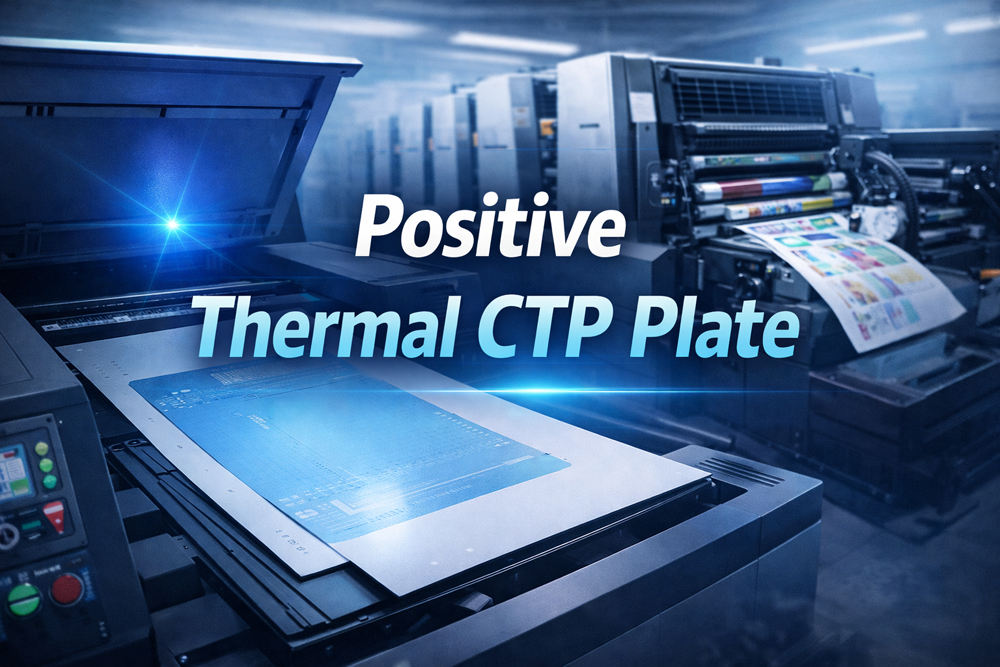
In today’s highly competitive commercial printing industry, efficiency, consistency, and image quality are more critical than ever. As printing technologies evolve, Positive Thermal CTP Plates have become one of the most widely adopted solutions for offset printing worldwide.
Thanks to their excellent dot reproduction, stable performance, and compatibility with mainstream thermal CTP systems, positive thermal CTP plates are now a standard choice for newspapers, commercial printing, packaging, and book printing.
This article provides a comprehensive and practical guide to Positive Thermal CTP Plates—covering their working principle, structure, advantages, applications, and key considerations when choosing the right plate for your printing operation.
What Is a Positive Thermal CTP Plate?
A Positive Thermal CTP Plate is an aluminum-based offset printing plate designed for computer-to-plate (CTP) systems that use thermal laser exposure, typically at 830 nm.
In a positive-working process:
The exposed areas of the plate become soluble in the developer
The unexposed areas remain ink-receptive and form the printing image
After development, the image areas attract ink, while the non-image areas attract water, following the fundamental principle of offset lithography.
How Does a Positive Thermal CTP Plate Work?
The plate-making process involves several key steps:
1. Thermal Laser Imaging
The CTP machine uses a thermal laser to expose the plate directly from digital files, eliminating film and manual processes.
2. Chemical Reaction
The thermal energy changes the solubility of the coating in exposed areas.
3. Development
During processing, exposed areas are removed by the developer, revealing the hydrophilic aluminum base.
4. Printing on Press
The plate is mounted on the offset press, delivering stable ink-water balance and high-quality print output.
Structure of a Positive Thermal CTP Plate
A standard positive thermal CTP plate consists of multiple precision-engineered layers:
Electrochemically grained and anodized aluminum base
Ensures excellent water retention and mechanical strengthThermal-sensitive positive coating
Reacts precisely to laser exposureProtective overcoat (optional)
Enhances scratch resistance and plate handling safety
This layered structure guarantees consistent imaging performance and long press life.
Key Technical Specifications
Typical specifications of positive thermal CTP plates include:
Laser wavelength: 830 nm
Resolution: 1–99% @ 200 lpi (FM screening compatible)
Run length:
100,000 impressions (unbaked)
Up to 1,000,000 impressions (baked)
Plate thickness: 0.15 mm – 0.40 mm
Developer: Standard positive plate developer
Advantages of Positive Thermal CTP Plates
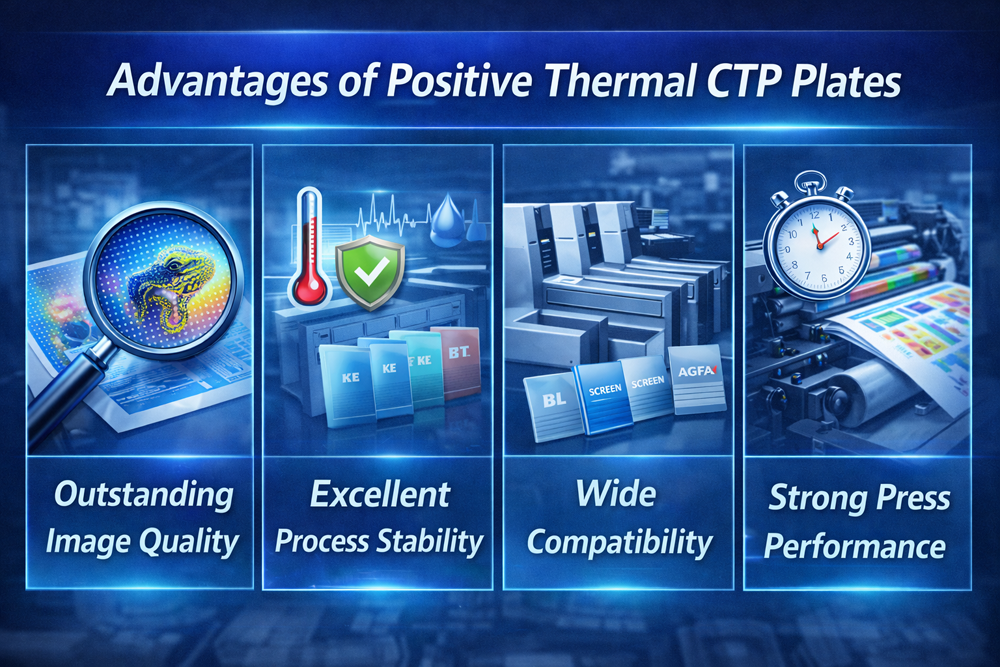
1. Outstanding Image Quality
Thermal imaging ensures precise dot formation, smooth gradients, and sharp text—ideal for high-end commercial printing.
2. Excellent Process Stability
Insensitive to ambient light and temperature fluctuations, thermal plates deliver highly repeatable results.
3. Wide Compatibility
Compatible with most mainstream thermal CTP machines, including Kodak, Screen, Agfa, and other brands.
4. Strong Press Performance
Stable ink-water balance reduces start-up waste and ensures consistent printing throughout long runs.
5. Baking Capability
After baking, plates achieve significantly extended run lengths, suitable for large-volume production.
Positive Thermal vs. Violet CTP Plates
| Feature | Positive Thermal CTP Plate | Violet CTP Plate |
|---|---|---|
| Exposure Method | Thermal laser | Violet laser |
| Stability | Very high | Moderate |
| Image Quality | Excellent | Good |
| Environmental Sensitivity | Low | Higher |
| Initial Cost | Higher | Lower |
| Long Run Printing | Excellent | Limited |
For printers focused on quality, reliability, and long-term efficiency, positive thermal CTP plates remain the preferred option.
Common Applications of Positive Thermal CTP Plates
Positive thermal CTP plates are widely used across multiple printing segments:
Commercial printing (brochures, catalogs, flyers)
Book and textbook printing
Newspaper printing
Packaging printing (paper boxes, labels)
High-end graphic printing
Their flexibility and consistent performance make them suitable for both short-run and long-run jobs.
Storage and Handling Recommendations
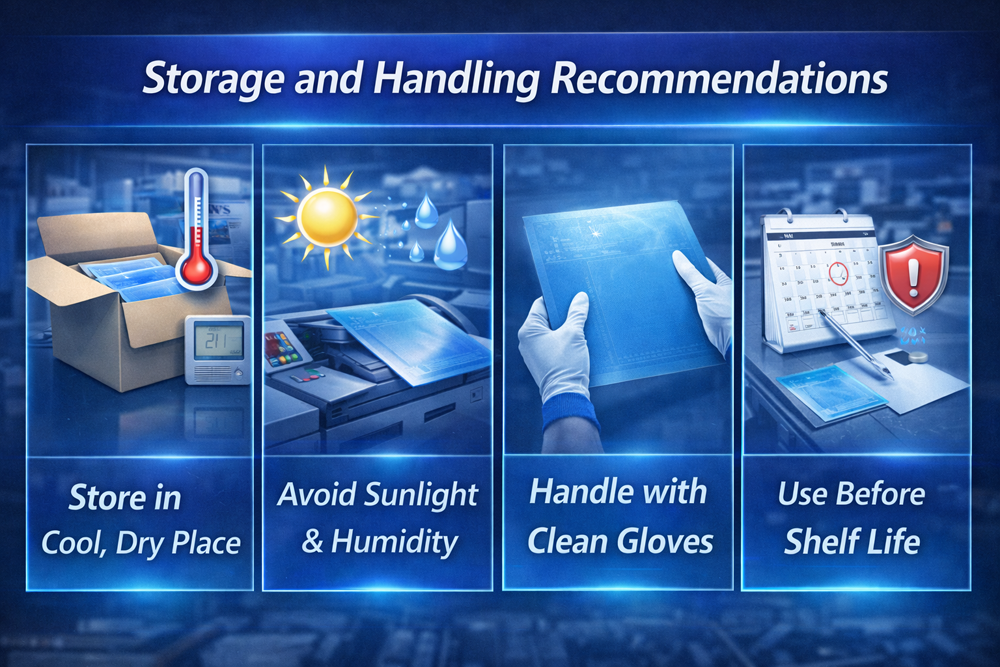
To maintain optimal plate performance:
Store plates in a cool, dry environment
Avoid direct sunlight and excessive humidity
Handle with clean gloves to prevent fingerprints
Use plates before the recommended shelf life
Proper storage helps preserve coating sensitivity and imaging accuracy.
How to Choose the Right Positive Thermal CTP Plate
When selecting a plate, consider the following factors:
Your CTP machine compatibility
Required run length and baking needs
Printing application (commercial vs. packaging)
Developer compatibility
Consistency of supply and technical support
Choosing the right plate directly impacts productivity, cost control, and print quality.
Future Trends in Thermal CTP Plate Technology
As sustainability and automation become more important, modern positive thermal CTP plates are evolving toward:
Lower chemical consumption
Faster processing speeds
Improved coating uniformity
Better compatibility with eco-friendly workflows
These advancements continue to strengthen the role of thermal CTP plates in modern offset printing.
Conclusion: A Reliable Choice for Professional Printers
The Positive Thermal CTP Plate remains one of the most reliable and widely used solutions in the offset printing industry. With its excellent imaging precision, stable press performance, and strong adaptability, it is an ideal choice for printers seeking high-quality and efficient production.
👉 We are also a professional manufacturer of Positive Thermal CTP Plates, offering stable quality, consistent performance, and reliable supply.
If you are looking for a trusted partner for your offset printing plates, feel free to contact us for more information or technical support.
Why Does a CTP Plate Scum on Press ? 9 Common Causes and Proven Solutions
Learn why CTP plates scum on press, the most common causes, troubleshooting methods, and practical solutions to improve offset printing quality and reduce downtime.

Which Offset Machine Is Best ? A Practical Guide for Commercial Printing
Which offset machine is best? Learn how to choose the right offset printing machine based on format, volume, cost, and CTP technology.
Where to Buy Thermal CTP Plates for Offset Printing | Best Supplier Guide & Expert Tips
Looking for reliable thermal CTP plates for offset printing? This expert guide explains how to choose a trustworthy supplier, compares global and Chinese manufacturers, and shares key quality criteria.