What Is the Difference Between Thermal CTP and Violet CTP?
Computer-to-Plate (CTP) technology has become the standard in modern offset printing, replacing traditional film-based plate making. Among the various CTP technologies available, thermal CTP and violet CTP are the two most widely used systems in commercial and packaging printing.
Although both serve the same core purpose—directly imaging digital files onto printing plates—their working principles, plate characteristics, cost structures, and application scenarios are significantly different.
In this article, we will explain in detail the difference between thermal CTP and violet CTP, helping printers and print managers choose the right solution for their production needs.
1. What Is CTP Technology?
CTP (Computer to Plate) is a digital plate-making process that images printing plates directly from digital files, eliminating film output and manual plate exposure.
Key advantages of CTP include:
Within CTP systems, thermal CTP and violet CTP differ mainly in the laser wavelength and plate chemistry used.
2. What Is Thermal CTP?
2.1 Working Principle of Thermal CTP
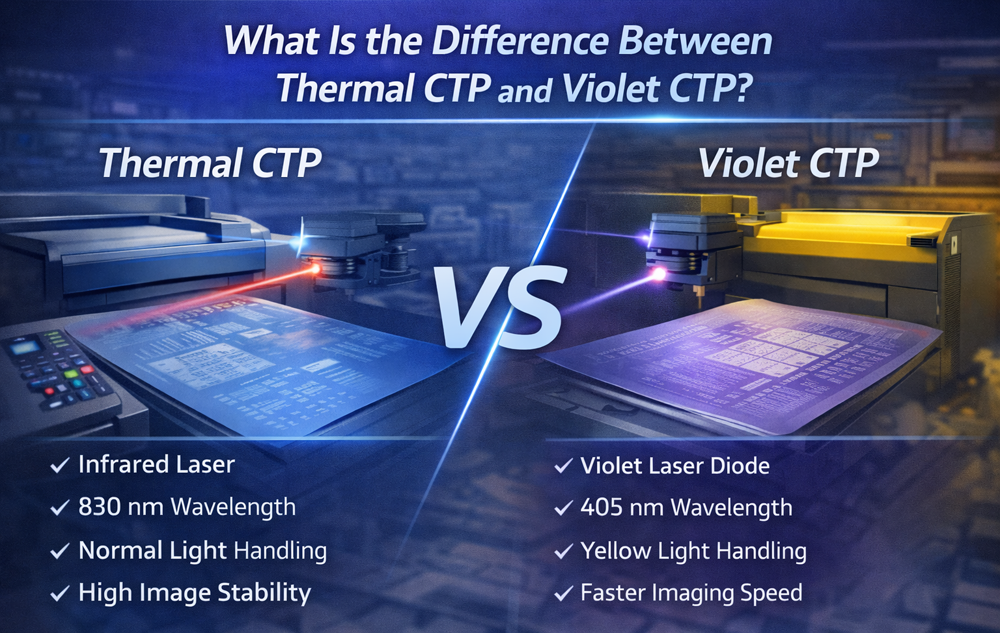
Thermal CTP uses infrared laser technology, typically operating at a wavelength of 830 nm. The laser heats specific areas of the plate coating, triggering a chemical reaction that forms the image.
Thermal plates are not sensitive to visible light, which allows them to be handled safely under normal room lighting conditions.
2.2 Characteristics of Thermal CTP Plates
High image stability
Excellent dot reproduction
Strong resistance to ambient light
Suitable for long press runs
Compatible with high-quality commercial and packaging printing
Thermal CTP is widely regarded as a high-end and highly stable plate-making solution.
3. What Is Violet CTP?
3.1 Working Principle of Violet CTP
Violet CTP systems use violet laser diodes, typically at a wavelength of 405 nm. The laser activates a photosensitive coating on the plate, similar to traditional UV exposure.
Because violet plates are sensitive to visible light, plate handling usually requires yellow safe light conditions.
3.2 Characteristics of Violet CTP Plates
Violet CTP systems are often chosen by small to medium-sized printing companies focusing on cost efficiency.
4. Key Differences Between Thermal CTP and Violet CTP
4.1 Laser Wavelength
| Technology | Laser Type | Wavelength |
|---|
| Thermal CTP | Infrared laser | ~830 nm |
| Violet CTP | Violet laser diode | ~405 nm |
The laser wavelength directly affects plate sensitivity, handling conditions, and imaging stability.
4.2 Plate Handling Environment
Thermal CTP Plates
Violet CTP Plates
This difference significantly impacts workflow flexibility.
4.3 Image Quality and Stability
Thermal CTP generally offers:
Violet CTP provides:
4.4 Print Run Length
For packaging and high-volume commercial printing, thermal CTP is often preferred.
4.5 Processing Requirements
Both systems can support:
Processed plates
Low-chemistry solutions
However:
4.6 Equipment and Operating Costs
| Cost Factor | Thermal CTP | Violet CTP |
|---|
| Equipment cost | Higher | Lower |
| Plate cost | Higher | Lower |
| Maintenance | Lower long-term | Moderate |
| Stability | Very high | Medium |
Violet CTP offers a lower initial investment, while thermal CTP provides better long-term stability and performance.
5. Application Scenarios: Which One Should You Choose?
Choose Thermal CTP If You:
Focus on high-end commercial printing
Produce packaging with long print runs
Need maximum image stability
Want process-free or low-chemistry solutions
Value reliability over initial cost
Choose Violet CTP If You:
6. Thermal CTP vs Violet CTP in Packaging Printing
Packaging printing demands:
Strong ink adhesion
Long press runs
High dot stability
For this reason, thermal CTP plates dominate packaging applications, while violet CTP is more common in commercial print environments with lower run lengths.
7. Environmental Considerations
Thermal CTP supports:
Process-free plates
Reduced chemical usage
Lower water consumption
This makes thermal CTP more attractive for printers aiming to meet environmental and sustainability standards.
8. Future Trends in CTP Technology
The CTP industry continues to evolve toward:
Process-free plate solutions
Higher imaging efficiency
Reduced energy consumption
Improved environmental performance
Thermal CTP technology is leading this trend, although violet CTP remains relevant in cost-sensitive markets.
9. Summary: Thermal CTP vs Violet CTP
In summary, the difference between thermal CTP and violet CTP lies in laser technology, plate sensitivity, stability, cost, and application suitability.
Thermal CTP = high stability, high quality, long runs
Violet CTP = lower cost, fast imaging, short to medium runs
Choosing the right technology depends on your production goals and budget.
Conclusion: Choose the Right CTP Plate Partner
Understanding what is the difference between thermal CTP and violet CTP helps printers optimize efficiency, quality, and cost control.
👉 We are also a professional manufacturer of Thermal CTP Plates and Violet CTP Plates, supplying stable, reliable plate solutions for commercial and packaging printing applications.
If you are looking for consistent quality, technical support, and long-term cooperation, feel free to contact us. We are ready to support your CTP plate needs.