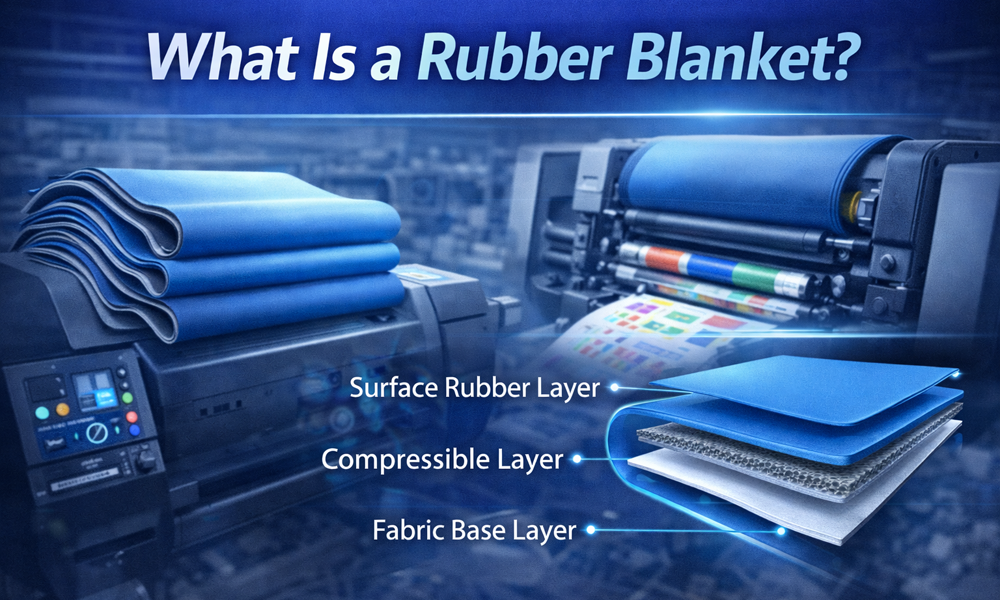
What Is a Rubber Blanket? A Complete Guide for Offset Printing Professionals
In modern offset printing, image quality, consistency, and production efficiency depend heavily on one critical component: the rubber blanket. Although it may appear simple at first glance, the rubber blanket plays a decisive role in transferring ink accurately from the printing plate to the paper.
This article provides a comprehensive explanation of what a rubber blanket is, how it works, its structure, types, advantages, applications, and how to choose the right rubber blanket for your printing needs.
1. What Is a Rubber Blanket?
A rubber blanket is a flexible, multi-layered sheet installed on the blanket cylinder of an offset printing press. Its primary function is to transfer the inked image from the printing plate onto the substrate (paper or other materials).
In offset lithography, ink does not move directly from the plate to the paper. Instead, the image is first transferred to the rubber blanket, and then from the blanket to the paper. This indirect printing process is what makes offset printing highly accurate and adaptable to different substrates.
2. How Does a Rubber Blanket Work in Offset Printing?
The offset printing process follows three main steps:
Plate to Blanket
The printing plate carries the inked image. When it contacts the rubber blanket, the image is transferred precisely onto the blanket surface.Blanket to Substrate
The rubber blanket then presses against the paper, transferring the image evenly and cleanly.Shock Absorption and Adaptation
The elasticity of the rubber blanket compensates for surface irregularities in the paper, ensuring consistent ink coverage.
Because of its flexibility and resilience, the rubber blanket allows offset printing to achieve high-quality results even on rough or textured substrates.
3. Structure of a Rubber Blanket
A high-quality rubber blanket typically consists of three main layers, each serving a specific function:
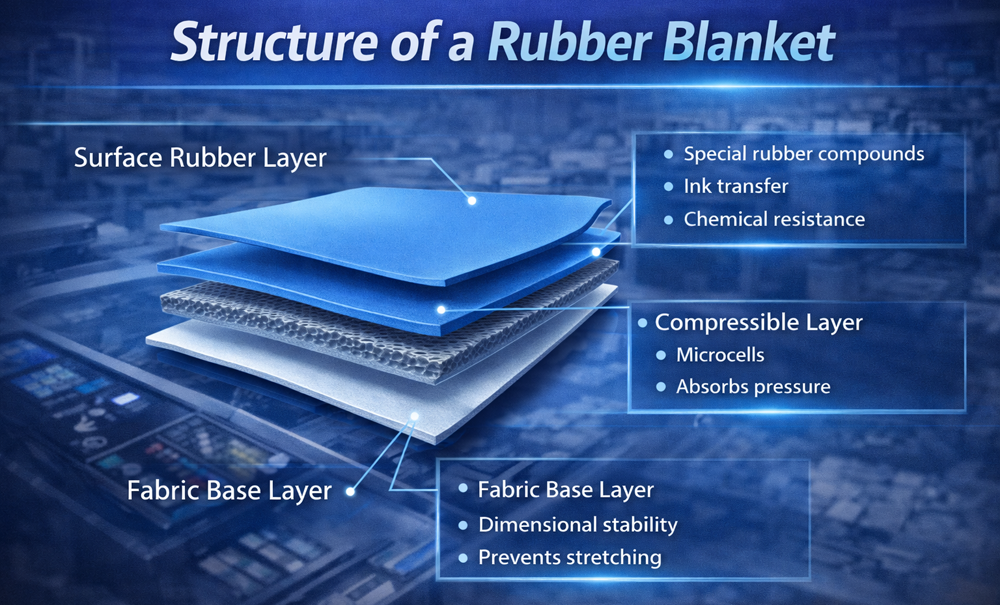
3.1 Surface Rubber Layer
Made from specially formulated rubber compounds
Responsible for ink transfer
Offers excellent ink release and chemical resistance
3.2 Compressible Layer
Contains microcells or compressible materials
Absorbs pressure variations during printing
Protects plates and improves dot reproduction
3.3 Fabric Base Layer
Provides dimensional stability
Prevents stretching and deformation
Ensures long service life and accurate registration
This multi-layer structure ensures durability, stability, and consistent print quality.
4. Types of Rubber Blankets
Different printing requirements call for different types of rubber blankets. The most common categories include:
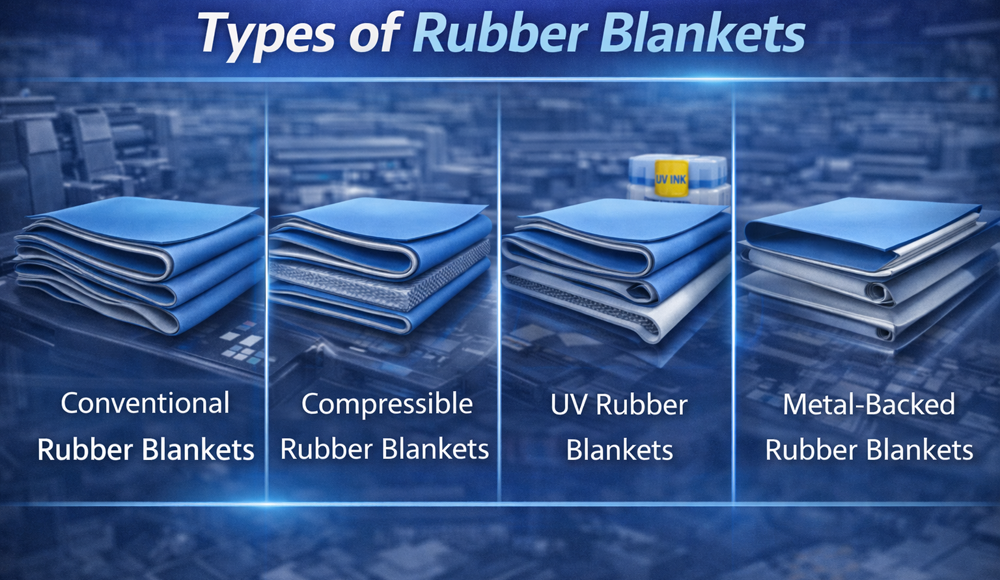
4.1 Conventional Rubber Blankets
Suitable for standard offset printing
Reliable performance and cost-effective
Widely used in commercial printing
4.2 Compressible Rubber Blankets
Feature enhanced compressible layers
Ideal for high-speed and high-precision printing
Reduce vibration and mechanical stress
4.3 UV Rubber Blankets
Designed for UV-curable inks
Excellent chemical resistance
Commonly used in packaging and label printing
4.4 Metal-Backed Rubber Blankets
Equipped with aluminum or steel backing
Offer precise thickness and stability
Often used in specialized printing machines
5. Key Advantages of Rubber Blankets
Using the right rubber blanket brings several technical and economic benefits:
Excellent Ink Transfer Efficiency
Ensures sharp images and accurate color reproductionConsistent Print Quality
Maintains uniform ink density across the sheetWide Substrate Compatibility
Works well with paper, cardboard, plastic films, and moreReduced Plate Wear
Protects printing plates by absorbing mechanical stressLong Service Life
High-quality blankets resist swelling, cracking, and ink buildup
6. Common Applications of Rubber Blankets
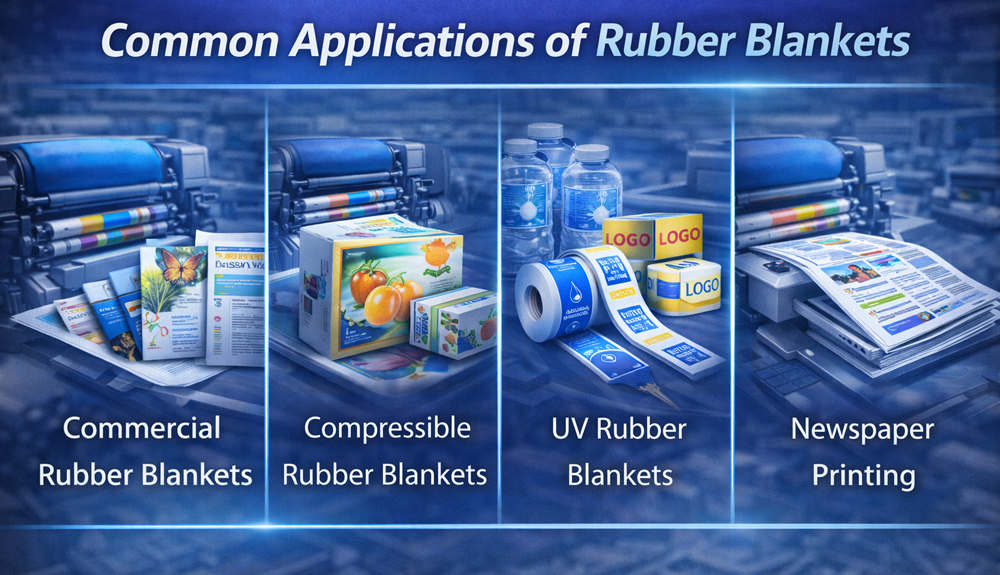
Rubber blankets are widely used across various printing sectors:
Commercial printing (books, magazines, brochures)
Packaging printing (cartons, paperboard, folding boxes)
Label printing
Newspaper printing
Specialty printing applications
Each application may require a different blanket specification depending on speed, ink type, and substrate.
7. How to Choose the Right Rubber Blanket
When selecting a rubber blanket, consider the following factors:
7.1 Printing Press Type
Different presses have specific blanket thickness and tension requirements.
7.2 Ink Type
Conventional inks, UV inks, and hybrid inks require compatible rubber compounds.
7.3 Substrate Characteristics
Rough or thick materials may require higher compressibility.
7.4 Print Speed and Pressure
High-speed presses benefit from advanced compressible blankets.
7.5 Durability and Maintenance
Choose blankets that are easy to clean and resistant to chemicals.
A professional supplier can help match the right blanket to your production conditions.
8. Rubber Blanket Maintenance Tips
Proper maintenance significantly extends blanket life:
Clean the blanket regularly using approved cleaners
Avoid aggressive solvents that damage rubber surfaces
Store spare blankets flat in a cool, dry environment
Prevent excessive pressure and over-tightening
Well-maintained rubber blankets ensure stable print quality over long production runs.
9. Rubber Blanket vs. Printing Plate: What’s the Difference?
| Feature | Rubber Blanket | Printing Plate |
|---|---|---|
| Function | Transfers ink to paper | Carries the image |
| Material | Rubber-based composite | Aluminum or polymer |
| Flexibility | High | Low |
| Direct contact with paper | Yes | No |
Both components are essential, but the rubber blanket acts as the critical bridge between plate and substrate.
Conclusion: Choose a Reliable Rubber Blanket Supplier
Understanding what a rubber blanket is and how it affects print quality is essential for any offset printing operation. The right rubber blanket improves image sharpness, extends equipment life, and enhances overall productivity.
👉 We are also a professional rubber blanket manufacturer, offering high-quality rubber blankets for various offset printing applications.
If you are looking for reliable products, technical support, and competitive pricing, feel free to contact us anytime — we are ready to support your printing business.

Why Does a CTP Plate Scum on Press ? 9 Common Causes and Proven Solutions
Learn why CTP plates scum on press, the most common causes, troubleshooting methods, and practical solutions to improve offset printing quality and reduce downtime.

Which Offset Machine Is Best ? A Practical Guide for Commercial Printing
Which offset machine is best? Learn how to choose the right offset printing machine based on format, volume, cost, and CTP technology.
Where to Buy Thermal CTP Plates for Offset Printing | Best Supplier Guide & Expert Tips
Looking for reliable thermal CTP plates for offset printing? This expert guide explains how to choose a trustworthy supplier, compares global and Chinese manufacturers, and shares key quality criteria.