Introduction
Digital printing has become one of the most important technologies in the modern printing industry. From commercial printing and packaging to textiles and signage, digital printing enables faster production, lower setup costs, and highly flexible customization.
A common and frequently searched question is:
How many types of digital printing are there?
Understanding the different types of digital printing helps printers, brand owners, and procurement managers choose the right technology, control costs, and achieve the desired print quality. In this article, we provide the most complete and professional explanation of digital printing types available today.
How Many Types of Digital Printing Are There?
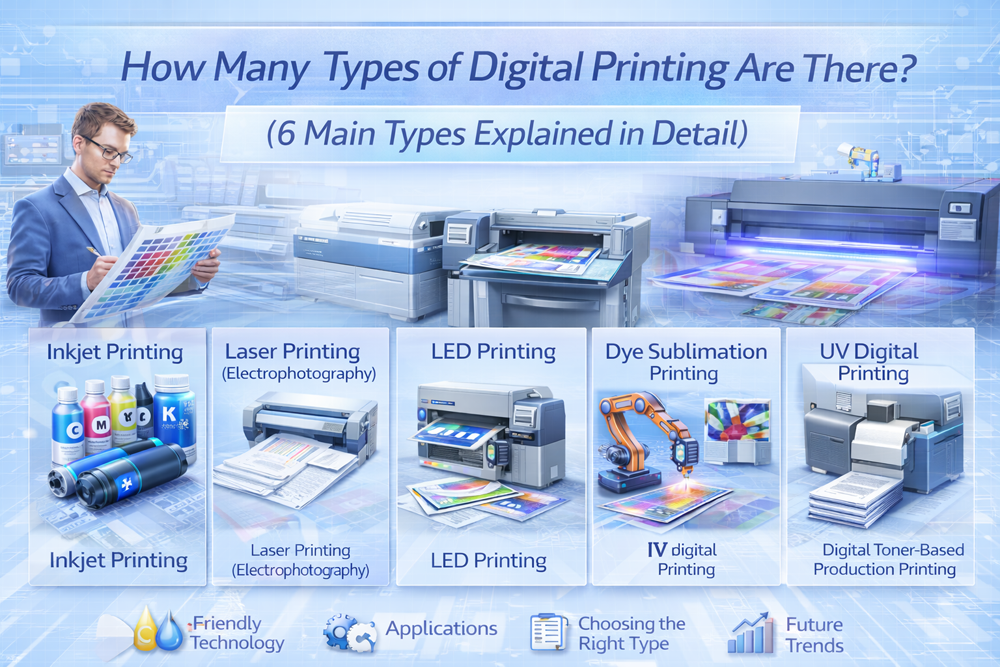
There are six main types of digital printing commonly used in the printing industry today. These include inkjet printing, laser printing, LED printing, dye sublimation printing, UV digital printing, and digital toner-based production printing. Each type is designed for specific materials, production volumes, and quality requirements.
Main Types of Digital Printing
Inkjet Printing
Laser Printing (Electrophotography)
LED Printing
Dye Sublimation Printing
UV Digital Printing
Digital Toner-Based Production Printing
The sections below explain how each type works, where it is used, and its key advantages.
1. Inkjet Printing
How Inkjet Printing Works
Inkjet printing works by spraying microscopic droplets of ink directly onto a substrate through thousands of precision nozzles. The print image is created digitally without any physical plates.
Main Inkjet Technologies
Thermal inkjet
Piezoelectric inkjet
Continuous inkjet (CIJ)
Applications
Commercial printing
Packaging and labels
Textile and fabric printing
Signage and large-format graphics
Industrial coding and marking
Advantages
Extremely high resolution
Compatible with many substrates
Scalable from desktop to industrial production
Inkjet printing is the most widely used digital printing type worldwide.
2. Laser Printing (Electrophotography)
How Laser Printing Works
Laser printing uses a laser beam to create an electrostatic image on a photoconductive drum. Toner particles are attracted to the charged areas and fused onto paper using heat and pressure.
Applications
Office printing
Commercial documents
Books and manuals
Transactional printing
Advantages
Fast printing speed
Sharp text quality
Consistent color reproduction
Laser printing is ideal for short- to medium-run commercial printing where speed and reliability are critical.
3. LED Printing
How LED Printing Works
LED printing is similar to laser printing but uses a fixed LED array instead of a moving laser beam to expose the drum.
Applications
Office and light commercial printing
Label prototypes
Entry-level packaging applications
Advantages
Fewer moving parts
Lower maintenance requirements
Stable and uniform image quality
LED printing is considered a separate digital printing type due to its unique exposure system.
4. Dye Sublimation Printing
How Dye Sublimation Printing Works
Dye sublimation printing uses heat to convert solid dye into gas, allowing it to bond permanently with coated substrates or polyester-based materials.
Applications
Textile and apparel printing
Soft signage
Photo printing
Promotional products
Advantages
Smooth, continuous-tone images
No cracking or peeling
Excellent wash and fade resistance
Dye sublimation is a key technology in digital textile printing.
5. UV Digital Printing
How UV Digital Printing Works
UV digital printing uses ultraviolet light to instantly cure specially formulated inks as they are printed.
Applications
Rigid materials (glass, metal, wood, acrylic)
Packaging and labels
Industrial decoration
Signage and displays
Advantages
Instant curing and fast production
Excellent adhesion on non-porous materials
High scratch and chemical resistance
UV printing is widely used in industrial and high-end commercial applications.
6. Digital Toner-Based Production Printing
How Digital Toner Printing Works
This technology is an advanced form of electrophotographic printing used in high-speed production presses.
Applications
Books and magazines
Direct mail
Variable data printing
Commercial print shops
Advantages
Very high printing speed
Excellent color control
Ideal for personalization and short runs
This type bridges the gap between traditional offset printing and digital printing.
How Are These Digital Printing Types Classified?
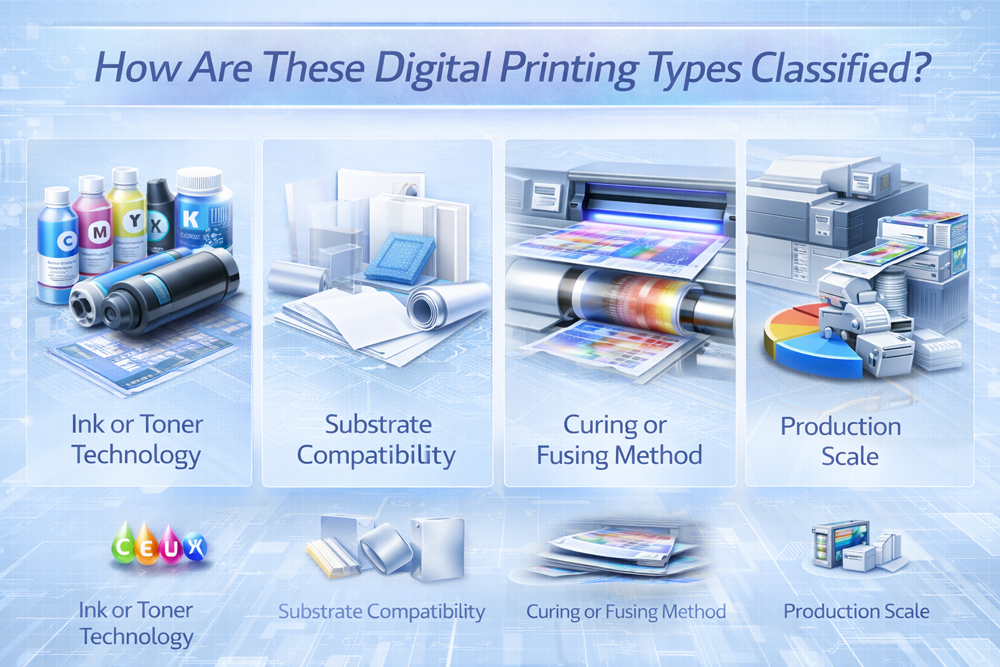
Digital printing types can be classified based on:
Ink or toner technology
Substrate compatibility
Curing or fusing method
Production scale
Although some sources mention more variations, most industry professionals agree on six core digital printing types.
How to Choose the Right Type of Digital Printing
When selecting a digital printing technology, consider:
Substrate type (paper, plastic, fabric, metal)
Print volume and turnaround time
Image quality and durability requirements
Operating and consumables cost
Choosing the correct digital printing type ensures optimal efficiency and print performance.
Future Trends in Digital Printing
Digital printing technologies continue to evolve with trends such as:
Eco-friendly inks and consumables
Higher printing speeds
Wider material compatibility
Smart and connected printing systems
These innovations are expanding the capabilities of all digital printing types.
Frequently Asked Questions About Digital Printing
How many types of digital printing are there?
There are six main types of digital printing: inkjet printing, laser printing, LED printing, dye sublimation printing, UV digital printing, and digital toner-based production printing.
What is the most common type of digital printing?
Inkjet printing is the most common type due to its flexibility, high resolution, and wide material compatibility.
Is UV printing considered digital printing?
Yes, UV printing is a type of digital printing that uses ultraviolet light to cure ink instantly during printing.
Conclusion
So, how many types of digital printing are there?
In practical industry terms, there are six main types, each designed for specific printing needs and applications.
Understanding these technologies helps businesses improve print quality, reduce costs, and choose the right equipment and supplies.
👉 We are also a professional manufacturer and supplier of Digital Printing Supplies, offering inks, consumables, and auxiliary materials compatible with various digital printing technologies.
If you have any requirements or are looking for reliable digital printing supplies, feel free to contact us — we are ready to support your business.
Why Does a CTP Plate Scum on Press ? 9 Common Causes and Proven Solutions
Learn why CTP plates scum on press, the most common causes, troubleshooting methods, and practical solutions to improve offset printing quality and reduce downtime.
Which Offset Machine Is Best ? A Practical Guide for Commercial Printing
Which offset machine is best? Learn how to choose the right offset printing machine based on format, volume, cost, and CTP technology.
Where to Buy Thermal CTP Plates for Offset Printing | Best Supplier Guide & Expert Tips
Looking for reliable thermal CTP plates for offset printing? This expert guide explains how to choose a trustworthy supplier, compares global and Chinese manufacturers, and shares key quality criteria.