Introduction
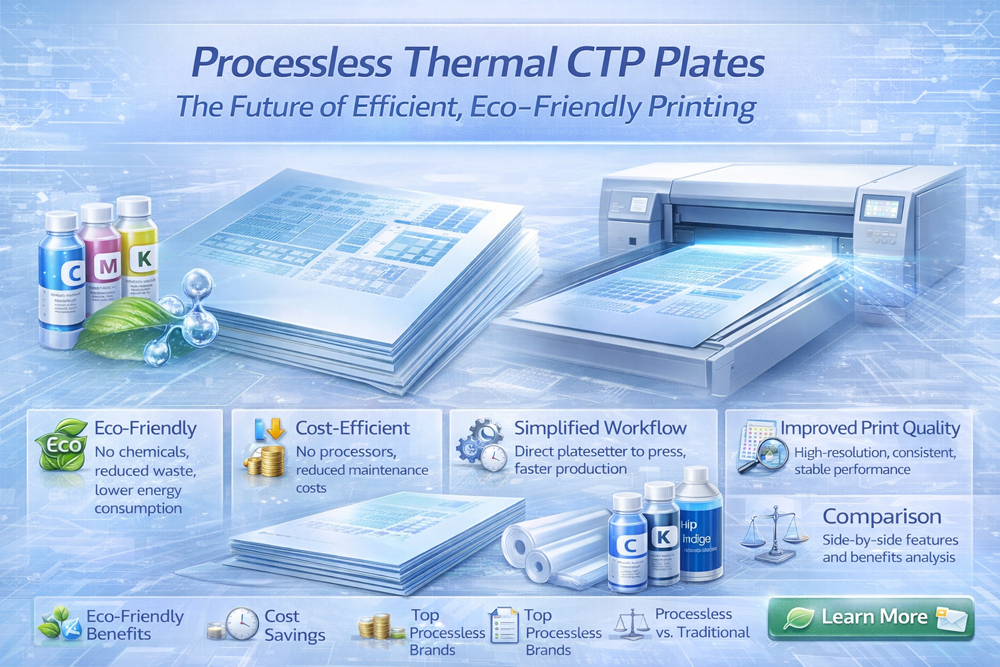
In the fast-evolving world of commercial and packaging printing, efficiency, cost reduction, and environmental sustainability are paramount. Enter processless thermal CTP plates—a revolutionary innovation transforming the printing industry. Unlike traditional plates that require chemical processing, processless thermal CTP plates eliminate the need for developing, cleaning, and processing steps, enabling printers to streamline production, reduce waste, and achieve superior print quality.
This comprehensive guide dives deep into what processless thermal CTP plates are, how they work, their advantages, and why they are rapidly becoming the preferred choice for printers worldwide. Whether you’re an offset printer, a packaging specialist, or a sustainability advocate, understanding this technology will empower you to enhance your printing operations.
What Are Processless Thermal CTP Plates?
Processless thermal CTP plates are a type of Computer-to-Plate (CTP) technology that uses thermal laser imaging to create printing plates without the need for traditional chemical processing. After exposure in a platesetter, these plates can be mounted directly on the press, where the image is developed during the initial press startup, eliminating the processor, developer chemicals, and water usage.
How Do Processless Thermal CTP Plates Work?
The technology behind processless thermal CTP plates relies on a special photosensitive coating that reacts directly to thermal laser exposure:
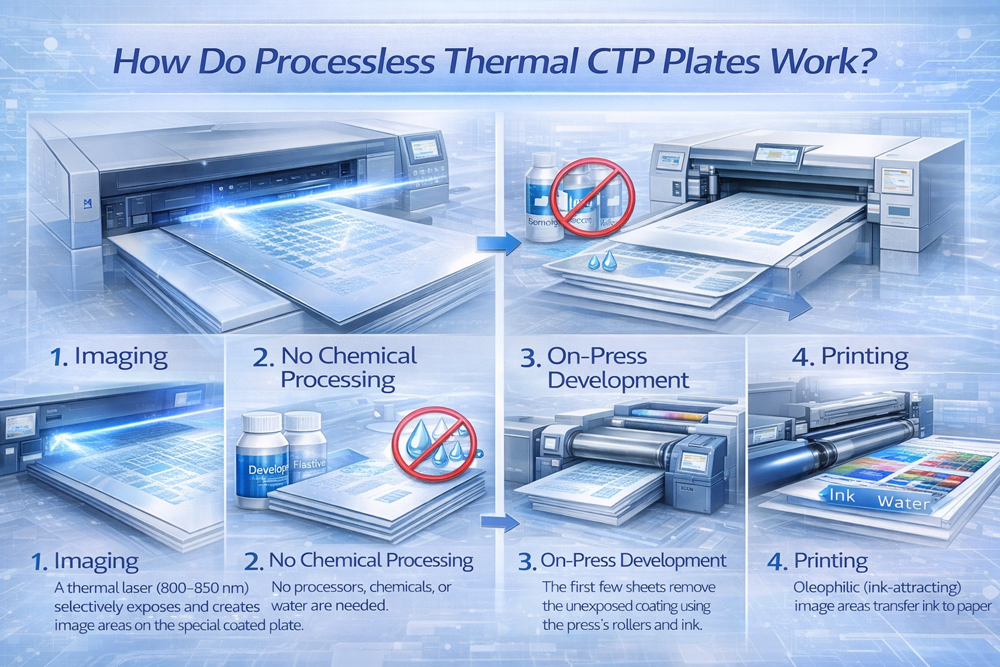
Imaging
A thermal laser (typically operating between 800-850 nm wavelength) scans the plate, creating the image areas through selective exposure.
No Chemical Processing
Unlike traditional plates, there is no need for developing or washing. The plate’s coating is designed to be removed or transformed during the initial press startup.
On-Press Development
The plate is mounted on the press, and during the first few sheets, the press’s rollers and ink remove the unexposed coating, revealing the image.
Printing
The plate then functions normally, with oleophilic (ink-attracting) image areas and hydrophilic (water-attracting) non-image areas transferring ink to paper.
Key Features of Processless Thermal CTP Plates
Chemical-Free Processing: Completely eliminates the need for chemical developers, cleaners, and processing equipment.
Environmental Sustainability: Reduces chemical waste, water consumption, and energy use.
Time Efficiency: Shortens plate-making time by removing multiple steps in the workflow.
High Run Lengths: Capable of producing between 30,000 to 200,000 impressions depending on plate type and printing conditions.
Compatibility: Works with various press types including sheetfed, heat-set web, cold-set web, and UV inks.
Stable Image Quality: Offers consistent, high-resolution printing with excellent tonal reproduction (1-99% @ 200 lpi).
Wide Sensitivity Range: Typically sensitive to thermal laser wavelengths of 800-850 nm.
Advantages of Processless Thermal CTP Plates
1. Simplified Workflow
By removing the chemical processing stage, processless thermal CTP plates dramatically simplify the plate-making workflow. Printers can go from imaging to press faster, reducing setup times and labor costs. This streamlined process also minimizes the potential for human error during plate development.
2. Cost Reduction
No Processor or Chemicals: Eliminating the processor and associated chemicals cuts down on capital investment, maintenance, and operational expenses.
Lower Waste Disposal Costs: Reduced chemical and water waste means lower environmental compliance costs.
Energy Savings: Without the need to power processors, energy consumption is significantly decreased.
3. Environmental Sustainability
Processless plates align with green printing initiatives by:
Eliminating chemical effluents that pollute water systems.
Reducing water usage during plate production.
Minimizing waste generation from processing chemicals and materials.
4. Improved Print Quality and Consistency
The direct imaging process ensures sharper images with excellent dot reproduction and tonal range. Consistency across print runs is enhanced as plates are less prone to chemical variability or processing errors.
5. Greater Operational Flexibility
Processless plates are compatible with a broad range of ink formulations, fount solutions, and press conditions, including UV inks. This versatility makes them suitable for diverse printing applications, from commercial brochures to packaging labels.
Popular Processless Thermal CTP Plates on the Market
Fujifilm SUPERIA Processless Thermal CTP Plates
Fujifilm’s SUPERIA series represents one of the most advanced processless thermal plate technologies available:
SUPERIA ZP: Eliminates processor, chemistry, gum, and water. Plates go directly from platesetter to press.
SUPERIA ZD: Offers high robustness and compatibility with UV inks, supporting long press runs and consistent quality.
Features include high ink receptivity, fast on-press development, and tolerance for varied press conditions.
Bridgehead TPH 500 Processless Thermal CTP Plate
Bridgehead’s TPH 500 is an eco-friendly, negative-working processless plate designed for:
High-quality sheetfed and web offset printing.
Run lengths up to 200,000 impressions on heat-set web presses.
No developer or chemical processing required.
Safe handling under yellow or fluorescent lighting conditions.
Haomei Aluminum Processless Thermal CTP Plates
Haomei offers a range of processless thermal plates with the following specifications:
Thickness options from 0.15 mm to 0.40 mm.
Spectral sensitivity at 830 nm.
Run lengths up to 100,000 impressions.
No baking or development necessary.
Designed for commercial and packaging printing applications.
Processless Thermal CTP Plates vs. Traditional Plates
| Feature | Traditional Plates | Processless Thermal CTP Plates |
|---|---|---|
| Chemical Processing | Required (developing, washing) | Not required |
| Environmental Impact | High chemical and water use | Eco-friendly, minimal waste |
| Plate-Making Time | Longer due to processing steps | Faster, direct from platesetter to press |
| Cost | Higher due to chemicals, equipment | Lower operational and maintenance costs |
| Image Quality | Variable, dependent on processing | Consistent, high-resolution imaging |
| Run Length | Typically 30,000-100,000 impressions | Up to 200,000 impressions |
| Press Compatibility | Standard inks and founts | Wide range including UV inks |
Applications of Processless Thermal CTP Plates
Commercial Printing: Ideal for magazines, brochures, catalogs, and posters where quick turnaround and high quality are essential.
Packaging Printing: Suitable for short-run packaging jobs requiring fast setup and consistent results.
Environmentally Conscious Printing: Perfect for printing companies aiming to reduce their carbon footprint and chemical waste.
UV Printing: Some processless plates are compatible with UV inks, broadening their use in specialty printing.
Best Practices for Using Processless Thermal CTP Plates
Proper Storage: Store plates in a cool, dry environment (18-25°C, 30-60% relative humidity) to maintain shelf life (typically 12 months).
Safe Handling: Avoid contact with water, saliva, or aqueous solutions on the plate surface before imaging.
Correct Imaging Parameters: Calibrate laser energy and exposure settings according to platesetter manufacturer recommendations.
Press Start-up: Follow recommended press start-up procedures, including running water rollers for 30-60 seconds before ink application.
Use of Protection Gum: Applying recommended protection gums (e.g., Fuji FN-6 or GU-7) can enhance plate durability and run length.
Environmental Impact and Sustainability
Processless thermal CTP plates significantly reduce environmental impact by:
Eliminating hazardous chemicals such as developers, fixers, and cleaners.
Reducing water consumption by removing washing steps.
Minimizing waste generation, including chemical sludge and contaminated water.
Lowering energy consumption by removing the need for plate processors.
These benefits align with growing industry trends toward sustainable printing practices and regulatory pressures to reduce pollution.
Frequently Asked Questions (FAQs)
Q1: Can processless thermal CTP plates be used on all types of presses?
A: Yes, they are compatible with most sheetfed and web offset presses, including those using UV and conventional inks. However, it’s important to verify compatibility with your specific press and ink formulations.
Q2: What is the typical run length of processless thermal CTP plates?
A: Run lengths vary by plate type and printing conditions but typically range from 30,000 to 200,000 impressions.
Q3: Do processless plates require any special handling or storage?
A: Plates should be stored in a controlled environment, away from direct sunlight and moisture, to maintain optimal performance.
Q4: How do processless plates affect print quality?
A: They provide high-resolution, consistent image quality with excellent tonal reproduction, often outperforming traditional plates due to the elimination of chemical variability.
Q5: Are samples available for testing?
A: Many manufacturers, including Fujifilm and Bridgehead, offer sample plates for testing purposes upon request.
Conclusion
The adoption of processless thermal CTP plates marks a significant leap forward in printing technology, offering unmatched efficiency, cost savings, and environmental benefits. By eliminating chemical processing and simplifying workflows, these plates empower printers to deliver high-quality prints faster and more sustainably.
Whether you are aiming to reduce your environmental footprint, cut operational costs, or improve turnaround times, processless thermal CTP plates provide a reliable solution tailored to modern printing demands.
Why Does a CTP Plate Scum on Press ? 9 Common Causes and Proven Solutions
Learn why CTP plates scum on press, the most common causes, troubleshooting methods, and practical solutions to improve offset printing quality and reduce downtime.

Which Offset Machine Is Best ? A Practical Guide for Commercial Printing
Which offset machine is best? Learn how to choose the right offset printing machine based on format, volume, cost, and CTP technology.
Where to Buy Thermal CTP Plates for Offset Printing | Best Supplier Guide & Expert Tips
Looking for reliable thermal CTP plates for offset printing? This expert guide explains how to choose a trustworthy supplier, compares global and Chinese manufacturers, and shares key quality criteria.