What is the Difference Between Thermal CTP and Violet CTP?
TL;DR
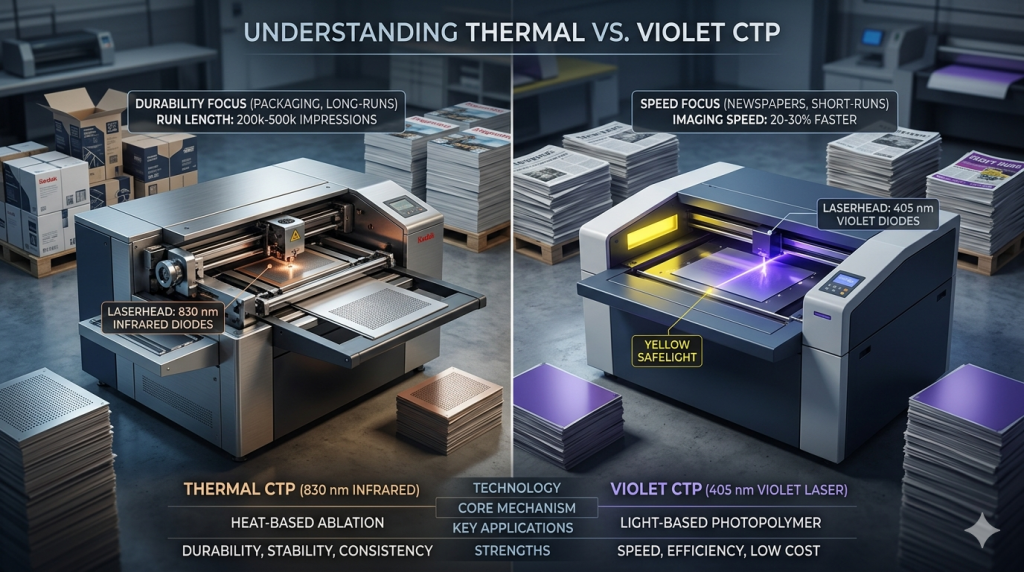
Thermal CTP and violet CTP are two dominant computer-to-plate technologies used in offset printing. Thermal CTP uses 830 nm infrared lasers and offers higher durability, with run lengths up to 500,000 impressions. Violet CTP uses 405 nm lasers, enabling faster imaging and lower energy consumption but shorter run lengths, typically 50,000–150,000 impressions. The choice depends on print volume, cost structure, and environmental priorities.
What is thermal CTP?
Thermal CTP is a plate imaging technology that uses infrared lasers, typically at a wavelength of 830 nm, to expose printing plates. It is widely adopted in commercial and packaging printing due to its high stability and long run length performance.
Thermal CTP refers to a process where heat energy from the laser creates a chemical change in the plate coating. This results in highly durable images that can withstand long print runs exceeding 200,000 impressions.
Thermal systems are known for their consistency and resistance to ambient light. According to industry data, thermal plates can operate in normal lighting conditions, reducing the need for controlled environments.
What is violet CTP?
Violet CTP is a plate imaging technology that uses violet laser diodes at approximately 405 nm wavelength. It is commonly used in newspaper printing and short-to-medium run commercial jobs due to its high imaging speed.
Violet CTP refers to a system where lower-energy laser exposure activates a photosensitive coating on the plate. These plates typically require less energy, around 30–50 mJ/cm², compared to thermal systems.
Violet plates are more sensitive to ambient light and usually require safelight conditions. However, studies show that violet systems can achieve imaging speeds up to 20–30% faster than thermal systems.
How do thermal and violet CTP technologies differ in core mechanism?
Thermal CTP relies on heat-based ablation or chemical reaction, where the laser physically alters the plate coating. This mechanism ensures high dot stability and precise reproduction, especially at resolutions up to 240 lpi.
Violet CTP uses photopolymer or silver halide chemistry that reacts to light rather than heat. This allows lower power consumption but results in coatings that are generally less robust under long press runs.
The fundamental difference is energy type: thermal systems use heat energy, while violet systems use light energy. This distinction directly impacts durability, speed, and operating costs.
What are the key differences in performance and specifications?
| Feature | Thermal CTP | Violet CTP |
|---|---|---|
| Laser Wavelength | 830 nm (infrared) | 405 nm (violet) |
| Exposure Energy | 100–200 mJ/cm² | 30–50 mJ/cm² |
| Run Length | 200k–500k impressions | 50k–150k impressions |
| Imaging Speed | Moderate | High (20–30% faster) |
| Resolution | Up to 240 lpi | Up to 200 lpi |
| Light Sensitivity | Low | High |
| Processing | Usually required | Often required or processless |
Thermal CTP systems deliver higher durability and consistency, while violet systems prioritize speed and efficiency. According to industry benchmarks, thermal plates last up to 3× longer than violet plates in high-volume production.
Which technology is more cost-effective?
Thermal CTP systems typically have higher upfront costs due to more complex laser systems and plate materials. Plate costs can be 10–20% higher compared to violet plates.
Violet CTP systems are generally more affordable in terms of equipment and energy consumption. Lower exposure energy translates to reduced electricity usage by approximately 15–25%.
However, total cost of ownership depends on production volume. For long runs, thermal plates reduce replacement frequency, which can offset higher initial costs.
How do thermal and violet CTP compare in environmental impact?
Thermal CTP traditionally requires chemical processing, which involves developers, water usage, and waste management. This increases environmental impact, especially in high-volume operations.
Violet CTP systems, particularly processless variants, significantly reduce chemical usage. Water consumption can decrease by up to 80%, and chemical waste can be nearly eliminated.
Energy usage also differs. Violet systems consume less energy due to lower laser power requirements, contributing to a 10–20% reduction in carbon footprint according to industry studies.
What are the typical use cases for each technology?
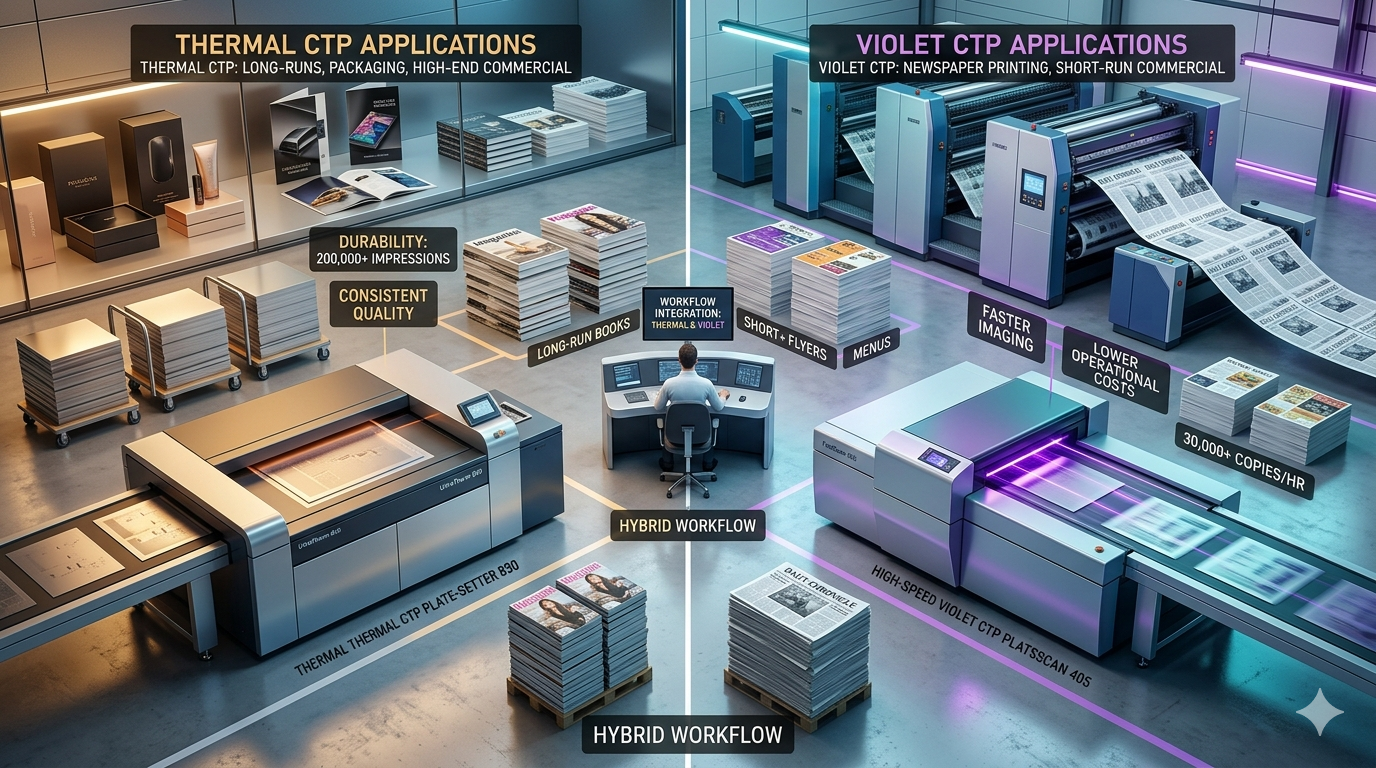
Thermal CTP is widely used in packaging, high-end commercial printing, and long-run publishing. These applications often require durability beyond 200,000 impressions and consistent image quality.
Violet CTP is commonly used in newspaper printing and short-run commercial jobs. Newspaper presses, which often exceed 30,000 copies per hour, benefit from faster plate imaging and lower operational costs.
In hybrid workflows, some print shops use both technologies to balance speed and durability depending on job requirements.
What are the limitations of each technology?
Thermal CTP systems have higher energy consumption and require chemical processing in most cases. This increases operational complexity and environmental compliance requirements.
Violet CTP systems have shorter plate life and higher sensitivity to light exposure. This can lead to increased waste during setup, typically 1–3% more paper during press startup.
Additionally, violet plates may require stricter environmental controls, including temperature and humidity ranges of 20–25°C and 40–60% humidity.
Expert Insight: Choosing between thermal and violet CTP
The decision between thermal and violet CTP depends on production strategy rather than technology superiority. Thermal CTP is optimal for long-run, high-value print jobs where durability and consistency are critical.
Violet CTP is better suited for high-frequency, short-run environments where speed and cost efficiency are priorities. According to industry data, print shops handling over 70% short-run jobs often achieve better ROI with violet systems.
A hybrid approach is increasingly common, allowing printers to optimize both cost and performance across diverse job types.
FAQ: Thermal vs Violet CTP
What is the main difference between thermal and violet CTP?
Thermal CTP uses heat-based infrared lasers, while violet CTP uses light-based violet lasers. This results in differences in durability, speed, and energy consumption.
Which CTP technology is more durable?
Thermal CTP plates are more durable, with run lengths up to 500,000 impressions, compared to 150,000 impressions for violet plates.
Is violet CTP faster than thermal CTP?
Yes, violet CTP systems are typically 20–30% faster due to lower energy requirements and faster laser imaging speeds.
Which is more environmentally friendly?
Violet CTP, especially processless variants, is more environmentally friendly due to reduced chemical use and lower water consumption.
Can thermal CTP be processless?
Yes, processless thermal plates exist, but they are less common and often more expensive than violet processless options.
Which is better for newspaper printing?
Violet CTP is preferred for newspaper printing due to its speed and lower operational costs.
Which technology is more cost-effective?
Violet CTP is more cost-effective for short runs, while thermal CTP is more economical for long-run, high-volume printing.
Why Does a CTP Plate Scum on Press ? 9 Common Causes and Proven Solutions
Learn why CTP plates scum on press, the most common causes, troubleshooting methods, and practical solutions to improve offset printing quality and reduce downtime.

Which Offset Machine Is Best ? A Practical Guide for Commercial Printing
Which offset machine is best? Learn how to choose the right offset printing machine based on format, volume, cost, and CTP technology.
Where to Buy Thermal CTP Plates for Offset Printing | Best Supplier Guide & Expert Tips
Looking for reliable thermal CTP plates for offset printing? This expert guide explains how to choose a trustworthy supplier, compares global and Chinese manufacturers, and shares key quality criteria.