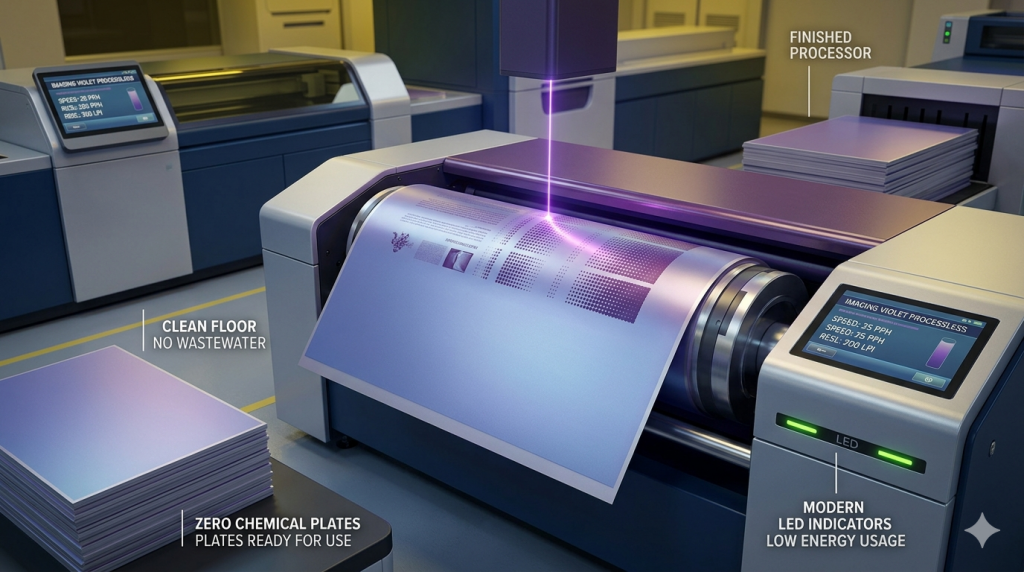
Violet Processless CTP Plates: Definition, Technology, and Industry Applications
TL;DR
Violet processless CTP plates are printing plates designed for computer-to-plate systems that use violet laser exposure and require no chemical processing. They reduce water, energy, and chemical consumption by up to 80%, according to industry data. These plates improve workflow efficiency, lower operational costs, and support sustainable printing, while maintaining resolution up to 200 lpi for commercial and newspaper applications.
What are violet processless CTP plates?
Violet processless CTP plates are lithographic printing plates that are imaged using violet laser diodes, typically at a wavelength of 405 nm. These plates eliminate the need for traditional chemical processing after exposure, enabling direct mounting on the press.
Violet processless CTP plates refer to a category of offset plates that combine violet laser sensitivity with on-press development technology. The image is formed during printing startup, where fountain solution and ink remove the unexposed coating.
This technology is widely used in newspaper printing and mid-volume commercial printing, where speed and environmental compliance are critical. According to industry data, processless systems can reduce plate-making steps by 30–50%.
How do violet processless CTP plates work?
Violet processless CTP plates work by using a low-energy violet laser to selectively expose a photosensitive coating. The exposed areas become ink-receptive, while unexposed areas are removed during the initial press run.
The coating chemistry is designed to react to 405 nm laser energy with high sensitivity, typically requiring 30–50 mJ/cm² exposure energy. This lower energy requirement allows faster imaging speeds compared to thermal plates.
During press startup, approximately 20–50 sheets are used to clean the plate surface. Studies show that modern processless plates achieve stable ink-water balance within the first 100 impressions.
What are the key benefits of violet processless CTP plates?
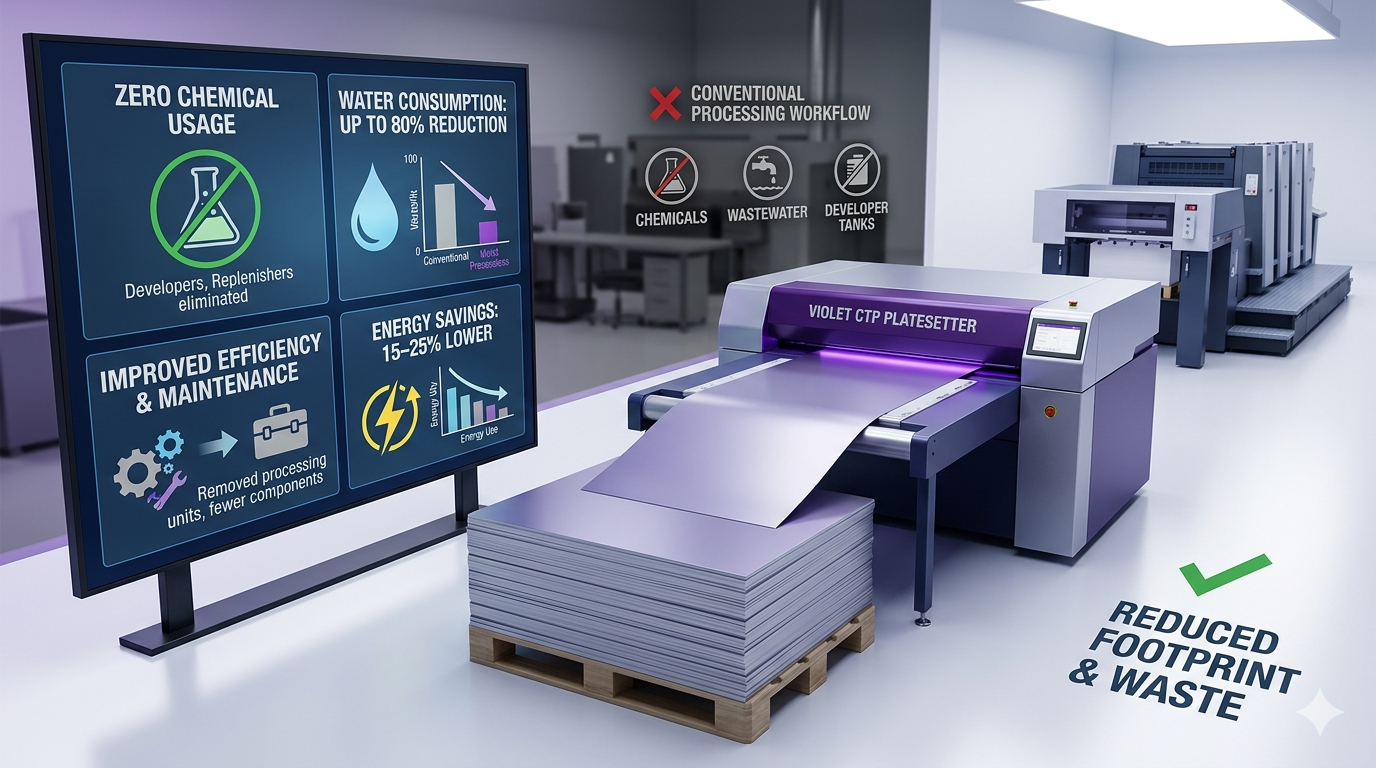
Violet processless CTP plates reduce chemical usage to zero, eliminating developers, replenishers, and wastewater treatment. According to environmental studies, this can reduce water consumption by up to 80% compared to conventional processed plates.
These plates improve workflow efficiency by removing processing units, which reduces equipment footprint by 20–30%. Maintenance costs also decrease due to fewer mechanical components and no chemical handling.
Energy consumption is significantly lower because processors and drying systems are not required. Industry benchmarks indicate energy savings of 15–25% in plate production environments.
What are the limitations of violet processless CTP plates?
Violet processless CTP plates typically have shorter run lengths compared to thermal plates. Standard durability ranges from 50,000 to 150,000 impressions, depending on press conditions and substrate.
They are more sensitive to ambient light and require controlled handling environments. Exposure to white light can degrade plate performance, necessitating yellow safelight conditions in prepress areas.
Ink compatibility and press calibration are critical. Improper ink-water balance can lead to slower image stabilization during startup, increasing paper waste by 1–3% in some cases.
How do violet processless plates compare with other CTP technologies?
| Feature | Violet Processless Plates | Thermal Processed Plates | UV-CTP Plates |
|---|---|---|---|
| Laser Type | 405 nm violet laser | 830 nm infrared laser | UV light |
| Processing Required | No | Yes | Yes |
| Run Length | 50k–150k impressions | 200k–500k impressions | 100k–300k impressions |
| Energy Consumption | Low | Medium–High | Medium |
| Environmental Impact | Very low | High (chemicals) | Moderate |
| Imaging Speed | High | Moderate | Moderate |
Violet processless plates are optimized for speed and sustainability, while thermal plates offer longer durability. UV-CTP plates occupy a middle ground with moderate processing requirements.
What are the main applications of violet processless CTP plates?
Violet processless CTP plates are widely used in newspaper printing, where daily plate changes and high throughput demand fast turnaround. Typical newspaper presses operate at speeds exceeding 30,000 copies per hour.
Commercial printing applications include brochures, flyers, and packaging inserts with run lengths under 100,000 impressions. These plates are ideal for quick job changes and short production cycles.
They are also used in environmentally regulated regions where wastewater discharge limits are strict. According to industry reports, adoption rates exceed 60% in some European markets.
How sustainable are violet processless CTP plates?
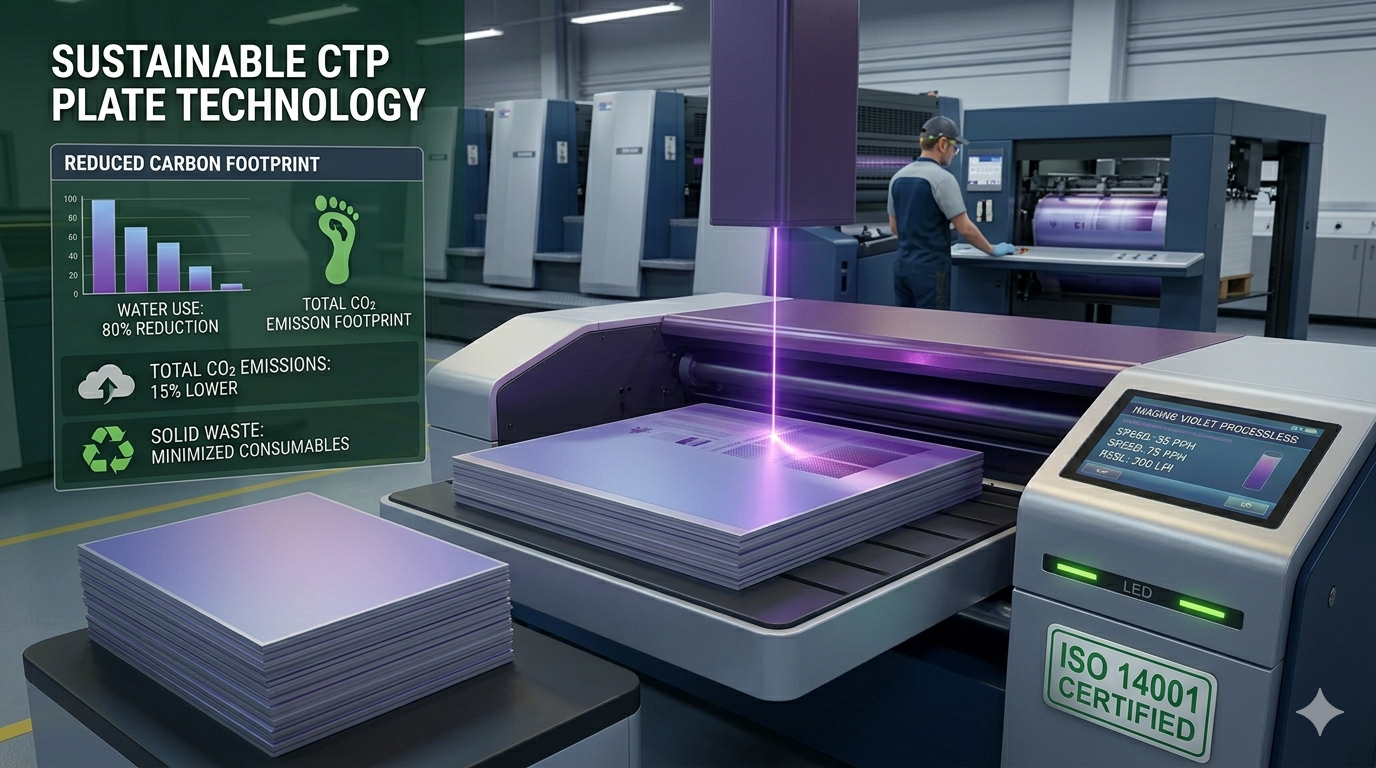
Violet processless CTP plates eliminate chemical waste entirely, reducing hazardous discharge to near zero. This aligns with global environmental standards such as ISO 14001.
Water usage is reduced by up to 80%, and chemical disposal costs are eliminated. Studies show that total carbon emissions in plate production can decrease by 10–20% when switching to processless systems.
Solid waste is also minimized, as fewer consumables such as filters and chemical containers are required. This contributes to a lower overall environmental footprint.
What factors affect performance and quality?
Plate performance depends on laser calibration, coating uniformity, and press conditions. Consistent exposure energy, typically within ±5%, ensures stable dot reproduction.
Environmental conditions such as temperature (20–25°C) and humidity (40–60%) affect plate stability. Deviations can lead to coating degradation or inconsistent imaging results.
Press setup is critical for optimal results. Proper ink-water balance and roller settings determine how quickly the plate reaches full image quality, usually within the first 100 sheets.
Expert Insight: Why violet processless plates are gaining adoption
Violet processless technology represents a shift toward simplified and sustainable prepress workflows. The elimination of processing equipment reduces capital expenditure by 15–25%, making it attractive for small and mid-sized print shops.
From an operational perspective, faster imaging speeds—often 20–30% higher than thermal systems—enable higher throughput. This directly impacts productivity in high-frequency job environments such as newspapers.
However, adoption depends on matching plate durability with job requirements. For long-run packaging or high-abrasion substrates, thermal plates remain more suitable despite higher environmental costs.
FAQ: Violet Processless CTP Plates
1. What is a violet processless CTP plate?
A violet processless CTP plate is a printing plate that uses 405 nm laser exposure and requires no chemical development. The image is formed directly on the press during startup.
2. How long do violet processless plates last?
Typical run lengths range from 50,000 to 150,000 impressions. Performance depends on press conditions, ink type, and substrate.
3. Are processless plates truly chemical-free?
Yes, processless plates eliminate developers and processing chemicals. However, standard printing consumables like ink and fountain solution are still required.
4. Do violet processless plates reduce costs?
They reduce operational costs by eliminating chemicals, water usage, and processor maintenance. Total cost savings can reach 10–20% depending on production volume.
5. What is the difference between violet and thermal CTP plates?
Violet plates use 405 nm lasers and are faster but less durable. Thermal plates use 830 nm lasers and offer longer run lengths but require chemical processing.
6. Are violet processless plates environmentally friendly?
Yes, they significantly reduce water consumption, energy use, and chemical waste. This makes them one of the most sustainable plate technologies available.
7. Can they be used for packaging printing?
They can be used for short-run packaging jobs, but thermal plates are preferred for long-run or high-abrasion packaging applications.
Why Does a CTP Plate Scum on Press ? 9 Common Causes and Proven Solutions
Learn why CTP plates scum on press, the most common causes, troubleshooting methods, and practical solutions to improve offset printing quality and reduce downtime.

Which Offset Machine Is Best ? A Practical Guide for Commercial Printing
Which offset machine is best? Learn how to choose the right offset printing machine based on format, volume, cost, and CTP technology.
Where to Buy Thermal CTP Plates for Offset Printing | Best Supplier Guide & Expert Tips
Looking for reliable thermal CTP plates for offset printing? This expert guide explains how to choose a trustworthy supplier, compares global and Chinese manufacturers, and shares key quality criteria.