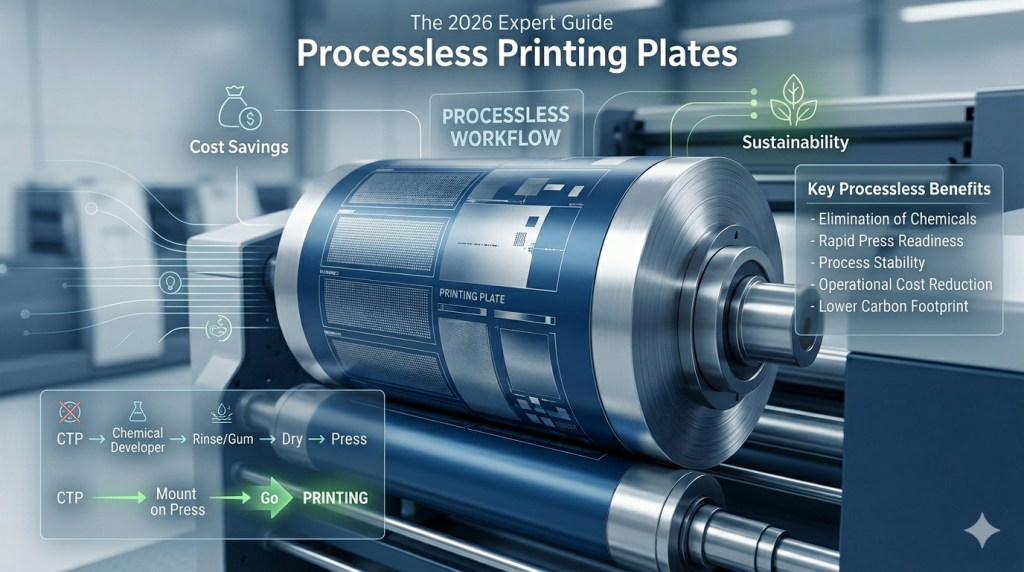
In today’s highly competitive printing industry, efficiency, sustainability, and cost control are no longer optional—they are essential. One of the most impactful innovations addressing all three is processless printing plate technology.
So, what are the benefits of processless printing plates?
Are they truly better than traditional thermal plates?
Can they meet the demands of commercial and packaging printing?
This comprehensive 2026 expert guide provides a deep, technical, yet practical analysis of processless plates, helping printers, procurement managers, and distributors make informed decisions.
1. What Are Processless Printing Plates?
Processless printing plates are offset printing plates that do not require chemical processing after imaging.
In traditional workflows:
- Plate is imaged
- Developed using chemicals
- Washed and gummed
- Dried before mounting
With processless plates:
- Plate is imaged
- Mounted directly on press
- Non-image coating is removed during initial printing
This eliminates the need for:
- Plate processors
- Developer chemicals
- Water rinsing systems
2. What Are the Benefits of Processless Printing Plates?
Let’s explore the benefits from a professional, real-world production perspective.
2.1 Significant Cost Reduction
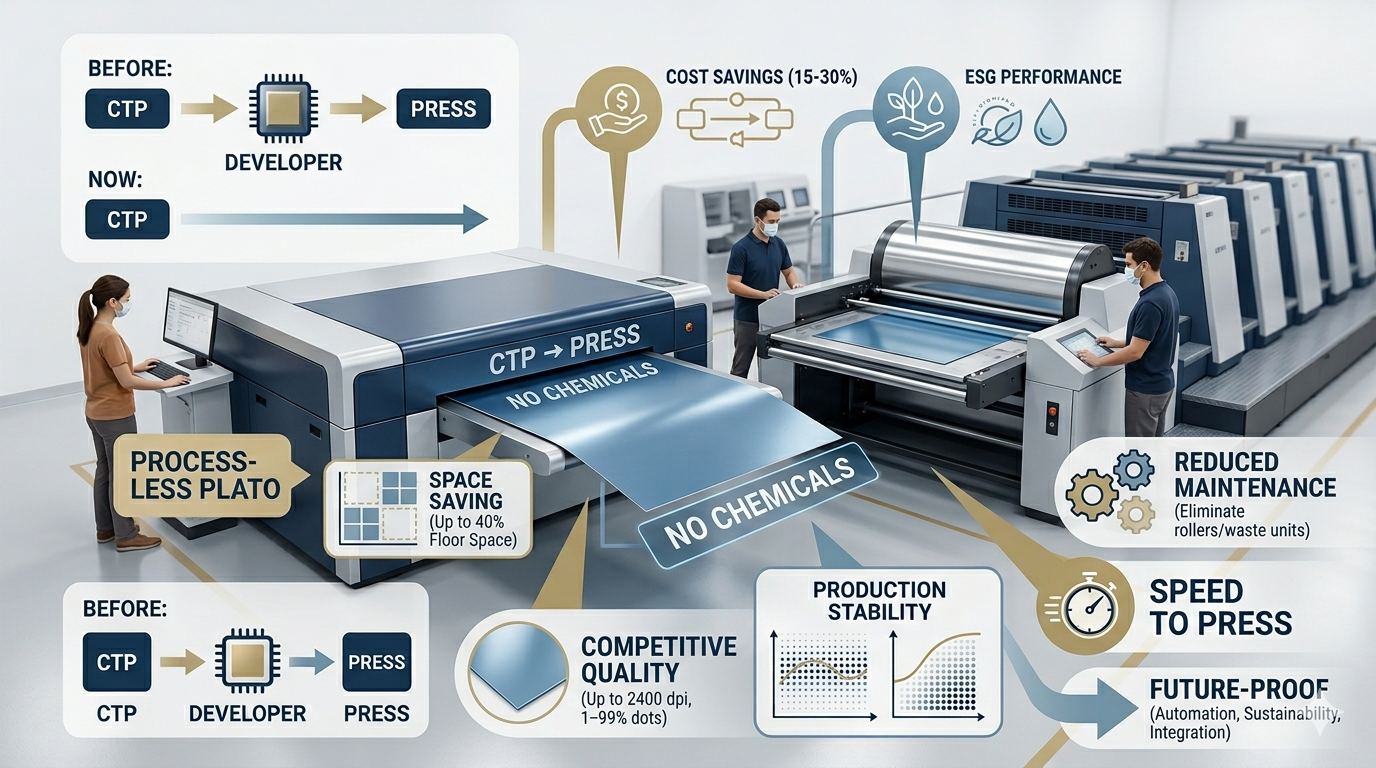
Although the unit price of processless plates may be slightly higher, the total cost of ownership (TCO) is significantly lower.
Savings Include:
- No developer chemicals
- No replenisher
- No gum solution
- Reduced water usage
- No processor maintenance
- Lower labor costs
Real Impact:
Printing plants typically reduce prepress operational costs by 15–30%.
Over time, this creates a strong financial advantage.
2.2 Environmental Sustainability
Environmental compliance is one of the strongest drivers behind the adoption of processless plates.
Benefits:
- Zero chemical discharge
- No hazardous waste
- Reduced water consumption
- Lower carbon footprint
Many regions (Europe, North America) now enforce strict environmental regulations.
Processless technology allows printers to:
- Meet compliance requirements
- Improve ESG performance
- Attract eco-conscious clients
2.3 Simplified Workflow
Traditional plate processing involves multiple steps and equipment.
Processless plates simplify everything:
Before:
CTP → Processor → Rinse → Gum → Dry → Press
After:
CTP → Press
Advantages:
- Faster job turnaround
- Reduced workflow complexity
- Lower risk of human error
- Increased production efficiency
2.4 Reduced Equipment and Maintenance
Eliminating the plate processor removes:
- Chemical tanks
- Rollers and motors
- Temperature control systems
- Waste treatment units
Result:
- Lower maintenance cost
- Reduced downtime
- Fewer mechanical failures
This is especially valuable for small and medium-sized printing plants.
2.5 Improved Production Stability
Chemical processing introduces variability:
- Developer exhaustion
- Temperature fluctuations
- Roller contamination
Processless plates eliminate these variables.
Benefits:
- Consistent imaging results
- Stable dot reproduction
- Reliable ink-water balance
Consistency improves overall print quality and reduces waste.
2.6 Faster Time-to-Press
In modern printing, speed is critical.
Processless plates allow:
- Immediate plate mounting
- No waiting for processing
- Faster job switching
This is particularly beneficial for:
- Short-run jobs
- On-demand printing
- Quick turnaround orders
2.7 Competitive Print Quality
Modern processless plates offer:
- High-resolution imaging (up to 2400 dpi)
- 1–99% dot reproduction
- Smooth gradients
- Sharp text clarity
Advancements in coating technology ensure performance comparable to traditional thermal plates.
2.8 Space Saving
Plate processors take up valuable floor space.
Removing them results in:
- More compact production layout
- Reduced infrastructure requirements
- Lower electricity consumption
This is especially important in urban printing facilities.
2.9 Safer Working Environment
Without chemicals, the workplace becomes:
- Cleaner
- Safer for operators
- Easier to manage
There is no exposure to:
- Corrosive chemicals
- Chemical fumes
- Hazardous waste
2.10 Future-Proof Technology
The printing industry is evolving toward:
- Automation
- Sustainability
- Digital integration
Processless plates align perfectly with these trends.
They represent a future-ready solution for modern printing businesses.
3. Are There Any Limitations?
While the benefits of processless printing plates are substantial, there are a few considerations:
- Slightly higher plate cost
- Requires proper press calibration
- Run length may be lower than top-tier thermal plates in extreme conditions
However, for most commercial printing applications, these limitations are minimal.
4. Ideal Applications for Processless Plates
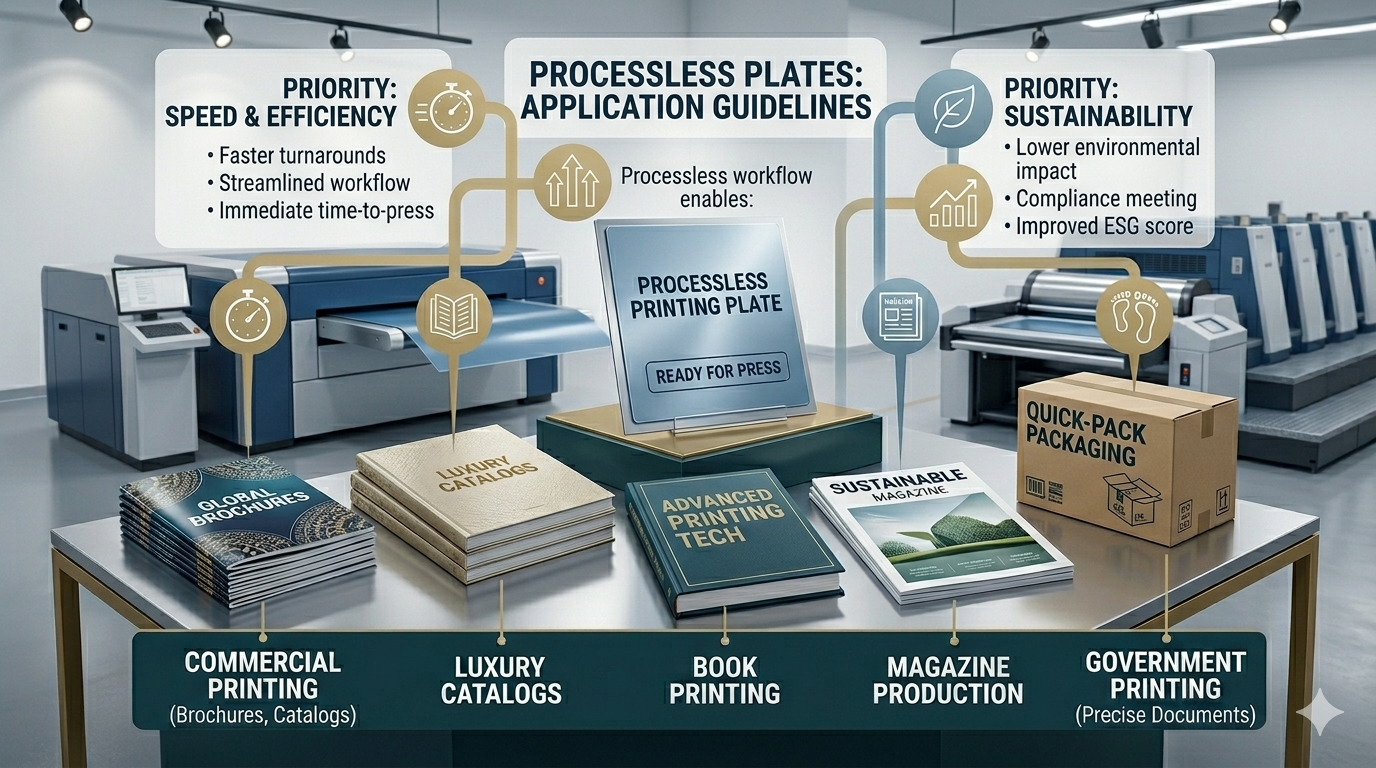
Processless plates are widely used in:
- Commercial printing (brochures, catalogs)
- Book printing
- Magazine production
- Short- to medium-run packaging
- Government printing
They are especially effective where speed, efficiency, and sustainability are priorities.
5. Comparison with Traditional Thermal Plates
| Feature | Processless Plates | Traditional Thermal Plates |
|---|---|---|
| Chemical processing | Not required | Required |
| Environmental impact | Very low | Medium |
| Workflow complexity | Simple | Complex |
| Cost efficiency | High (long-term) | Medium |
| Run length | Medium–High | High |
| Maintenance | Minimal | High |
6. Industry Trends in 2026
Global adoption of processless plates is increasing rapidly.
Key Drivers:
- Environmental regulations
- Rising chemical costs
- Labor shortages
- Demand for faster production
More printing companies are transitioning to processless systems to stay competitive.
7. How to Successfully Transition to Processless Plates
To maximize the benefits, printers should:
- Calibrate CTP exposure settings
- Ensure clean press conditions
- Optimize dampening solution
- Conduct trial testing
- Work with experienced suppliers
A proper transition ensures smooth operation and optimal performance.
Frequently Asked Questions (FAQ)
Q1: What are the benefits of processless printing plates compared to traditional plates?
Processless plates eliminate chemical processing, reducing costs, simplifying workflow, improving sustainability, and maintaining high print quality.
Q2: Do processless plates reduce production costs?
Yes. Although plate cost may be slightly higher, total costs decrease due to savings in chemicals, water, labor, and maintenance.
Q3: Are processless plates environmentally friendly?
Yes. They produce no chemical waste and significantly reduce environmental impact.
Q4: What is the typical run length?
Most processless plates achieve 80,000–150,000 impressions, depending on printing conditions.
Q5: Can processless plates be used with existing CTP machines?
Yes. Most thermal CTP systems (830 nm) are compatible, with minor calibration adjustments.
Q6: Do processless plates affect print quality?
No. Modern plates provide high-resolution output comparable to traditional thermal plates.
Q7: Are they suitable for packaging printing?
Yes, especially for short- and medium-run packaging applications.
Q8: Is switching to processless technology difficult?
No. With proper testing and calibration, most printing plants can transition smoothly.
Conclusion
So, what are the benefits of processless printing plates?
They offer a powerful combination of:
- Cost savings
- Environmental sustainability
- Simplified workflow
- High-quality printing
- Operational efficiency
Processless plates are not just an alternative—they are becoming the new standard in modern offset printing.
Looking for a Reliable Processless Printing Plate Manufacturer?
We are a professional manufacturer specializing in:
- Processless CTP plates
- Thermal CTP plates
- UV CTP plates
We provide:
- Stable quality
- Competitive pricing
- Custom sizes and specifications
- Technical support and testing
If you are considering upgrading to processless technology, feel free to contact us for samples and consultation.
We are ready to support your printing business with high-performance, eco-friendly plate solutions.
Why Does a CTP Plate Scum on Press ? 9 Common Causes and Proven Solutions
Learn why CTP plates scum on press, the most common causes, troubleshooting methods, and practical solutions to improve offset printing quality and reduce downtime.
Which Offset Machine Is Best ? A Practical Guide for Commercial Printing
Which offset machine is best? Learn how to choose the right offset printing machine based on format, volume, cost, and CTP technology.
Where to Buy Thermal CTP Plates for Offset Printing | Best Supplier Guide & Expert Tips
Looking for reliable thermal CTP plates for offset printing? This expert guide explains how to choose a trustworthy supplier, compares global and Chinese manufacturers, and shares key quality criteria.