Introduction
Book printing remains one of the largest segments of the global offset printing industry. Despite the growth of digital publishing, millions of textbooks, educational materials, novels, magazines, journals, and commercial publications are still produced using offset printing technology every year.
For printing companies, selecting the right Computer-to-Plate (CTP) solution directly affects print quality, production efficiency, operating costs, and customer satisfaction.
One of the most common questions from printers and publishing houses is:
What are the best CTP plates for book printing?
The answer depends on several factors, including print volume, press configuration, budget, workflow requirements, and environmental considerations.
This guide compares the most commonly used CTP plate technologies and helps publishers, commercial printers, and printing plate distributors choose the best solution for book production in 2026.
Why CTP Plate Selection Matters in Book Printing
Unlike packaging printing, which often involves special coatings and substrates, book printing typically requires:
- Consistent image quality
- Accurate text reproduction
- Stable long production runs
- Cost-effective plate consumption
- Reliable repeatability
Because book projects frequently involve thousands or even hundreds of thousands of impressions, plate durability and imaging precision become critical factors.
A poorly selected plate can lead to:
- Dot gain issues
- Text clarity problems
- Increased waste
- Press downtime
- Higher production costs
Key Requirements for Book Printing Plates
Before choosing a plate type, printers should evaluate their production requirements.
High Resolution
Book printing often includes:
- Small text
- Fine lines
- Detailed graphics
- Grayscale images
The plate must provide excellent dot reproduction and image stability.
Long Run Length
Educational publishers and large-volume book manufacturers often print:
- 20,000 copies
- 50,000 copies
- 100,000+ copies
The plate should maintain image quality throughout extended press runs.
Cost Efficiency
Since books are usually produced in large quantities with competitive pricing pressures, plate cost significantly affects overall production profitability.
Consistent Performance
Publishers demand consistent quality across multiple editions and reprints.
The chosen plate must deliver repeatable imaging and printing performance.
Types of CTP Plates Used in Book Printing
The most common options include:
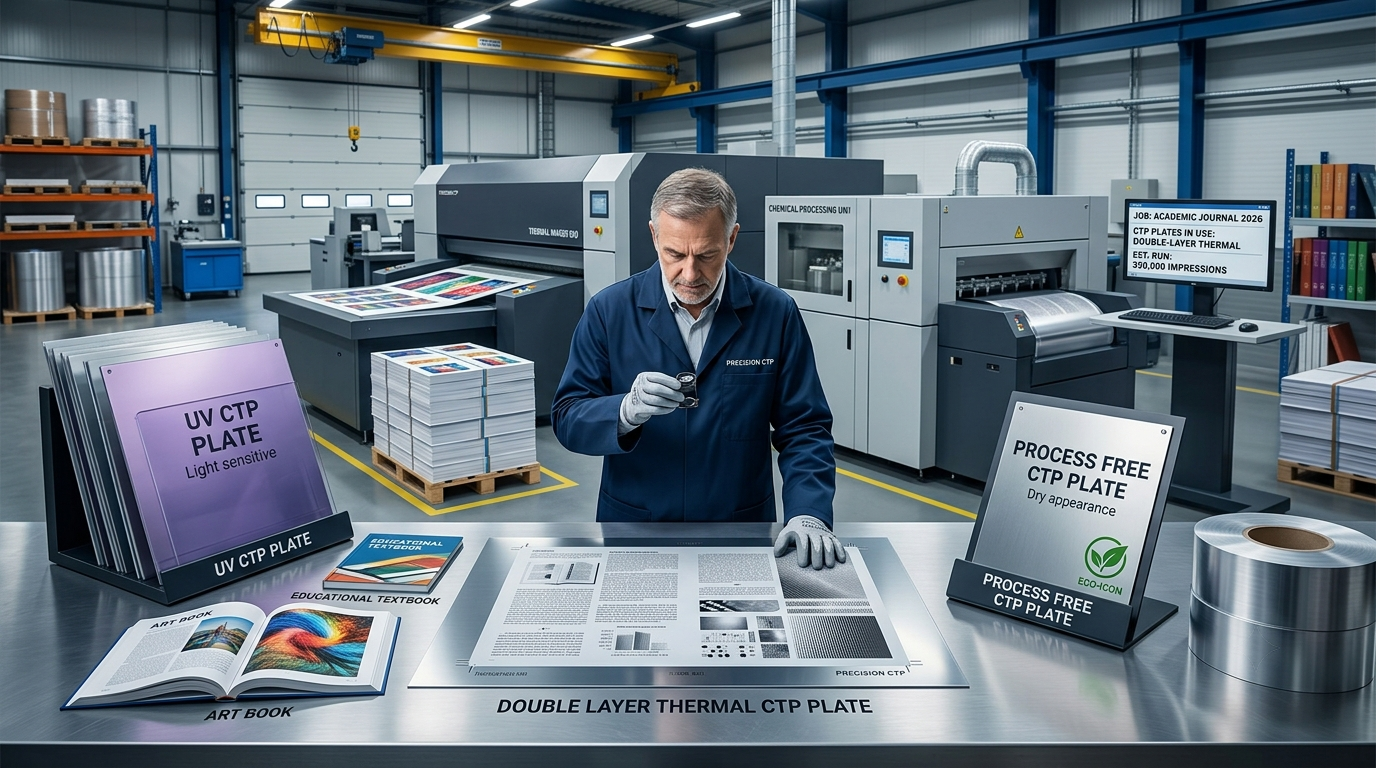
Thermal CTP Plates
Process Free CTP Plates
UV CTP Plates
Each technology offers different advantages depending on the printing environment.
Thermal CTP Plates: The Preferred Choice for High-Quality Book Printing
Thermal CTP plates remain the most widely used solution among professional book printers worldwide.
Advantages
- Excellent image stability
- Superior dot reproduction
- High resolution output
- Long run length
- Broad compatibility with modern CTP systems
Typical Applications
- Educational textbooks
- Academic publications
- High-volume commercial books
- Art books
- Professional publishing
Typical Run Length
| Plate Type | Average Run Length |
|---|---|
| Single Layer Thermal Plate | 100,000–200,000 impressions |
| Double Layer Thermal Plate | 200,000–500,000 impressions |
For large publishing houses, thermal plates are often considered the industry benchmark.
Process Free Plates: A Growing Choice for Sustainable Publishing
As environmental regulations become stricter, many book printers are transitioning toward process free technology.
Process free plates eliminate traditional processing steps and reduce chemical consumption.
Advantages
- No developer chemicals required
- Lower environmental impact
- Reduced maintenance costs
- Faster workflow
- Simplified production
Ideal Applications
- Commercial book printing
- Educational publishing
- Medium-to-high volume production
Considerations
Modern process free plates offer excellent print quality, although run length may vary depending on the manufacturer and printing conditions.
UV CTP Plates: A Cost-Effective Solution for Regional Book Printers
UV CTP plates remain popular in regions where violet laser CTP systems are widely installed.
Advantages
- Lower plate cost
- Lower equipment investment
- Proven technology
- Reliable performance
Ideal Applications
- Regional publishing
- Short-to-medium print runs
- Cost-sensitive production environments
Limitations
Compared with premium thermal plates, UV plates may provide slightly lower image stability for highly demanding applications.
Comparison: Best CTP Plates for Book Printing
| Criteria | Thermal CTP Plate | Process Free Plate | UV CTP Plate |
|---|---|---|---|
| Print Quality | Excellent | Excellent | Good |
| Text Reproduction | Excellent | Excellent | Good |
| Run Length | Excellent | Very Good | Good |
| Production Cost | Medium | Medium | Low |
| Environmental Impact | Good | Excellent | Good |
| Maintenance Requirements | Medium | Low | Medium |
| Publishing Industry Adoption | Very High | Growing Rapidly | Moderate |
Which CTP Plate Is Best for Different Book Printing Scenarios?
Educational Textbooks
Recommended:
Thermal CTP Plates
Reasons:
- Long print runs
- Consistent quality
- Reliable reproduction of text and graphics
Academic Publishing
Recommended:
Thermal or Process Free Plates
Reasons:
- High-resolution requirements
- Detailed image reproduction
- Consistent reprint quality
Commercial Book Printing
Recommended:
Process Free Plates
Reasons:
- Reduced operating costs
- Environmental advantages
- Excellent production efficiency
Budget-Conscious Regional Printers
Recommended:
UV CTP Plates
Reasons:
- Lower investment costs
- Reliable technology
- Strong return on investment
How Publishers Evaluate Plate Performance
Leading publishers often evaluate plates based on:
Text Sharpness
Small text must remain crisp and readable throughout the production run.
Dot Reproduction
Accurate dot formation ensures image consistency and smooth tonal transitions.
Press Stability
Stable ink-water balance minimizes waste and improves productivity.
Reprint Consistency
Books frequently require additional print runs months or years later.
Consistent plate performance helps maintain publication quality standards.
What to Look for in a CTP Plate Supplier
Selecting the right plate is only part of the decision.
Choosing a reliable supplier is equally important.
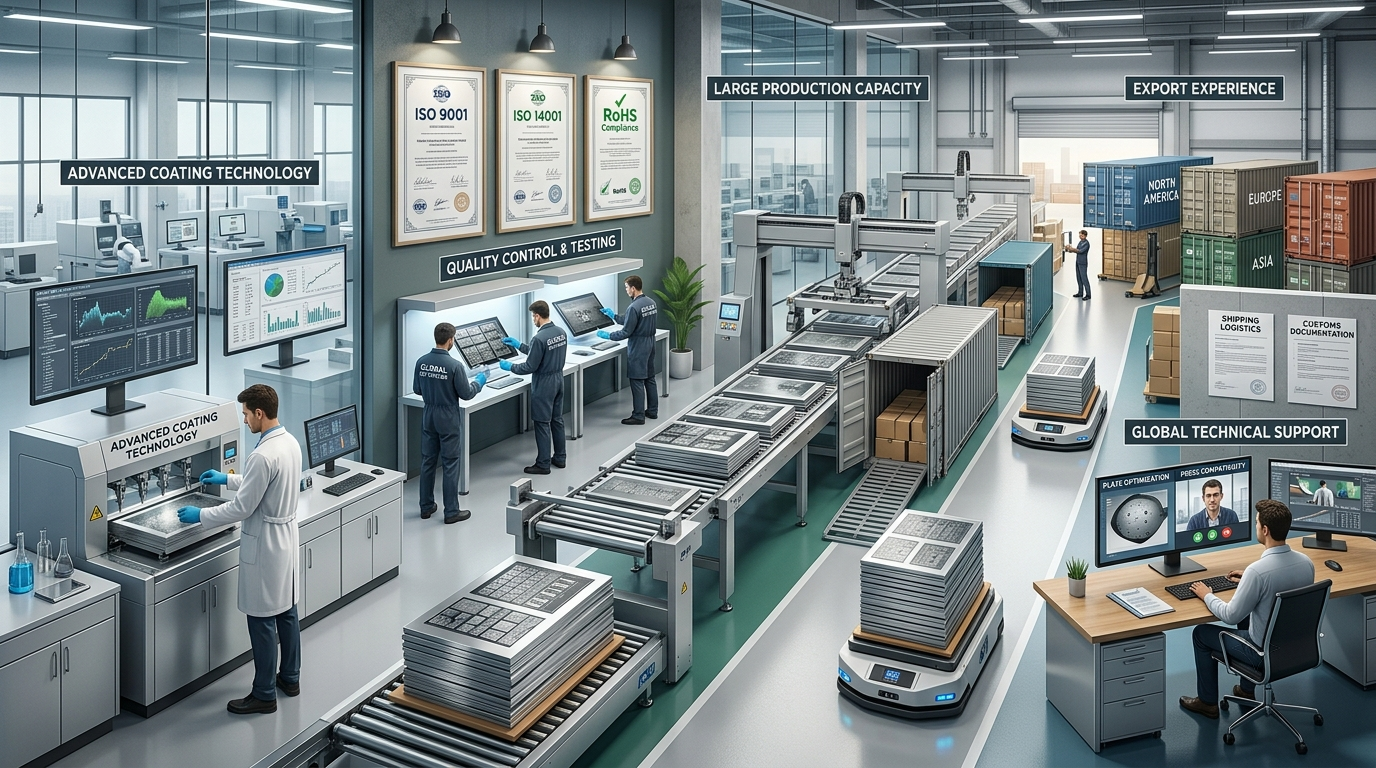
Manufacturing Experience
Look for manufacturers with:
- Advanced coating technology
- Stable quality control systems
- Large production capacity
Certifications
Recommended certifications include:
- ISO 9001
- ISO 14001
- RoHS Compliance
Technical Support
Professional suppliers should offer:
- Plate testing
- Imaging optimization
- Press compatibility guidance
- Troubleshooting assistance
Export Experience
International buyers benefit from suppliers experienced in:
- Packaging protection
- Shipping logistics
- Customs documentation
- Global distribution
Frequently Asked Questions
What is the best CTP plate for book printing?
Thermal CTP plates are generally considered the best option for high-volume book printing because of their excellent image quality, durability, and production consistency.
Are process free plates suitable for book printing?
Yes. Modern process free plates provide excellent print quality and are increasingly used by commercial book printers seeking sustainable production solutions.
Can UV CTP plates be used for book printing?
Absolutely. UV CTP plates remain a practical and cost-effective option for many regional and medium-volume book printing operations.
Which plate provides the longest run length?
Double-layer thermal CTP plates typically offer the longest run length and are often used for large publishing projects.
How can printers reduce plate costs in book production?
Working directly with manufacturers, optimizing plate specifications, and selecting the appropriate plate technology can significantly reduce production expenses.
Conclusion
Selecting the best CTP plate for book printing depends on balancing print quality, durability, operational efficiency, and budget requirements.
For large-scale publishing and premium book production, thermal CTP plates continue to set the industry standard. Process free plates are rapidly gaining market share due to their environmental and operational advantages, while UV CTP plates remain a cost-effective solution for many regional printing businesses.
By understanding production requirements and partnering with a reliable CTP plate manufacturer, publishers and commercial printers can improve print quality, reduce waste, and achieve long-term production efficiency.
Why Does a CTP Plate Scum on Press ? 9 Common Causes and Proven Solutions
Learn why CTP plates scum on press, the most common causes, troubleshooting methods, and practical solutions to improve offset printing quality and reduce downtime.
Which Offset Machine Is Best ? A Practical Guide for Commercial Printing
Which offset machine is best? Learn how to choose the right offset printing machine based on format, volume, cost, and CTP technology.
Where to Buy Thermal CTP Plates for Offset Printing | Best Supplier Guide & Expert Tips
Looking for reliable thermal CTP plates for offset printing? This expert guide explains how to choose a trustworthy supplier, compares global and Chinese manufacturers, and shares key quality criteria.