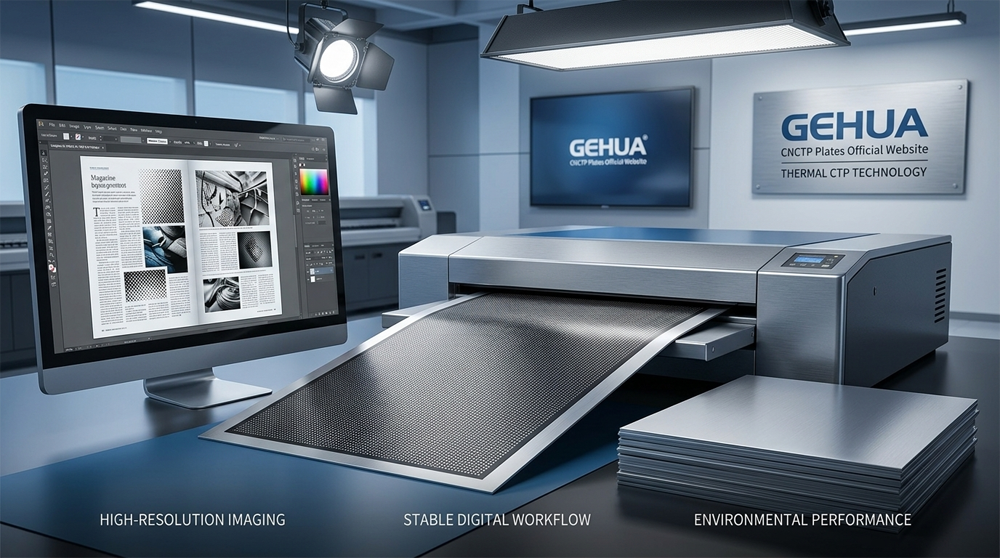
What Is Thermal CTP Plates?
Thermal CTP plates are advanced offset printing plates that use infrared laser technology to directly transfer digital images from a computer to the printing plate without requiring traditional photographic film.
Unlike conventional plate-making methods, thermal Computer-to-Plate (CTP) technology eliminates the need for film output and improves printing accuracy, productivity, and environmental performance.
A thermal CTP plate contains a specially designed thermal-sensitive coating that reacts when exposed to an 830nm infrared laser inside a CTP imaging machine. The exposed areas or unexposed areas are selectively removed during processing, creating a high-resolution printing image.
Today, thermal CTP plates are widely used in commercial printing, newspaper printing, packaging printing, and high-quality offset applications because of their excellent image reproduction, stability, and compatibility with modern digital workflows.
Why Are Thermal CTP Plates Important in Modern Printing?
The printing industry has moved from analog plate production to fully digital workflows.
Traditional offset plate production required:
- film output
- film developing
- manual plate positioning
- additional chemical processes
These steps increased:
- production time
- material consumption
- labor costs
- environmental waste
Thermal CTP technology changed this process by allowing printers to directly image plates from digital files.
For commercial printers, this means:
| Traditional Plate Making | Thermal CTP Workflow |
|---|---|
| Requires film | No film required |
| More manual operations | Fully digital workflow |
| Lower registration accuracy | Higher imaging precision |
| More chemical consumption | Reduced chemical usage |
| Longer preparation time | Faster plate production |
As printing companies continue to improve automation and sustainability, thermal CTP plates have become one of the most important technologies in modern offset printing.
How Does Thermal CTP Technology Work?
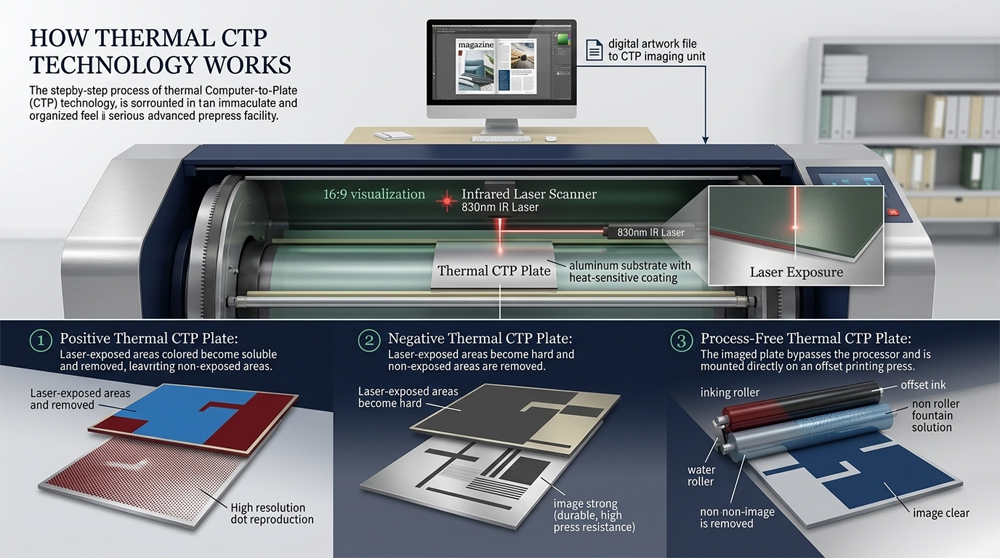
A thermal CTP plate works through a combination of digital imaging technology and heat-sensitive coating chemistry.
The process begins when a digital artwork file is sent from the prepress workflow system to a CTP imaging machine.
Inside the CTP machine, an infrared laser scans the plate surface with extremely high accuracy. The laser energy activates the thermal coating according to the digital image information.
The exposed plate then goes through a suitable processing method depending on the plate type.
Common thermal CTP plate technologies include:
1. Positive Thermal CTP Plates
Positive thermal plates use a coating that becomes soluble after laser exposure.
During processing:
- Laser-exposed areas are removed
- Non-exposed areas remain as the printing image
These plates are known for:
- excellent dot reproduction
- high resolution
- stable printing performance
They are widely used for commercial offset printing.
2. Negative Thermal CTP Plates
Negative thermal plates work in the opposite way.
The laser exposure causes the coating to harden or polymerize.
During processing:
- Exposed areas become the image area
- Unexposed areas are removed
Advantages include:
- strong image durability
- high press resistance
- suitability for long printing runs
3. Process-Free Thermal CTP Plates
Process-free thermal CTP plates eliminate traditional chemical processing.
After laser imaging:
- the plate can go directly onto the printing press
- ink and fountain solution remove the non-image coating
Benefits:
- lower chemical consumption
- reduced environmental impact
- simplified workflow
- lower operating costs
This technology is becoming increasingly popular among environmentally conscious printing companies.
Main Components of a Thermal CTP Plate
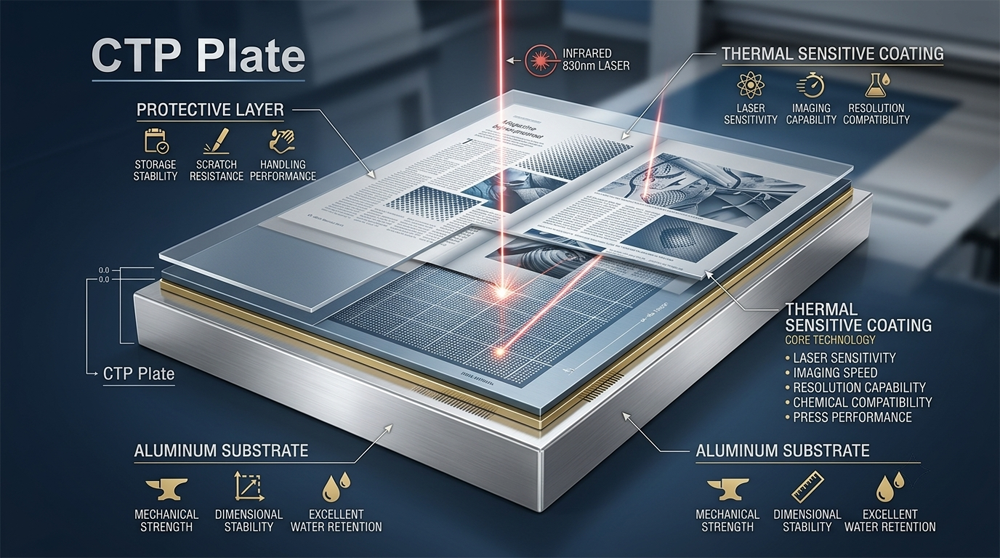
A thermal CTP plate normally consists of several functional layers.
Aluminum Substrate
The aluminum base provides:
- mechanical strength
- dimensional stability
- excellent water retention characteristics
High-quality thermal CTP plates usually use specially treated aluminum substrates to improve printing consistency.
Thermal Sensitive Coating
The thermal coating is the core technology of the plate.
It determines:
- laser sensitivity
- imaging speed
- resolution capability
- chemical compatibility
- press performance
Different manufacturers develop proprietary coating formulas to achieve different printing requirements.
Protective Layer
Some thermal plates include a protective layer to improve:
- storage stability
- scratch resistance
- handling performance
What Are the Advantages of Thermal CTP Plates?
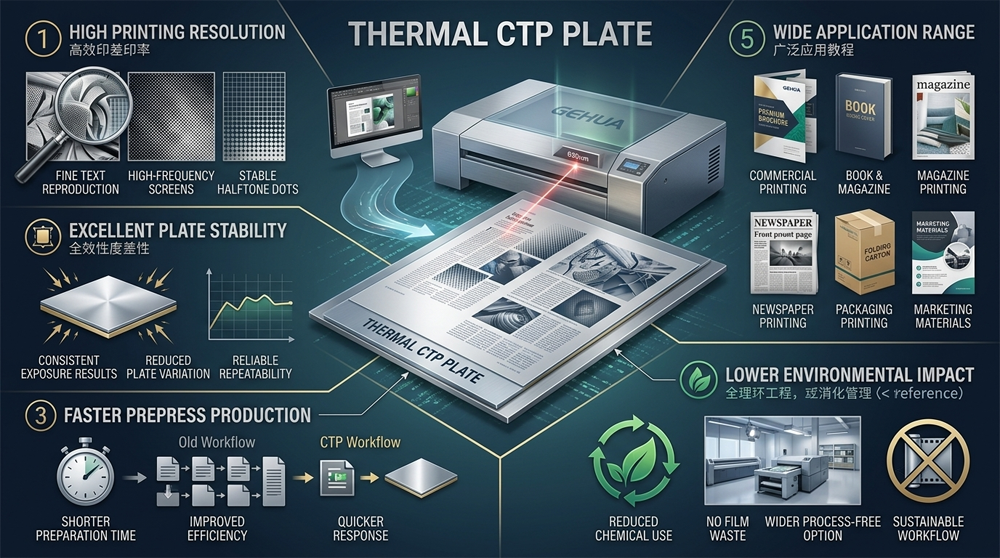
1. High Printing Resolution
Thermal CTP plates can achieve extremely accurate laser imaging, supporting:
- fine text reproduction
- high-frequency screens
- detailed images
- stable halftone dots
This makes them suitable for premium commercial printing.
2. Excellent Plate Stability
Thermal imaging technology provides stable performance under different production conditions.
Benefits include:
- consistent exposure results
- reduced plate variation
- reliable repeatability
3. Faster Prepress Production
Because thermal CTP eliminates film production, printers can significantly shorten preparation time.
This helps printing companies:
- respond faster to customer orders
- improve production efficiency
- reduce labor requirements
4. Lower Environmental Impact
Compared with traditional plate-making methods, thermal CTP technology reduces:
- film waste
- chemical consumption
- wastewater generation
Process-free thermal CTP plates further improve sustainability.
5. Wide Application Range
Thermal CTP plates are suitable for:
- commercial printing
- book printing
- magazine printing
- newspaper printing
- packaging printing
- high-end marketing materials
Thermal CTP Plates vs UV CTP Plates: What Is the Difference?
| Feature | Thermal CTP Plates | UV CTP Plates |
|---|---|---|
| Laser type | Infrared laser | UV laser |
| Typical wavelength | Around 830nm | Around 405nm |
| Imaging speed | High | Moderate |
| Workflow | Modern digital workflow | Compatible with UV systems |
| Market adoption | Very common | Growing in specific markets |
| Main advantage | Stability and quality | Lower equipment cost |
Thermal CTP remains the preferred choice for many professional commercial printers because of its balance between image quality, reliability, and productivity.
How to Choose the Right Thermal CTP Plates?
When selecting thermal CTP plates, printing companies should consider several factors:
Printing Volume
Different plates are designed for different run lengths.
Consider:
- short-run commercial printing
- medium production
- long-run packaging printing
CTP Machine Compatibility
Before purchasing, confirm compatibility with:
- CTP equipment model
- laser wavelength
- plate size
- processor type
Plate Performance Requirements
Important parameters include:
- resolution
- sensitivity
- chemical resistance
- press life
- storage stability
Supplier Reliability
A professional thermal CTP plate supplier should provide:
- consistent quality control
- technical support
- stable production capacity
- customized sizes
Applications of Thermal CTP Plates
Thermal CTP plates are widely used in:
Commercial Printing
Including:
- brochures
- catalogs
- posters
- marketing materials
Book Printing
Thermal plates provide:
- stable long-run performance
- accurate text reproduction
- consistent color quality
Packaging Printing
Used for:
- cartons
- labels
- folding packaging
Newspaper Printing
High-speed production requires plates with:
- fast imaging
- reliable performance
- excellent durability
Frequently Asked Questions About Thermal CTP Plates
What is a thermal CTP plate?
A thermal CTP plate is an offset printing plate that uses infrared laser exposure technology to create printing images directly from digital files.
Are thermal CTP plates better than traditional PS plates?
Yes, in most modern printing environments thermal CTP plates provide better workflow efficiency, higher accuracy, and reduced preparation time compared with traditional PS plates.
What wavelength do thermal CTP plates use?
Most thermal CTP plates are designed for 830nm infrared laser imaging systems.
Can thermal CTP plates be used without chemicals?
Yes. Process-free thermal CTP plates are available and can reduce or eliminate chemical processing.
How long can thermal CTP plates last?
Plate life depends on coating technology, printing conditions, ink, paper, and press operation. High-quality thermal CTP plates can support long printing runs.
Why Choose GEHUA Thermal CTP Plates?
CNCTP Plates Official Website provides professional thermal CTP plates designed for commercial printing applications.
With extensive experience in prepress materials manufacturing, GEHUA develops thermal CTP solutions focused on:
- consistent imaging quality
- stable plate performance
- international printing standards
- customized plate specifications
Our thermal CTP plates are suitable for printing companies looking for reliable performance and competitive production costs.
Conclusion
Thermal CTP plates represent one of the most important technologies in modern offset printing.
By replacing traditional film-based plate production with digital thermal imaging, they provide higher efficiency, better image quality, improved stability, and a more sustainable printing workflow.
For commercial printers, publishers, and printing service providers, choosing the right thermal CTP plate supplier is essential for achieving consistent production quality and reducing operating costs.
Why Does a CTP Plate Scum on Press ? 9 Common Causes and Proven Solutions
Learn why CTP plates scum on press, the most common causes, troubleshooting methods, and practical solutions to improve offset printing quality and reduce downtime.

Which Offset Machine Is Best ? A Practical Guide for Commercial Printing
Which offset machine is best? Learn how to choose the right offset printing machine based on format, volume, cost, and CTP technology.
Where to Buy Thermal CTP Plates for Offset Printing | Best Supplier Guide & Expert Tips
Looking for reliable thermal CTP plates for offset printing? This expert guide explains how to choose a trustworthy supplier, compares global and Chinese manufacturers, and shares key quality criteria.