
Introduction
In offset printing, the printing plate is not just a consumable—it is a key factor that determines image quality, production efficiency, operating cost, and workflow stability. As prepress technology has evolved, printers now commonly choose between CTP plates, CTcP plates, and traditional PS plates.
Although these three plate types serve the same basic function, their imaging methods, workflows, cost structures, and production suitability differ significantly. Understanding these differences is essential for printers who want to optimize productivity while controlling costs.
This article provides a clear and professional comparison of CTP plate, CTcP plate, and PS plate differences, helping you choose the right solution for your printing operation.
1. CTP Plate: Modern Digital Standard (Brief Overview)
A CTP (Computer-to-Plate) plate is imaged directly from digital files using a laser CTP system, without film. It represents the most advanced and widely adopted plate technology in modern offset printing.
Key characteristics:
Direct digital laser imaging
High precision and repeatability
Available as thermal, violet, and process-free versions
CTP plates are the mainstream choice for professional commercial and packaging printers.
2. CTcP Plate: Digital Imaging with Conventional Chemistry (Brief Overview)
A CTcP (Computer-to-Conventional Plate) plate is digitally exposed by a CTP device but processed using traditional PS plate chemistry.
Key characteristics:
UV laser exposure (typically 405 nm)
Compatible with existing PS processors
Lower equipment investment than thermal CTP
CTcP plates are often used as a cost-effective transition from PS to full CTP workflows.
3. PS Plate: Traditional Film-Based Technology (Brief Overview)
A PS (Pre-Sensitized) plate is exposed using film and UV light, followed by chemical development.
Key characteristics:
Film-based exposure
Manual or semi-automatic workflow
Lowest plate cost, highest labor involvement
PS plates are still used in some regions but are gradually being phased out.
4. Imaging Technology and Workflow Comparison
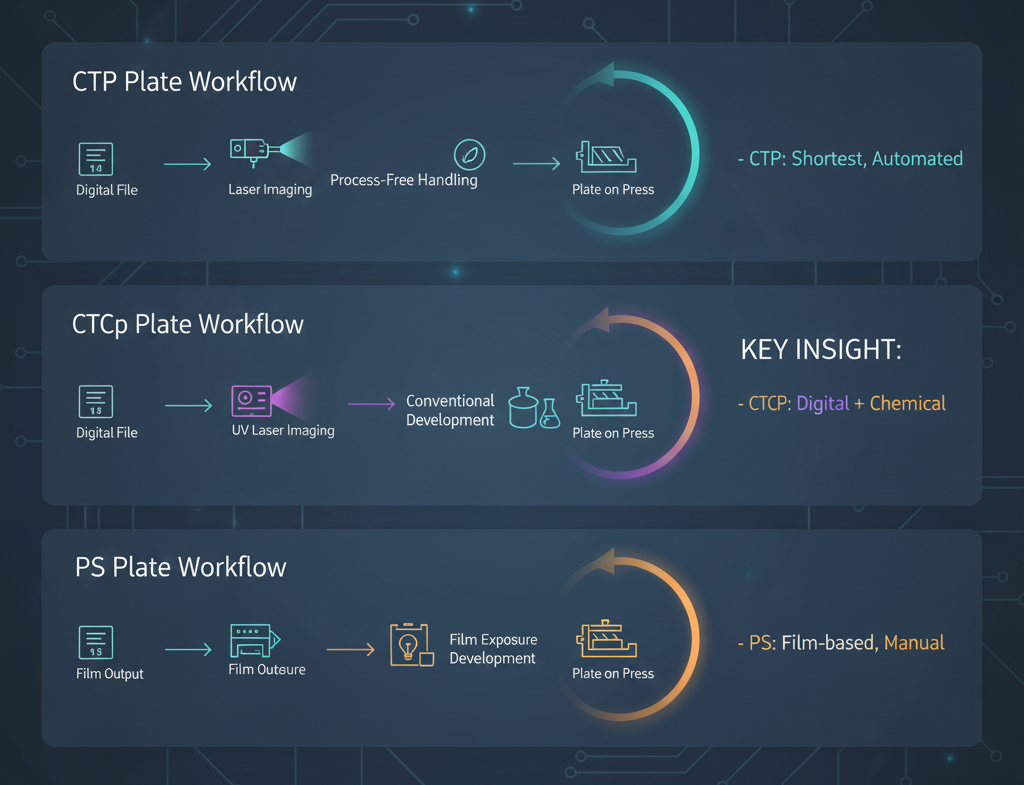
CTP Plate Workflow
Digital file → Laser imaging
Plate processing or process-free handling
Plate mounted on press
CTcP Plate Workflow
Digital file → UV laser imaging
Conventional plate development
Plate mounted on press
PS Plate Workflow
Digital file → Film output
Film exposure on plate
Chemical development
Plate mounted on press
Key insight:
CTP plates offer the shortest, most automated workflow, while PS plates involve the most steps and manual intervention.
5. Print Quality and Image Reproduction Differences
CTP Plates
Excellent dot accuracy
Sharp highlights and shadows
Stable ink-water balance
Highly consistent color reproduction
CTP plates are ideal for color-critical and high-resolution printing.
CTcP Plates
Very good image quality for most commercial work
Slightly narrower exposure latitude than thermal CTP
More sensitive to processing conditions
CTcP plates deliver reliable quality when properly controlled.
PS Plates
Quality depends heavily on film accuracy
Higher risk of dot loss or registration issues
Less consistency between jobs
PS plates are suitable for basic printing, but not demanding color work.
6. Production Efficiency and Labor Requirements
| Aspect | CTP Plate | CTcP Plate | PS Plate |
|---|---|---|---|
| Imaging Speed | Very fast | Fast | Slow |
| Manual Steps | Minimal | Moderate | High |
| Human Error Risk | Very low | Low | High |
| Job Repeatability | Excellent | Good | Limited |
Conclusion:
CTP plates significantly reduce labor dependency and production variability.
7. Cost Structure: Short-Term vs Long-Term
Plate Cost
PS plate: Lowest
CTcP plate: Medium
CTP plate: Medium to high
While PS plates appear cheaper initially, CTP plates usually deliver the lowest total cost per printed sheet.
8. Environmental and Sustainability Comparison
CTP Plates
No film waste
Process-free options available
Lower chemical and water usage
CTcP Plates
No film waste
Still require developer chemicals
PS Plates
Film disposal required
Higher water and chemical consumption
As environmental regulations tighten, CTP plates—especially process-free versions—are becoming the preferred choice.
9. Application Scenarios and Best Use Cases
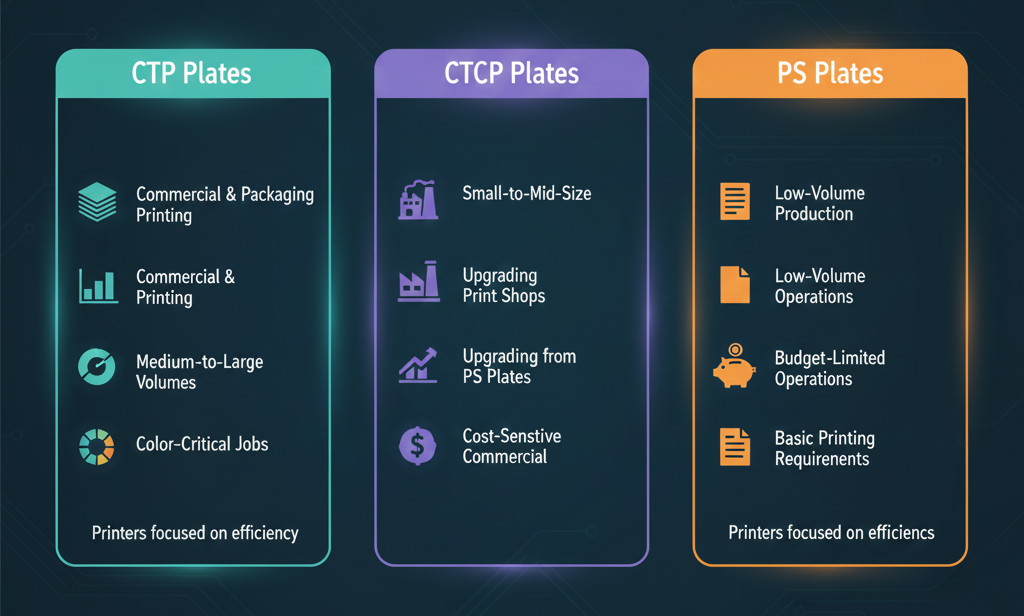
CTP Plates Are Best For:
Commercial and packaging printing
Medium to large production volumes
Color-critical jobs
Printers focused on efficiency and consistency
CTcP Plates Are Best For:
Small to mid-size print shops
Printers upgrading from PS plates
Cost-sensitive commercial printing
PS Plates Are Best For:
Low-volume production
Budget-limited operations
Basic printing requirements
10. Upgrade Path for Printers
Many printers follow this progression:
PS Plate → CTcP Plate → CTP Plate
CTcP often serves as a transitional technology, while CTP plates represent the long-term direction of offset printing.
11. Why We Manufacture CTP, CTcP, and PS Plates
As a professional manufacturer of CTP plates, CTcP plates, and PS plates, we understand that every printing operation has unique needs.
We offer:
Thermal and violet CTP plates
High-stability CTcP plates
Reliable conventional PS plates
Custom sizes and thicknesses
Consistent batch quality
Professional technical support
Our products are designed to deliver:
Stable imaging performance
Reliable press behavior
Competitive total cost of ownership
If you are evaluating CTP plates, CTcP plates, or PS plates, we are ready to support your production.
Feel free to contact us for samples, technical consultation, or pricing.
Why Does a CTP Plate Scum on Press ? 9 Common Causes and Proven Solutions
Learn why CTP plates scum on press, the most common causes, troubleshooting methods, and practical solutions to improve offset printing quality and reduce downtime.
Which Offset Machine Is Best ? A Practical Guide for Commercial Printing
Which offset machine is best? Learn how to choose the right offset printing machine based on format, volume, cost, and CTP technology.
Where to Buy Thermal CTP Plates for Offset Printing | Best Supplier Guide & Expert Tips
Looking for reliable thermal CTP plates for offset printing? This expert guide explains how to choose a trustworthy supplier, compares global and Chinese manufacturers, and shares key quality criteria.