FAQ of Processless CTP Plates
Below are the most frequently asked questions by printing professionals.
1. Do Processless Plates Require a Special CTP Machine?
Most processless plates are thermal plates designed for 830 nm laser CTP systems.
They are compatible with many widely used CTP machines, including:
Kodak Trendsetter series
Heidelberg Suprasetter
Screen PlateRite
Agfa Avalon
However, it is important to confirm laser wavelength compatibility and exposure energy settings when switching to processless plates.
In most cases, existing thermal CTP machines can be used without major modifications.
2. What Is the Typical Run Length of Processless CTP Plates?
Run length depends on several factors:
Printing press condition
Ink type
Paper substrate
Plate thickness
Press pressure
Typical run length ranges include:
| Application | Typical Run Length |
|---|---|
| Commercial printing | 80,000 – 120,000 impressions |
| Book printing | 100,000 – 150,000 impressions |
| Newspaper printing | 100,000 impressions |
| Packaging printing | varies depending on ink |
For most commercial printing jobs, processless plates provide sufficient durability and consistent print quality.
3. Do Processless Plates Affect Print Quality?
No. Modern processless plates are designed to achieve high-resolution dot reproduction comparable to traditional thermal plates.
Advantages include:
Stable halftone reproduction
Sharp text clarity
Smooth gradient transitions
Excellent ink balance
Advanced coating technology ensures stable imaging and reliable press performance.
4. Are Processless Plates More Expensive?
The unit price of processless plates can sometimes be slightly higher than traditional processed plates.
However, the total production cost is usually lower.
By eliminating plate processors and chemicals, printing companies save money on:
Developer chemicals
Water consumption
Equipment maintenance
Waste disposal
Labor costs
Overall cost savings can reach 15–30% in prepress operations.
5. Do Processless Plates Require Special Fountain Solution?
Processless plates work with most standard dampening systems.
However, optimal performance may require:
Low-chemistry fountain solutions
Proper pH balance
Stable conductivity levels
Modern printing plants often combine processless plates with alcohol-free printing systems to further improve environmental performance.
6. Are Processless Plates Environmentally Friendly?
Yes. Environmental sustainability is one of the biggest advantages.
Processless technology eliminates:
Plate developer chemicals
Wastewater from processing
Chemical storage and disposal
This significantly reduces the environmental footprint of printing operations and helps companies meet international environmental standards.
Many printers adopt processless plates to support green printing certification programs.
7. What Types of Printing Use Processless Plates?
Processless plates are widely used in several printing sectors:
Commercial Printing
Brochures, catalogs, magazines, and marketing materials.
Book Printing
Educational books, novels, and large publishing runs.
Newspaper Printing
Fast production cycles benefit from simplified workflows.
Packaging Printing
Short-run carton packaging and specialty printing.
Because processless plates reduce preparation time, they are especially valuable for short-run and fast-turnaround printing jobs.
8. Are Processless Plates Difficult to Switch To?
Switching from traditional thermal plates to processless plates is generally straightforward.
The transition usually involves:
Adjusting CTP exposure parameters
Testing plate imaging calibration
Optimizing press startup settings
Verifying ink-water balance
Most printing plants can complete the transition within a short testing period.
Professional suppliers typically provide technical support during this process.
9. What Plate Sizes Are Available?
Processless plates are available in a wide range of sizes to match different presses.
Common sizes include:
745 × 605 mm
1030 × 790 mm
1160 × 940 mm
900 × 700 mm
Manufacturers can also produce custom plate sizes according to press specifications.
10. What Factors Affect the Performance of Processless Plates?
Several factors influence performance:
CTP Exposure Energy
Incorrect laser power may affect imaging quality.
Press Cleanliness
Residual chemicals from old plates may interfere with plate behavior.
Ink Type
Different inks interact differently with the plate surface.
Paper Quality
Paper coating and absorbency can influence printing results.
Proper testing ensures stable and consistent production performance.
Best Practices When Using Processless CTP Plates
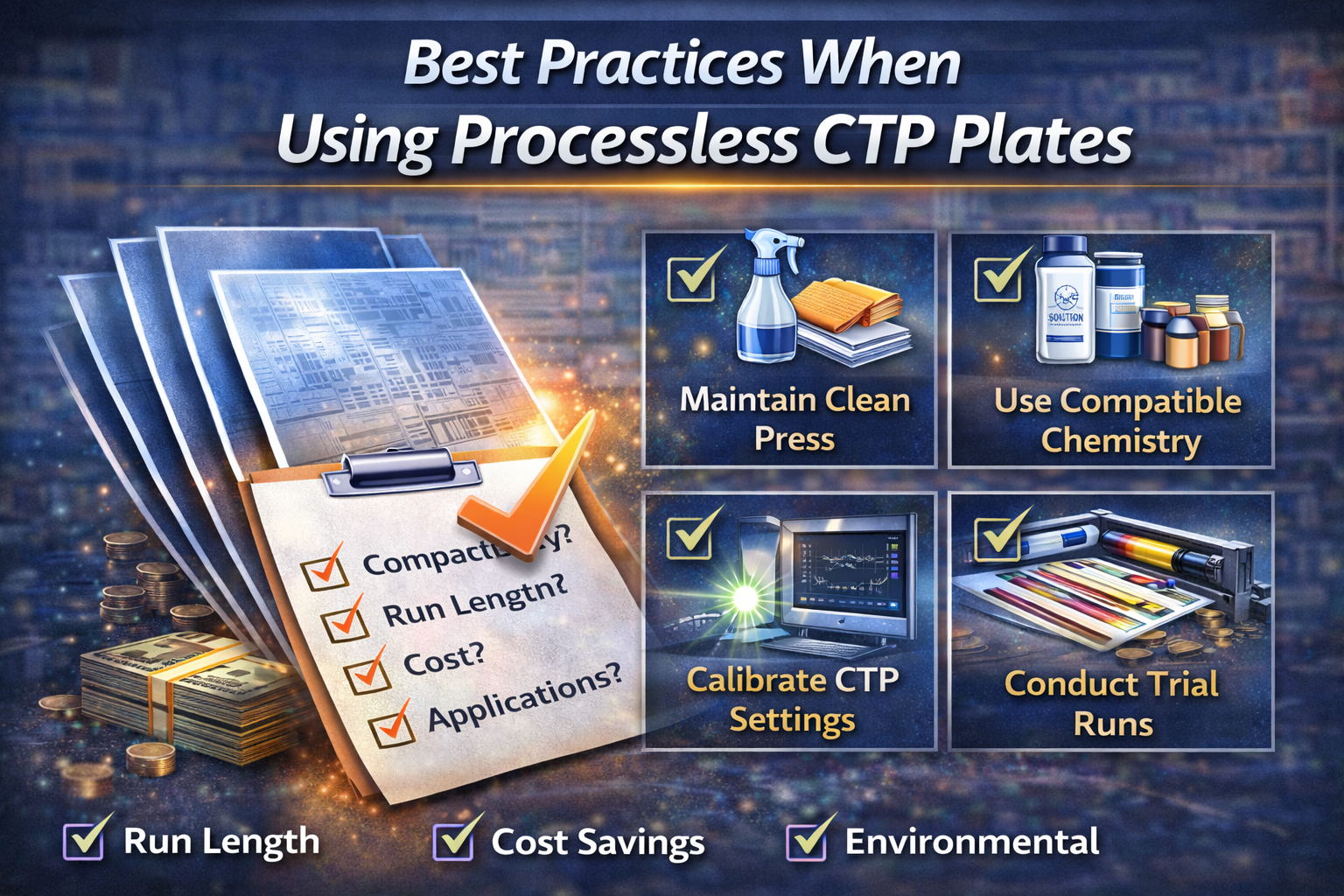
To achieve optimal performance, printers should follow these recommendations:
Maintain a clean press environment
Use compatible fountain solution chemistry
Calibrate CTP exposure settings
Conduct trial runs before full production
Work closely with experienced suppliers
These steps ensure maximum plate life and print quality.
The Future of Processless Plate Technology
Industry experts predict that processless plates will continue expanding across global printing markets.
Key trends include:
Higher durability coatings
Faster imaging sensitivity
Improved scratch resistance
Better compatibility with UV inks
As environmental regulations tighten worldwide, processless technology will likely become the standard solution for offset printing plates.
Conclusion
Understanding the FAQ of Processless CTP Plates helps printers make informed decisions when upgrading their prepress systems.
Processless plates offer numerous benefits:
Simplified workflow
Lower production costs
Reduced environmental impact
Faster production speed
Reliable print quality
As printing technology evolves, processless CTP plates are becoming a key component of modern, sustainable printing operations.
If you are looking for a reliable supplier, we are a professional manufacturer of Processless CTP Plates with extensive experience in global markets.
We provide:
High-quality thermal processless plates
Stable performance and long run length
Competitive factory pricing
Global export support
If you are interested in testing or purchasing Processless CTP Plates, feel free to contact us for product details, quotations, or sample plates.
Why Does a CTP Plate Scum on Press ? 9 Common Causes and Proven Solutions
Learn why CTP plates scum on press, the most common causes, troubleshooting methods, and practical solutions to improve offset printing quality and reduce downtime.

Which Offset Machine Is Best ? A Practical Guide for Commercial Printing
Which offset machine is best? Learn how to choose the right offset printing machine based on format, volume, cost, and CTP technology.
Where to Buy Thermal CTP Plates for Offset Printing | Best Supplier Guide & Expert Tips
Looking for reliable thermal CTP plates for offset printing? This expert guide explains how to choose a trustworthy supplier, compares global and Chinese manufacturers, and shares key quality criteria.