
Introduction: Why the Heat Transfer Film Coefficient Matters
In thermal engineering, material selection is not only about thickness, strength, or durability—it is fundamentally about how efficiently heat can move through a system. One of the most important parameters used to evaluate this performance is the heat transfer film coefficient.
The keyword heat transfer film coefficient is commonly searched by engineers, manufacturers, and product designers working in fields such as electronics cooling, packaging, industrial heating, automotive components, and thermal interface materials. Understanding this coefficient helps determine whether a heat transfer film will perform reliably under real operating conditions.
This article provides a clear, professional, and easy-to-understand explanation of the heat transfer film coefficient, including its definition, influencing factors, measurement methods, practical applications, and how to choose the right heat transfer film for your needs.
What Is the Heat Transfer Film Coefficient?
The heat transfer film coefficient (often referred to as the heat transfer coefficient, symbol h) describes the rate at which heat is transferred between a solid surface and a surrounding medium through a thin film layer.
It represents how effectively a heat transfer film can conduct and dissipate thermal energy.
Basic Definition
The heat transfer film coefficient is defined as:
The amount of heat transferred per unit area per unit temperature difference.
It is commonly expressed in:
W/m²·K (Watts per square meter per Kelvin)
A higher heat transfer film coefficient indicates better thermal performance.
Why the Heat Transfer Film Coefficient Is Critical
Heat transfer films are often used as intermediate layers between heat sources and heat sinks. Their performance directly impacts:
Thermal efficiency
Product reliability
Energy consumption
Component lifespan
Inadequate heat transfer can lead to overheating, material degradation, or system failure.
Key Factors Affecting the Heat Transfer Film Coefficient
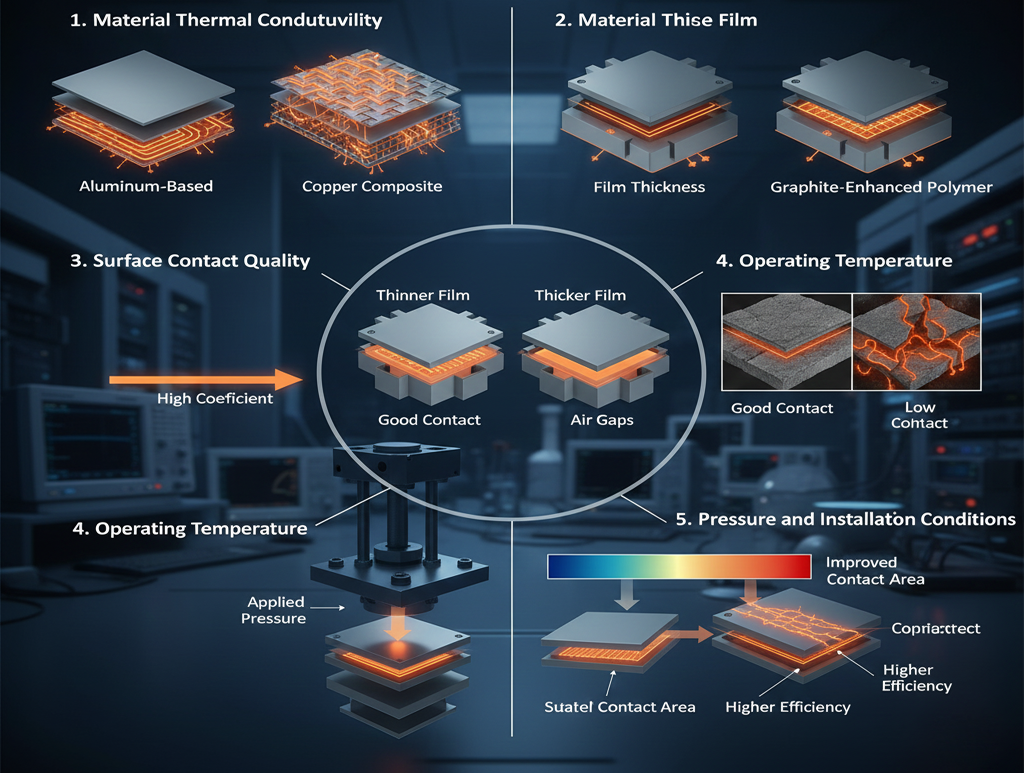
1. Material Thermal Conductivity
The base material of the heat transfer film has a major influence.
Materials with higher thermal conductivity typically exhibit higher heat transfer film coefficients, such as:
Aluminum-based films
Copper composite films
Graphite-enhanced polymer films
2. Film Thickness
Thickness plays a critical role:
Thinner films → lower thermal resistance → higher coefficient
Thicker films → increased resistance → lower coefficient
However, thickness must still meet mechanical and durability requirements.
3. Surface Contact Quality
Heat transfer films rely heavily on surface contact.
Factors include:
Surface roughness
Flatness of contact surfaces
Presence of air gaps
Poor contact significantly reduces the effective heat transfer film coefficient.
4. Operating Temperature
As temperature increases:
Material properties may change
Softening or expansion may improve contact
Degradation at extreme temperatures may reduce performance
Understanding the working temperature range is essential.
5. Pressure and Installation Conditions
Applied pressure improves:
Surface conformity
Contact area
Thermal transfer efficiency
This is why many heat transfer films are designed to perform optimally under specific pressure ranges.
How the Heat Transfer Film Coefficient Is Measured
1. Laboratory Testing
Standard test methods include:
Steady-state heat flow tests
Guarded hot plate method
Laser flash analysis (for conductivity reference)
Measured values are usually obtained under controlled pressure and temperature.
2. Application-Based Evaluation
In real applications, the effective coefficient is evaluated by:
Temperature drop across the interface
Power input vs heat dissipation
Thermal imaging
This provides a more realistic view of performance.
Typical Heat Transfer Film Coefficient Ranges
Depending on material and application:
Low-performance polymer films: 50–200 W/m²·K
Standard industrial heat transfer films: 200–1,000 W/m²·K
High-performance composite films: 1,000–5,000+ W/m²·K
Actual values depend heavily on installation and operating conditions.
Applications of Heat Transfer Films

1. Electronics and Power Devices
Used between:
CPUs and heat sinks
Power modules and cooling plates
A high heat transfer film coefficient ensures stable device operation.
2. Industrial Heating and Cooling Systems
Heat transfer films are applied in:
Heat exchangers
Temperature control panels
Industrial ovens
Efficiency improvements directly reduce energy consumption.
3. Automotive and EV Applications
Thermal films play a key role in:
Battery thermal management
Power electronics cooling
Motor control units
Reliability under vibration and temperature cycling is critical.
4. Packaging and Laminated Materials
In packaging, heat transfer films:
Improve heat sealing efficiency
Enhance temperature uniformity
Reduce process defects
How to Choose the Right Heat Transfer Film Based on Coefficient
Step 1: Define Thermal Requirements
Determine:
Maximum operating temperature
Heat flux
Allowable temperature rise
Step 2: Balance Thickness and Performance
Choose the thinnest film that:
Meets mechanical requirements
Maintains durability
Achieves required coefficient
Step 3: Consider Environmental Factors
Evaluate resistance to:
Moisture
Chemicals
Aging and thermal cycling
Step 4: Validate with Testing
Always request:
Technical data sheets
Sample testing
Application-specific performance data
Common Misunderstandings About Heat Transfer Film Coefficient
❌ Higher Is Always Better
Excessively high coefficients may not be necessary and can increase cost.
❌ Laboratory Values Equal Real Performance
Actual performance depends on installation quality and pressure.
❌ Thickness Doesn’t Matter
Even small thickness changes significantly affect thermal resistance.
Industry Trends in Heat Transfer Film Development
Modern heat transfer films are evolving toward:
Higher conductivity composites
Thinner and more flexible structures
Improved surface conformity
Long-term stability at higher temperatures
Manufacturers continue to innovate to meet growing thermal demands.
Conclusion: Understanding the Heat Transfer Film Coefficient Is Key to Thermal Success
The heat transfer film coefficient is one of the most important indicators of how well a heat transfer film performs in real applications. It reflects not only material properties but also installation quality, pressure, and operating conditions.
By understanding this coefficient, engineers and buyers can:
Select the right materials
Improve system reliability
Reduce energy loss
Extend product lifespan
👉 We are also a professional heat transfer film manufacturer, offering high-quality heat transfer films with optimized heat transfer film coefficients for various industrial applications.
If you are looking for reliable, efficient, and application-specific heat transfer film solutions, feel free to contact us — we are ready to support your project with technical expertise and customized products.

Why Does a CTP Plate Scum on Press ? 9 Common Causes and Proven Solutions
Learn why CTP plates scum on press, the most common causes, troubleshooting methods, and practical solutions to improve offset printing quality and reduce downtime.

Which Offset Machine Is Best ? A Practical Guide for Commercial Printing
Which offset machine is best? Learn how to choose the right offset printing machine based on format, volume, cost, and CTP technology.

Where to Buy Thermal CTP Plates for Offset Printing | Best Supplier Guide & Expert Tips
Looking for reliable thermal CTP plates for offset printing? This expert guide explains how to choose a trustworthy supplier, compares global and Chinese manufacturers, and shares key quality criteria.