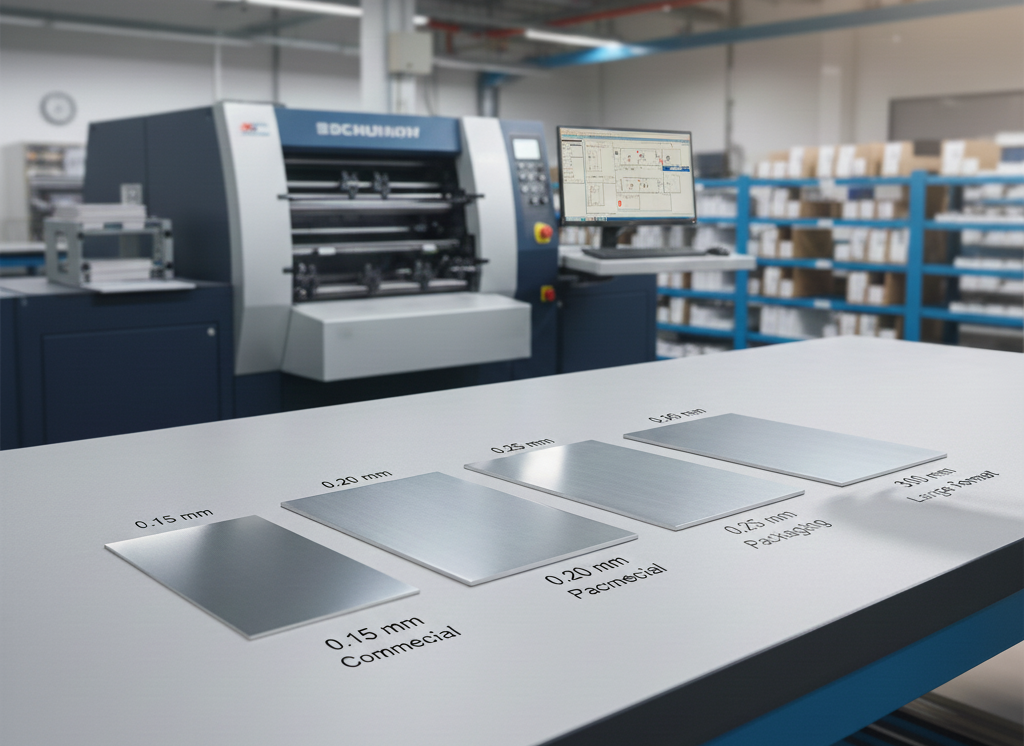
Introduction: Why CTP Plate Thickness Matters
The thickness of a CTP plate plays a critical role in press compatibility, registration accuracy, printing stability, and overall press performance. Selecting the wrong plate thickness can lead to mounting issues, poor ink transfer, or even damage to the press cylinder.
In this article, we provide a clear, professional, and practical explanation of CTP plate thickness, standard options, application scenarios, and how to choose the right thickness for your printing operation.
What Is a CTP Plate?
A CTP (Computer-to-Plate) plate is an aluminum-based offset printing plate imaged directly by a CTP platesetter, eliminating the need for film.
A typical CTP plate consists of:
Aluminum base (the main structural body)
Photosensitive coating (thermal, CTCP, UV, or process-free)
The plate thickness refers to the total thickness of the aluminum base plus coating, although the aluminum base accounts for nearly all of it.
How Thick Is a CTP Plate? Standard Thickness Explained
Common CTP Plate Thickness Options
The most widely used CTP plate thicknesses in the printing industry are:
| CTP Plate Thickness | Metric (mm) | Common Applications |
|---|---|---|
| Thin Plate | 0.15 mm | Newspaper printing |
| Standard Plate | 0.20 mm | Commercial printing |
| Thick Plate | 0.25 mm | Sheet-fed offset |
| Extra Thick Plate | 0.30 mm | Large-format / packaging |
These thicknesses cover more than 95% of global offset printing applications.
Why Are There Different CTP Plate Thicknesses?
Different printing applications have different mechanical and operational requirements.
1. Press Type Compatibility
Each printing press is designed for a specific plate thickness range.
Web offset presses (newspapers): usually 0.15 mm
Sheet-fed offset presses: typically 0.20 mm or 0.25 mm
Large packaging presses: often 0.30 mm
Using the wrong thickness can affect plate mounting and cylinder pressure.
2. Printing Stability and Durability
Thicker plates provide:
Higher rigidity
Better resistance to deformation
More stable ink transfer
This is especially important for long runs and high-speed presses.
3. Plate Bending and Mounting Requirements
Thin plates are:
Easier to bend
Faster to mount on web presses
Thicker plates require:
Stronger bending machines
More precise mounting
Detailed Analysis of Each CTP Plate Thickness
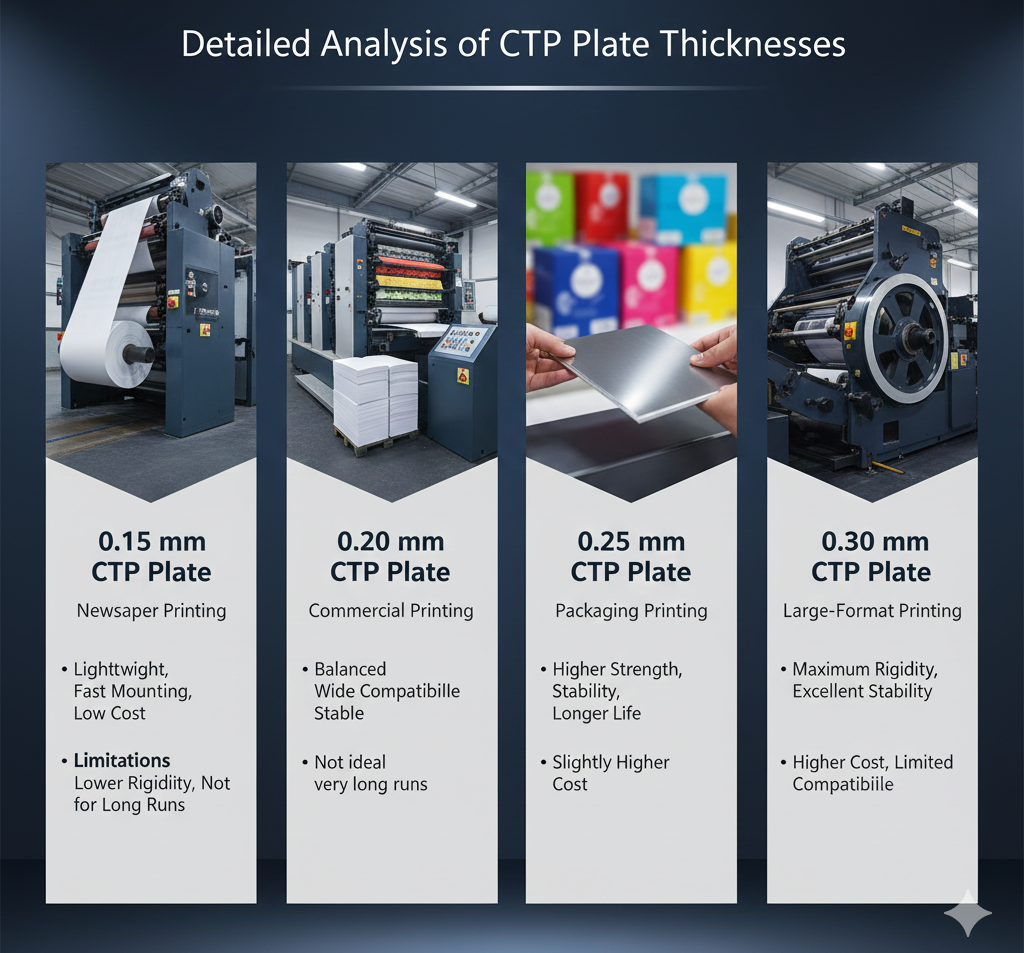
0.15 mm CTP Plate
Typical Use: Newspaper printing
Advantages:
Lightweight
Fast mounting
Lower aluminum cost
Limitations:
Lower rigidity
Not suitable for long runs
This thickness is ideal for high-speed web offset newspaper presses.
0.20 mm CTP Plate
Typical Use: Commercial sheet-fed printing
Advantages:
Balanced rigidity and flexibility
Wide press compatibility
Stable registration
Limitations:
Not ideal for very long runs
This is the most commonly used CTP plate thickness worldwide.
0.25 mm CTP Plate
Typical Use: High-quality commercial and packaging printing
Advantages:
Higher strength
Better press stability
Longer service life
Limitations:
Slightly higher cost
Preferred for medium to long print runs and thicker paper stocks.
0.30 mm CTP Plate
Typical Use: Large-format and carton printing
Advantages:
Maximum rigidity
Excellent press stability
Limitations:
Higher cost
Limited press compatibility
Used mainly on large offset presses.
How Plate Thickness Affects Printing Performance
1. Registration Accuracy
Proper plate thickness ensures:
Accurate plate seating
Stable image alignment
Reduced registration errors
2. Ink and Water Balance
A stable plate surface improves:
Ink transfer consistency
Dampening control
Reduced toning issues
3. Press Speed and Vibration
Thicker plates help reduce:
Plate vibration
Mechanical distortion
This is critical for high-speed presses.
Does Plate Thickness Affect Imaging Quality?
From an imaging standpoint:
Thickness does not affect resolution directly
Coating quality and CTP device matter more
However, thickness affects mechanical stability, which indirectly supports consistent imaging on press.
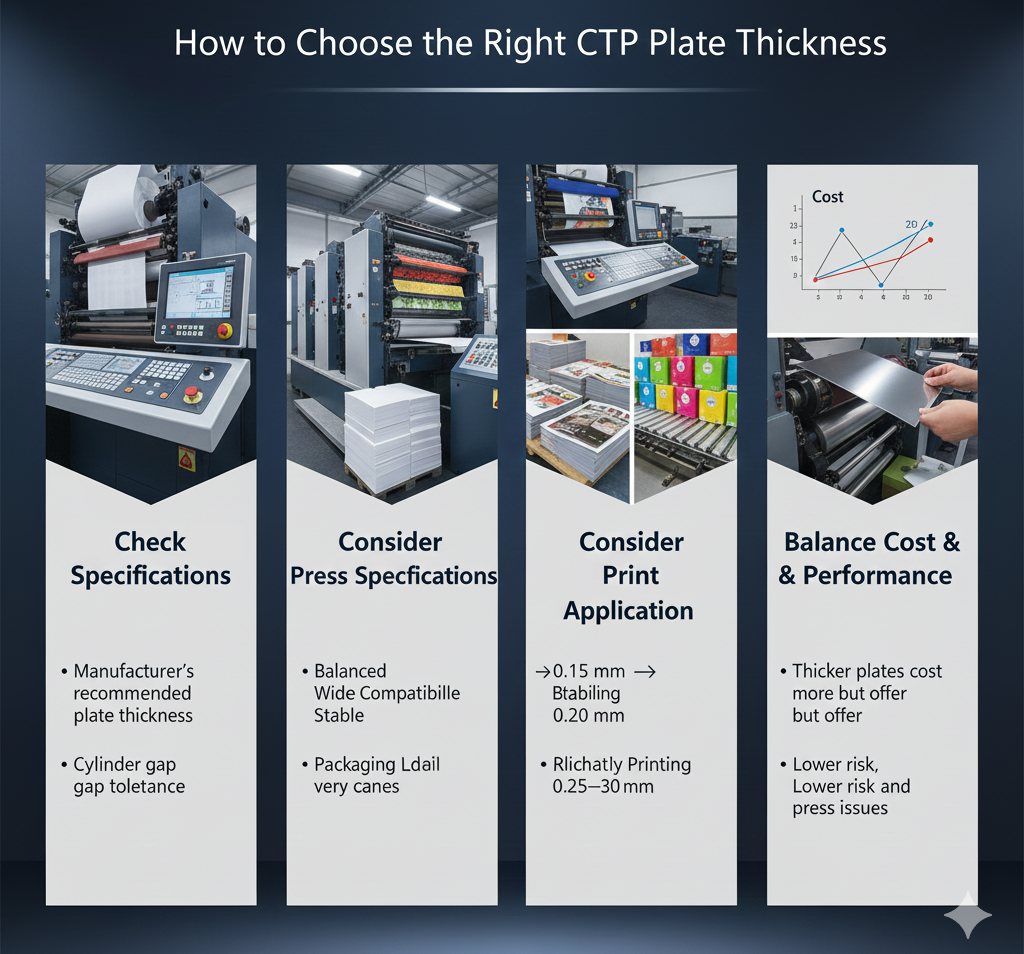
How to Choose the Right CTP Plate Thickness
Step 1: Check Press Specifications
Always confirm:
Manufacturer’s recommended plate thickness
Cylinder gap tolerance
Step 2: Consider Print Application
Newspapers → 0.15 mm
Commercial printing → 0.20 mm
Packaging printing → 0.25–0.30 mm
Step 3: Balance Cost and Performance
Thicker plates cost more but offer:
Better durability
Lower risk of press issues
Common Questions About CTP Plate Thickness
Can I Change Plate Thickness on the Same Press?
Only if the press supports multiple thicknesses and is properly adjusted.
Does Thicker Plate Mean Better Quality?
Not necessarily. Correct thickness matters more than maximum thickness.
Is Plate Thickness Related to Plate Type?
No. Thermal, CTCP, UV, and process-free plates are available in multiple thicknesses.
Conclusion: Choosing the Right Thickness Is Essential
So, how thick is a CTP plate?
The answer depends on your printing application, press type, and production requirements.
Choosing the correct CTP plate thickness ensures:
Press compatibility
Stable printing performance
Reduced downtime
Lower long-term costs
👉 We are also a professional CTP plate manufacturer, supplying CTP plates in 0.15 mm, 0.20 mm, 0.25 mm, and 0.30 mm for newspaper, commercial, and packaging printing.
If you are looking for reliable, high-quality CTP plates, feel free to contact us — we will help you select the most suitable plate thickness for your press.
Why Does a CTP Plate Scum on Press ? 9 Common Causes and Proven Solutions
Learn why CTP plates scum on press, the most common causes, troubleshooting methods, and practical solutions to improve offset printing quality and reduce downtime.

Which Offset Machine Is Best ? A Practical Guide for Commercial Printing
Which offset machine is best? Learn how to choose the right offset printing machine based on format, volume, cost, and CTP technology.
Where to Buy Thermal CTP Plates for Offset Printing | Best Supplier Guide & Expert Tips
Looking for reliable thermal CTP plates for offset printing? This expert guide explains how to choose a trustworthy supplier, compares global and Chinese manufacturers, and shares key quality criteria.