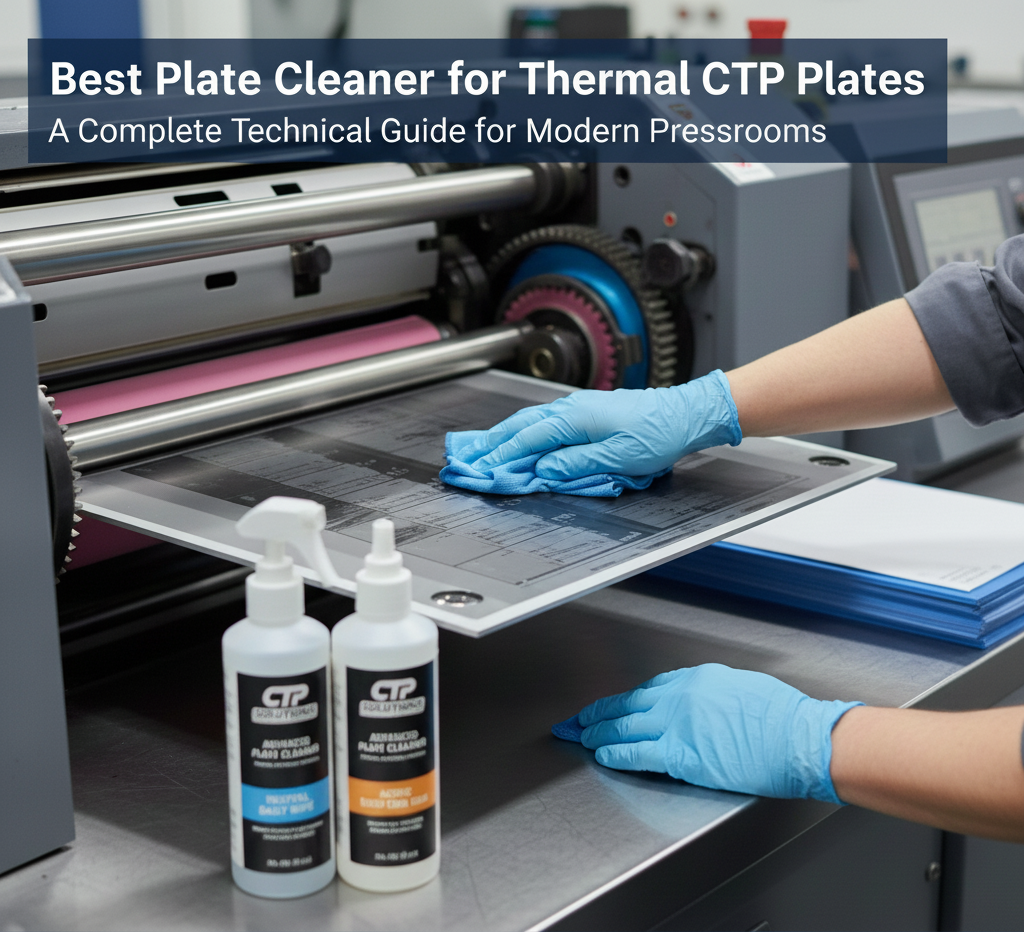
Best Plate Cleaner for Thermal CTP Plates: A Complete Technical Guide for Modern Pressrooms
Thermal CTP plates have become the global standard for offset printing due to their durability, high resolution, and compatibility with automated plate processing. But even the most advanced plate technology cannot maintain print quality without proper cleaning and maintenance.
The real question is not simply “Which cleaner is best?”
The correct question is:
“Which cleaner is best for my plate type, processing method, and press environment?”
This article explains plate cleaner chemistry, compatibility requirements, how cleaning interacts with plate coatings, troubleshooting, and how to choose the safest and most effective cleaner for thermal CTP operations.
1. Why Thermal CTP Plates Need Dedicated Cleaners
Although thermal plates offer strong resistance to scratches, oxidation, and handling marks, they face three unavoidable forms of contamination:
• Ink contamination
Residual ink, especially from long-run or high-density jobs, creates surface glaze that changes ink–water balance.
• Paper dust & coating particles
Paper coatings accumulate in non-image areas, causing scumming or background tinting.
• Oxidation & chemical residue
Exposure to air and fountain solution gradually alters the surface hydrophilicity of non-image areas.
A plate cleaner restores:
- The hydrophilic character of non-image areas
- Clean ink receptivity of image areas
- Surface smoothness
- Start-up speed and color stability
With the right cleaner, a thermal plate can reliably maintain consistent performance across long runs and repeated restarts.
2. Understanding Plate Cleaner Chemistry
Different cleaners are formulated for different plate technologies. Choosing randomly can damage the coating or reduce plate life.
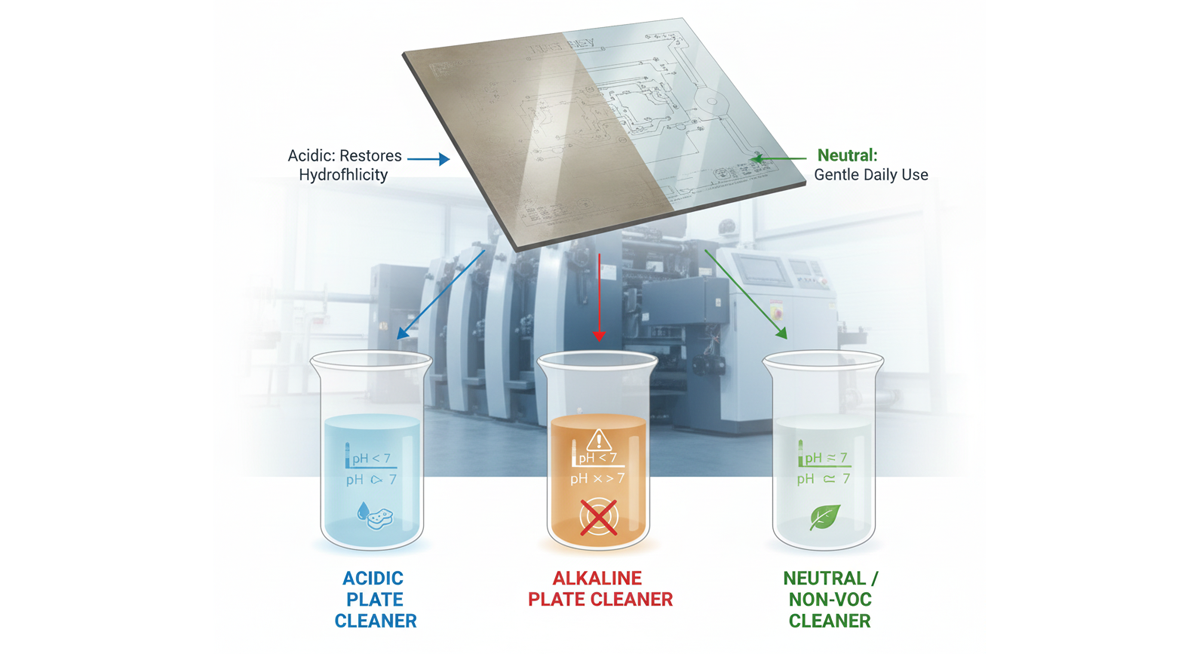
Below are the three main categories:
| Cleaner Type | Features | Best Use Cases | Advantages | Risks / Limitations |
|---|---|---|---|---|
| Acidic Plate Cleaners (Most Common for Thermal CTP) | • Mild acidic pH • Good cleaning + desensitizing • Removes oxidation films • Restores non-image hydrophilicity • Suitable for conventional & many process-free thermal plates | • Background toning • Fingerprints or mild scratches • Ink ghosting in non-image areas • Rapid start-up after press stops | • Cleans and desensitizes simultaneously • Low risk to most thermal coatings | • Over-aggressive types may dull image density if over-rubbed • Not suitable for certain aluminum-based specialty plates without testing |
| Alkaline Plate Cleaners (Use with Caution) | • Higher pH • Strong degreasing power • Designed for older analog or conventional plates | • Removing extremely heavy ink buildup • Cleaning plates specifically rated as alkaline-compatible | — Strong degreasing power | • Can attack thermal CTP image coatings • May cause image blinding or dot loss • Not recommended unless labeled “CTP-safe” |
| Neutral / Non-VOC Plate Cleaners | • Balanced pH • Gentle to plate coatings • Low odor & eco-friendly • Suitable for daily use | • Process-free plates with sensitive top layers • Environmentally restricted pressrooms • Frequent on-press wiping needs | • Very low risk of coating damage • Ideal for general maintenance | • Not as strong as acidic cleaners for stubborn scumming |
3. On-Press vs Off-Press Cleaning
Different working conditions require different cleaning approaches.
3.1 On-Press Cleaning
Purpose
- Clean the plate during production
- Avoid downtime
- Stabilize ink–water balance
Common Uses
- Removing small toning spots
- Clearing buildup on long runs
- Quick recovery after short press stops
Preferred Chemistry
- Mild acidic or neutral cleaners
- Fast-evaporating formulations
Tips
- Use a lint-free cloth
- Apply small quantity
- Avoid over-rubbing image areas
3.2 Off-Press Cleaning
Purpose
- Deep cleaning before storage or reuse
- Restoring plates after heavy contamination
Recommended Products
- Acidic plate cleaners with gum
- Scratch remover blends (if plate manufacturer allows)
- Desensitizing agents for severe oxidation
Key Benefits
- Full restoration of hydrophilicity
- Protection layer for temporary storage
- Removes stubborn glaze that on-press cleaning cannot handle
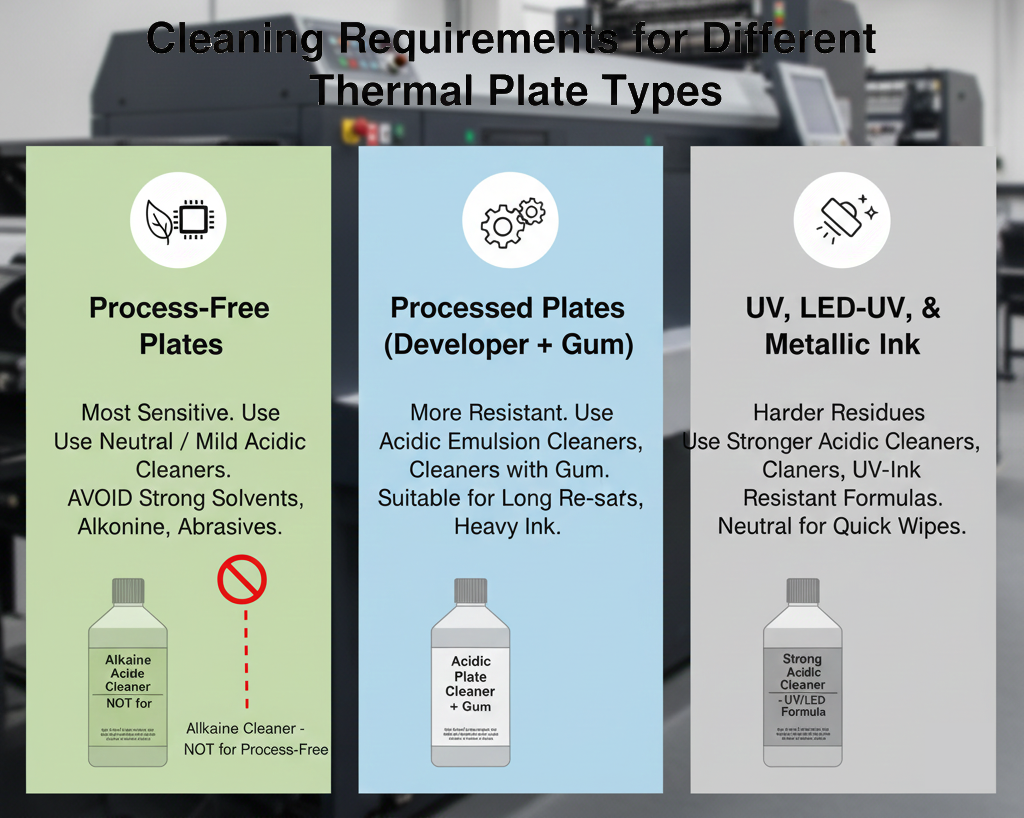
4. Cleaning Requirements for Different Thermal Plate Types
Thermal CTP plates vary widely in their top-layer chemistry. Selecting the wrong cleaner can reduce run length or damage the coating.
4.1 Process-Free / Chemistry-Free Thermal Plates
Most Sensitive Category
Characteristics
- Image forms via heat-induced structural change
- Top layer is designed for on-press development
- Over-aggressive cleaners can remove image dots or cause blinding
Recommended Cleaners
- Neutral non-VOC cleaners
- Mild acidic cleaners only if explicitly approved
Avoid
- Strong solvents
- Alkaline products
- Abrasive cloths
4.2 Processed Thermal Plates (Developer + Gum)
These are more resistant to cleaning chemistry.
Recommended Cleaners
- Acidic emulsion plate cleaners
- Acidic cleaners with desensitizing agents
- Plate cleaners with protective gum for storage
Suitable for
- Long runs
- Re-starts after downtime
- Heavy ink jobs
4.3 Thermal Plates for UV, LED-UV, and Metallic Ink Jobs
Challenges
- UV inks leave harder residues
- LED-UV inks contain high-reactivity monomers
- Metallic inks leave abrasive particles
Optimal Cleaners
- Stronger acidic cleaners
- Products designed for UV-ink resistance
- Neutral cleaners for quick on-press removal
5. Practical Pressroom Checklist
Daily
- Inspect for toning or background tint
- Wipe lightly with neutral or mild acidic cleaner
- Remove fingerprints immediately
Weekly
- Deep clean plates used for long jobs
- Check press wash chemistry compatibility
Monthly
- Clean processor rollers (if applicable)
- Sanitization of developer tanks
- Inspect plate archives for oxidation
When Needed
- Use gum-preservative cleaners before storage
- Apply scratch remover if allowed by plate brand
6. Troubleshooting Plate Problems Caused by Improper Cleaning
Below are the most common issues.
6.1 Background Toning or Tinting
Likely Cause: Insufficient cleaning, paper dust, weak fountain solution.
Solution: Use an acidic plate cleaner to desensitize non-image areas.
6.2 Image Blinding / Dot Loss
Likely Cause: Aggressive alkaline cleaner or over-scrubbing.
Solution: Switch to approved thermal-compatible cleaner; reduce friction when wiping.
6.3 Slow Roll-Up After Restart
Likely Cause: Ink residue or over-gumming.
Solution: Clean with mild acidic cleaner and apply a balanced gum preservative.
6.4 Poor Water Balance
Likely Cause: Glazed non-image areas.
Solution: Use an emulsion-type plate cleaner to restore hydrophilicity.
7. How to Choose the Best Cleaner for Your Thermal CTP Plates
A clear framework:
1. Identify plate type
- Process-free → neutral cleaner
- Processed → acidic cleaner
- UV/LED jobs → strong acidic cleaner
2. Determine cleaning frequency
- Frequent wiping → mild, low-residue cleaner
- Occasional deep cleaning → stronger acidic cleaner
3. Evaluate press environment
- High dust → desensitizing cleaner
- Long runs → cleaner with gum for protection
- Eco rules → non-VOC formulas
4. Always test before full adoption
A simple spot test avoids expensive plate damage.
8. Final Note — Where Our Products Fit In
Our company develops CTP plates and matching plate-cleaner formulations designed to work safely with thermal plate coatings, process-free plates, UV-ink workflows, and high-resolution offset production.
Our cleaners are:
- Balanced for thermal CTP sensitivity
- Effective at removing ink, oxidation, and glaze
- Available in acidic, neutral, and gum-preservative blends
- Designed to maintain hydrophilicity without damaging image areas
If you need guidance choosing the correct cleaner for your specific plate model or press routine, we can provide technical data sheets, recommendations, and samples to help your team evaluate performance in real production.
Why Does a CTP Plate Scum on Press ? 9 Common Causes and Proven Solutions
Learn why CTP plates scum on press, the most common causes, troubleshooting methods, and practical solutions to improve offset printing quality and reduce downtime.

Which Offset Machine Is Best ? A Practical Guide for Commercial Printing
Which offset machine is best? Learn how to choose the right offset printing machine based on format, volume, cost, and CTP technology.

Where to Buy Thermal CTP Plates for Offset Printing | Best Supplier Guide & Expert Tips
Looking for reliable thermal CTP plates for offset printing? This expert guide explains how to choose a trustworthy supplier, compares global and Chinese manufacturers, and shares key quality criteria.