Introduction
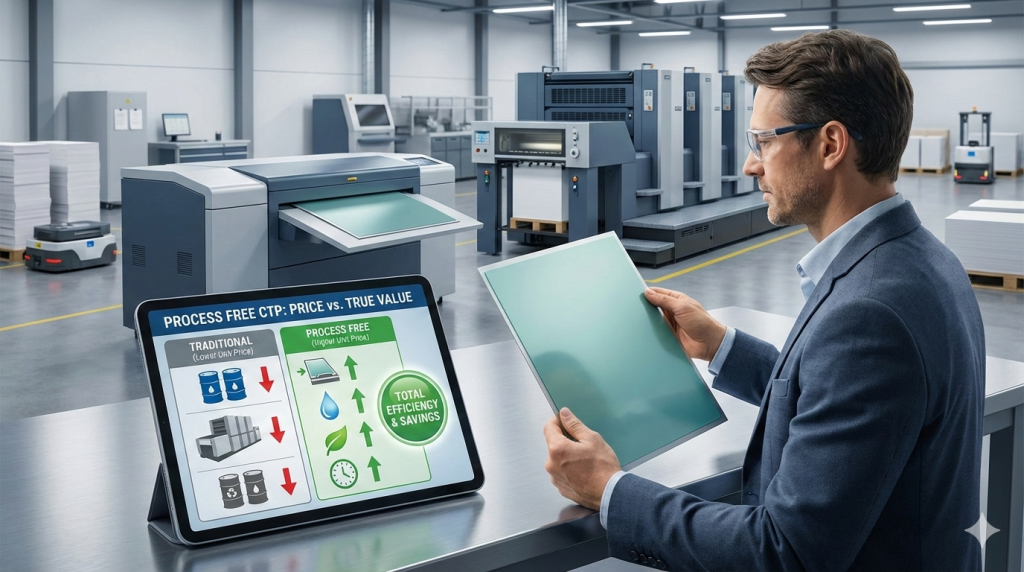
Process Free CTP plates are often marketed as a “cost-saving” solution for modern offset printing. The real value of process free CTP plates lies in reduced chemistry usage, simplified workflows, lower environmental impact, and operational efficiency.
This article breaks down process free CTP plate pricing from a professional buyer’s perspective, helping you understand what influences the price, how to evaluate true cost, and how to choose the right supplier.
1. What Is a Process Free CTP Plate?
A Process Free CTP plate is a thermal offset printing plate that does not require chemical developer processing. After imaging, the plate can be mounted directly on the press, where the non-image areas are removed during the first few revolutions.
Key Characteristics
-
No developer or processor required
-
Reduced water and chemical usage
-
Cleaner and more compact plate-making workflow
-
Compatible with most 830 nm thermal CTP systems
2. Typical Price Range of Process Free CTP Plates
While prices vary by region and supplier, process free CTP plates generally cost 10–30% more per square meter than conventional thermal positive CTP plates.
Why the Higher Unit Price?
-
More advanced coating technology
-
Higher R&D investment
-
Stricter quality control requirements
-
Specialized manufacturing processes
However, focusing only on plate price can be misleading.
3. Key Factors That Influence Process Free CTP Plate Price
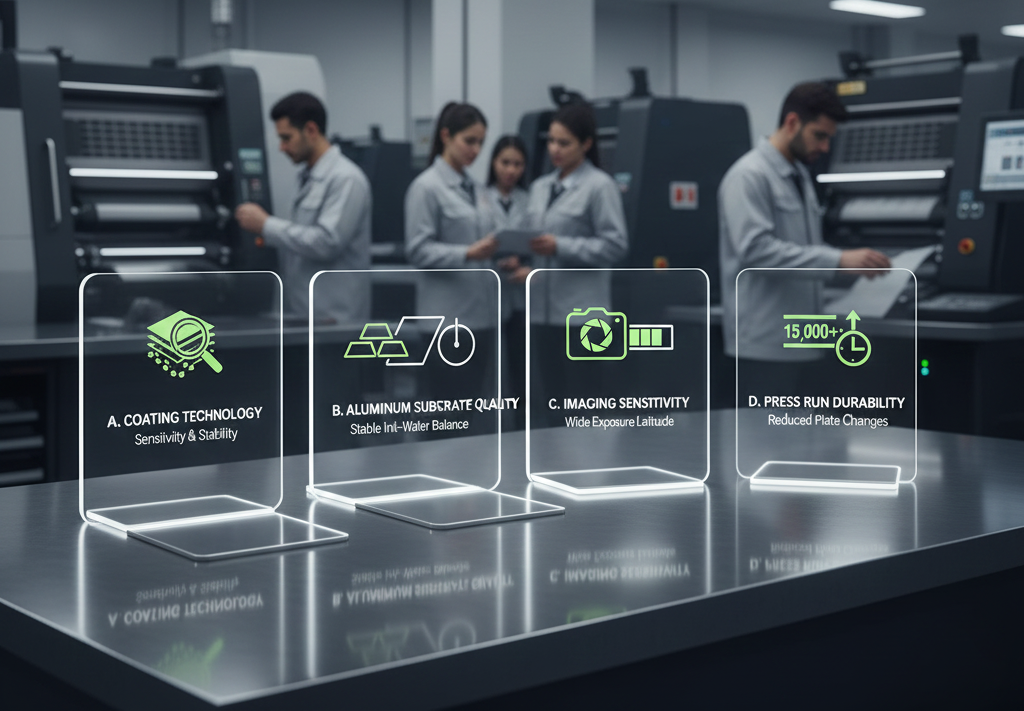
A. Coating Technology
Process free plates require highly sensitive and stable coatings that can:
-
Withstand handling before press
-
Clean up quickly on press
-
Maintain dot stability without chemical development
More advanced coatings result in higher manufacturing costs—but also better press performance.
B. Aluminum Substrate Quality
High-grade anodized aluminum is critical for:
-
Stable ink-water balance
-
Reliable plate cleanup
-
Longer press runs
Inferior aluminum lowers price but often increases press waste.
C. Imaging Sensitivity and Latitude
Plates with wider exposure latitude:
-
Work across multiple CTP brands
-
Reduce imaging errors
-
Require fewer recalibrations
This flexibility adds value and affects price.
D. Press Run Durability
Typical press runs:
-
Standard process free plates: 50,000–100,000 impressions
-
Enhanced versions: Up to 150,000 impressions
Higher durability coatings increase production cost but reduce plate changes.
4. Hidden Costs That Make Cheap Plates Expensive
A lower-priced process free plate may look attractive but often creates hidden costs.
Common Hidden Costs
-
Slower on-press clean-up
-
Higher paper waste during start-up
-
Inconsistent dot reproduction
-
More frequent plate remakes
Reality Check
A stable, slightly higher-priced plate often delivers lower total cost per printed job.
5. Process Free vs Traditional Thermal Plate: Cost Comparison
| Cost Item | Traditional Thermal Plate | Process Free Plate |
|---|---|---|
| Plate Unit Price | Lower | Higher |
| Developer & Chemicals | Required | None |
| Water Consumption | High | Minimal |
| Processor Maintenance | Required | Not needed |
| Environmental Costs | Higher | Lower |
When all costs are considered, many printers find process free plates economically competitive.
6. When Does the Higher Price Make Sense?
Process free CTP plates are not ideal for every printing operation.
Best Fit Scenarios
-
Commercial printers with frequent job changes
-
Plants aiming to reduce chemical handling
-
Facilities with limited space
-
Environmentally regulated markets
Less Suitable For
-
Extremely long-run packaging jobs
-
Printers optimized for baked plates
7. Regional Price Differences
Prices vary due to:
-
Import duties
-
Environmental regulations
-
Local market competition
-
Shipping and logistics costs
Working with an export-experienced manufacturer helps avoid unnecessary cost increases.
8. How to Evaluate Price Quotes from Suppliers
Buyer Checklist
-
Is pricing per square meter or per plate?
-
What press run is guaranteed?
-
Is technical support included?
-
Are packaging and logistics standardized?
-
Is batch consistency guaranteed?
Comparing quotes without these details leads to poor decisions.
9. Choosing a Reliable Process Free CTP Plate Manufacturer
Price should be evaluated alongside reliability.

A Professional Manufacturer Should Offer
-
Stable and repeatable quality
-
Technical guidance during installation
-
Clear performance specifications
-
Export-grade packaging
-
Long-term supply consistency
Why Choose Us as Your Process Free CTP Plate Manufacturer
We are a professional Process Free CTP Plate manufacturer with deep experience in global offset printing markets.
Our process free CTP plates offer:
-
Stable imaging and fast on-press clean-up
-
Consistent dot reproduction
-
Compatibility with mainstream thermal CTP systems
-
Reliable press performance at competitive pricing
If you are evaluating Process Free CTP Plate prices and want a solution that balances cost, performance, and reliability, contact us anytime for technical details, samples, or quotations.
Why Does a CTP Plate Scum on Press ? 9 Common Causes and Proven Solutions
Learn why CTP plates scum on press, the most common causes, troubleshooting methods, and practical solutions to improve offset printing quality and reduce downtime.

Which Offset Machine Is Best ? A Practical Guide for Commercial Printing
Which offset machine is best? Learn how to choose the right offset printing machine based on format, volume, cost, and CTP technology.
Where to Buy Thermal CTP Plates for Offset Printing | Best Supplier Guide & Expert Tips
Looking for reliable thermal CTP plates for offset printing? This expert guide explains how to choose a trustworthy supplier, compares global and Chinese manufacturers, and shares key quality criteria.