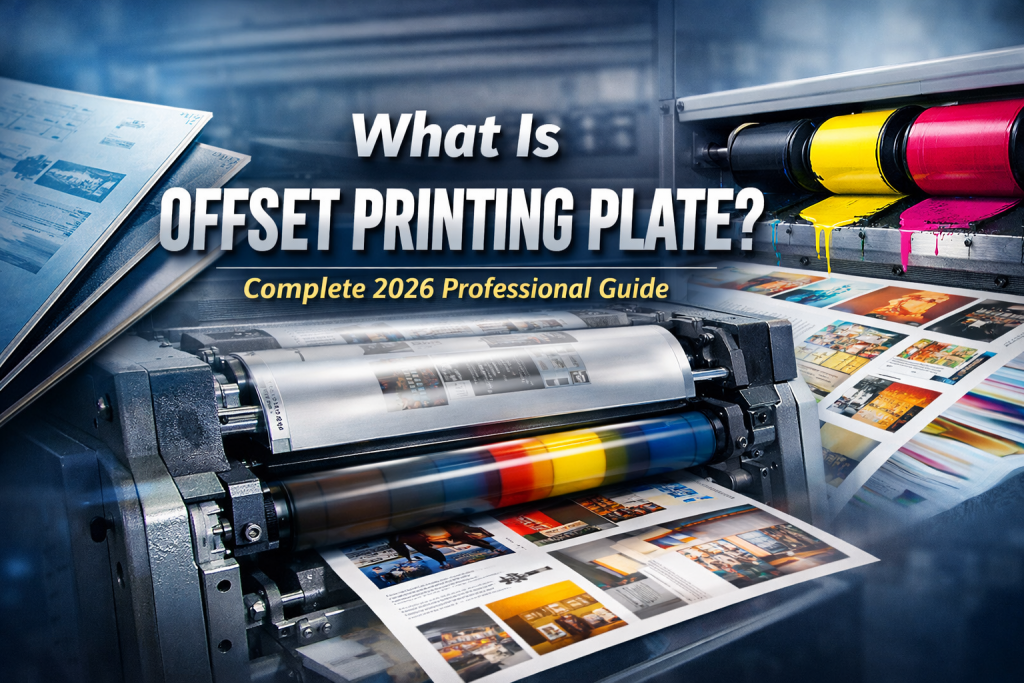
What is offset printing plate?
Although offset printing technology has existed for over a century, many professionals entering the field still lack a deep technical understanding of the core component that makes the entire system work — the offset printing plate.
This comprehensive 2026 guide explains:
What an offset printing plate is
How it works scientifically
Types of offset printing plates
Materials and structure
Manufacturing process
Differences between thermal, UV, and process-free plates
Selection tips for commercial and packaging printing
If you are sourcing printing consumables or optimizing production cost, this article will give you expert-level clarity.
1. What Is Offset Printing Plate?
An offset printing plate is a thin metal sheet (usually aluminum-based) used in offset lithography to transfer an image onto paper or other substrates.
It works based on the fundamental principle of:
Oil and water do not mix.
Offset printing uses a chemical process where:
Image areas attract ink (oleophilic)
Non-image areas attract water (hydrophilic)
This selective behavior enables precise ink transfer during high-speed printing.
The plate is mounted on a plate cylinder inside the offset press. Ink adheres only to image areas, then transfers to a rubber blanket, and finally to the printing substrate.
This indirect transfer process is why it is called offset printing.
2. The Scientific Principle Behind Offset Printing Plates
Offset printing plates operate on planographic printing technology, first developed in the late 18th century.
The industrial evolution of lithography was significantly influenced by companies such as:
Heidelberger Druckmaschinen AG
Komori Corporation
Koenig & Bauer
Modern plates are engineered with micro-level surface chemistry to control ink-water balance.
Surface Structure
An offset printing plate typically consists of:
Aluminum substrate
Anodized layer
Hydrophilic layer
Photosensitive coating
Each layer plays a specific role in durability and image precision.
3. Main Types of Offset Printing Plates
Understanding plate types is essential for buyers and printers.
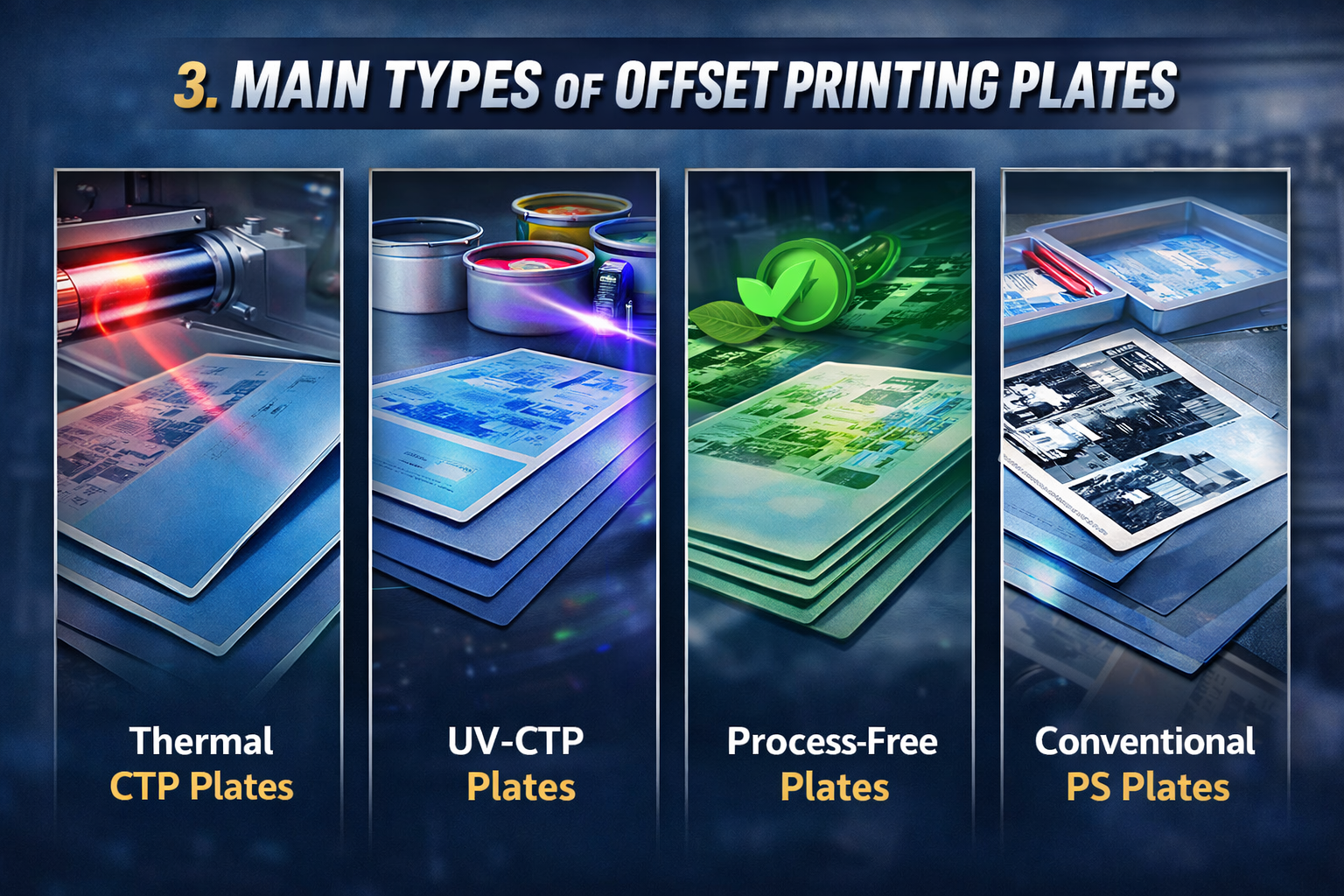
1️⃣ Thermal CTP Plates
Used with thermal platesetters (830 nm laser)
High resolution (1–99% dot reproduction)
Long run length
Stable in different climate conditions
Best for:
Commercial printing, book printing, magazine production
2️⃣ UV-CTP Plates
Designed for UV ink systems
Strong chemical resistance
Suitable for packaging and carton printing
Best for:
Food packaging, cosmetic packaging, pharmaceutical boxes
3️⃣ Process-Free Plates
No chemical processing required
Eco-friendly
Lower water consumption
Faster workflow
Best for:
Environmentally conscious printers and short-run production
4️⃣ Conventional PS Plates
Require film exposure
Chemical processing needed
Gradually being replaced by CTP systems
Still used in developing markets.
4. Materials Used in Offset Printing Plates
Aluminum Base
High-quality aluminum is critical.
Why aluminum?
Lightweight
High dimensional stability
Corrosion resistant
Excellent heat conductivity
Premium manufacturers use imported high-purity aluminum coils to ensure consistent thickness and flatness.
Photosensitive Coating
The coating determines:
Laser sensitivity
Dot sharpness
Chemical resistance
Ink affinity
Low-quality coating often leads to:
Background toning
Poor dot reproduction
Short plate life
5. How Is an Offset Printing Plate Made?
The manufacturing process involves:
Aluminum graining
Electrochemical roughening
Anodizing
Coating application
Drying and curing
Cutting and punching
Precision control in each stage ensures:
Thickness tolerance ±0.005 mm
Stable surface tension
Long shelf life
Professional factories use automated coating lines and cleanroom environments to guarantee uniformity.
6. How Does Offset Printing Plate Work in Real Production?
The workflow in a printing plant:
Design file prepared
Plate imaged by CTP machine
Plate mounted on press
Dampening system applies water
Inking rollers apply ink
Image transfers to blanket
Blanket transfers to paper
This process allows:
High-speed production
Consistent image quality
Large volume output
Offset printing remains dominant in:
Book publishing
Newspaper printing
Commercial advertising
Packaging industry
7. Key Performance Indicators of Offset Printing Plates
Professional buyers evaluate plates based on:
Run Length
Standard commercial: 50,000–100,000 impressions
UV packaging: 100,000–200,000 impressions
Resolution
Up to 2400 dpi imaging
1–99% dot reproduction capability
Chemical Resistance
Especially important for UV inks and aggressive fountain solutions.
Storage Stability
Typically 12–18 months under proper conditions.
8. Offset Printing Plate vs Digital Printing
| Feature | Offset Printing Plate | Digital Printing |
|---|---|---|
| Setup cost | Higher | Lower |
| Unit cost (large volume) | Very low | Higher |
| Image consistency | Excellent | Good |
| Ideal volume | Medium to large runs | Short runs |
Despite the growth of digital printing, offset printing remains more economical for bulk production.
9. Why Quality of Offset Printing Plate Matters
Using inferior plates can cause:
Plate cracking
Ink-water imbalance
Excessive waste sheets
Frequent plate changes
Production downtime
In high-volume commercial printing, downtime costs more than plate price differences.
Choosing stable plate quality improves:
Productivity
Profit margin
Customer satisfaction
10. Global Market Trends in 2026
The offset printing plate industry is evolving toward:
Process-free technology
Environmentally friendly coating
Thinner aluminum usage
Higher laser sensitivity
Automated plate handling systems
Sustainability is becoming a key purchasing factor, especially in European markets.
11. How to Choose the Right Offset Printing Plate Supplier
Professional checklist:
✔ Stable aluminum sourcing
✔ Automated coating line
✔ Strict QC inspection
✔ Sample testing support
✔ Consistent thickness tolerance
✔ Competitive export pricing
When selecting a supplier, avoid focusing only on low price. Long-term stability is more valuable than short-term savings.
Final Thoughts
So, what is offset printing plate?
It is the core imaging component of offset lithography — a precision-engineered aluminum plate designed to control ink and water interaction for high-quality, high-speed printing.
Without high-quality offset printing plates, even the best printing press cannot achieve optimal performance.
We Are Professional Offset Printing Plate Manufacturer
At CN CTP Plates, we specialize in:
Thermal CTP plates
UV CTP plates
Process-free plates
Custom sizes and thickness
OEM private labeling
Bulk export supply
We provide stable quality, competitive pricing, and global shipping support.
If you are looking for a reliable offset printing plate manufacturer or distributor partner, contact us today for samples and quotations.
We are ready to support your long-term printing business growth.
Why Does a CTP Plate Scum on Press ? 9 Common Causes and Proven Solutions
Learn why CTP plates scum on press, the most common causes, troubleshooting methods, and practical solutions to improve offset printing quality and reduce downtime.

Which Offset Machine Is Best ? A Practical Guide for Commercial Printing
Which offset machine is best? Learn how to choose the right offset printing machine based on format, volume, cost, and CTP technology.
Where to Buy Thermal CTP Plates for Offset Printing | Best Supplier Guide & Expert Tips
Looking for reliable thermal CTP plates for offset printing? This expert guide explains how to choose a trustworthy supplier, compares global and Chinese manufacturers, and shares key quality criteria.