In recent years, processless CTP plates have rapidly gained popularity across the global printing industry. With increasing environmental regulations, rising production costs, and the demand for faster turnaround times, many commercial printers and packaging companies are switching to processless plate technology.
However, when buyers begin sourcing these plates, one of the most common challenges is submitting an accurate RFQ of Processless CTP Plates. A poorly prepared RFQ often leads to incorrect quotations, mismatched products, production delays, or higher procurement costs.
This comprehensive guide explains how to prepare a professional RFQ for processless CTP plates, what technical parameters suppliers require, and how printers can optimize their purchasing decisions.
What Are Processless CTP Plates?
Processless CTP (Computer-to-Plate) plates are offset printing plates that do not require chemical processing after imaging. Unlike traditional CTP plates that require a developer, gum solution, and processing machine, processless plates can be mounted directly on the press after exposure.
During the first few revolutions of the printing press, the non-image coating is removed automatically by the fountain solution and ink.
Key Characteristics
No chemical development process
Reduced water and chemical consumption
Faster plate production workflow
Lower environmental impact
Simplified prepress operations
Because of these advantages, processless plates are widely used in:
Commercial printing
Newspaper printing
Book printing
Quick turnaround jobs
Environmentally certified printing plants
Why RFQ Matters When Purchasing Processless CTP Plates
Submitting a detailed RFQ of Processless CTP Plates ensures suppliers provide accurate pricing and compatible products.
Many printing companies mistakenly request quotes with only plate size and quantity, which is insufficient for technical evaluation.
A professional RFQ should include:
Printing press compatibility
Plate thickness
Laser wavelength
Plate run length
Application environment
Packaging requirements
Providing complete information helps manufacturers recommend the best-performing plate solution rather than simply the cheapest option.
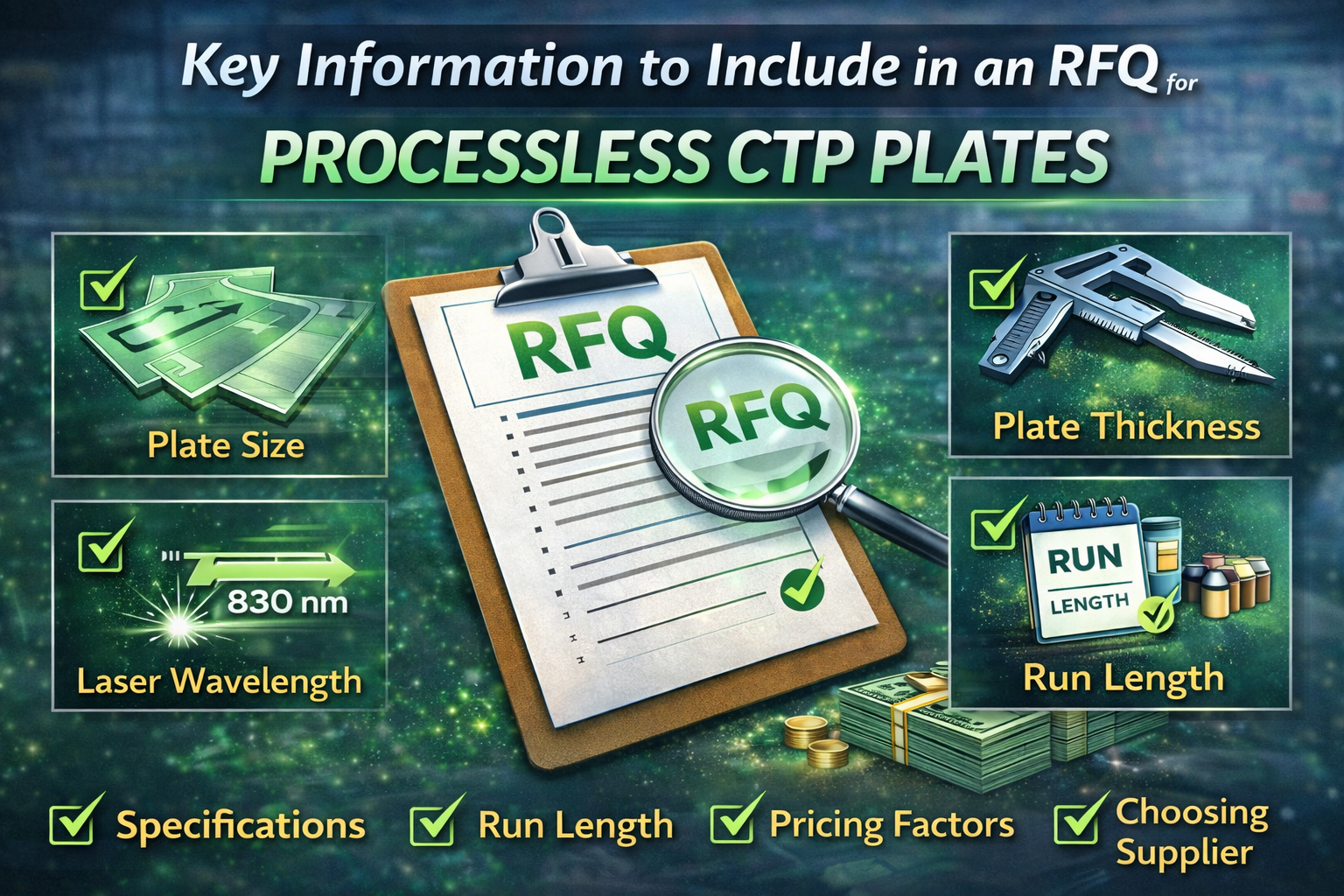
Key Information to Include in an RFQ for Processless CTP Plates
Below is the standard RFQ checklist used by professional printing companies.
1. Plate Size
The most basic information is the exact plate dimension required for your press.
Example:
1030 × 790 mm
745 × 605 mm
1160 × 940 mm
Tolerance requirements may also be specified for high-precision presses.
2. Plate Thickness
Processless plates are commonly available in several thicknesses.
Typical options include:
| Plate Thickness | Typical Application |
|---|---|
| 0.15 mm | Small commercial printing |
| 0.20 mm | Medium-sized presses |
| 0.25 mm | Large format presses |
| 0.30 mm | Packaging and heavy-duty printing |
Choosing the correct thickness ensures plate durability and stable mounting.
3. Laser Wavelength Compatibility
Most processless CTP plates are thermal plates designed for 830 nm laser systems.
You should specify your CTP machine brand and model in the RFQ.
Example machines include:
Kodak Trendsetter
Screen PlateRite
Heidelberg Suprasetter
Agfa Avalon
This ensures compatibility with the laser imaging system.
4. Plate Run Length Requirement
Different processless plates offer different durability levels.
Typical ranges include:
50,000 impressions (standard commercial)
100,000 impressions (enhanced durability)
150,000 impressions (high-end plates)
If UV inks or special coatings are used, the run length requirement may change.
5. Printing Application
Specifying the printing application helps suppliers recommend the correct plate formulation.
Common applications include:
Commercial printing
Newspaper printing
Book printing
Packaging printing
Label printing
Each application has different requirements for dot reproduction and durability.
6. Ink and Fountain Solution Type
Processless plates interact directly with the press environment.
RFQs should mention whether you use:
Conventional offset ink
UV ink
Low-chemistry fountain solution
Alcohol-free dampening system
These factors affect plate stability and image development.
7. Monthly or Annual Consumption
Suppliers often provide better pricing when they understand your expected purchasing volume.
Typical RFQ quantities may include:
Trial order: 500–1000 plates
Monthly demand: 3,000–10,000 plates
Annual contracts: 50,000+ plates
Volume estimates allow manufacturers to offer long-term supply agreements.
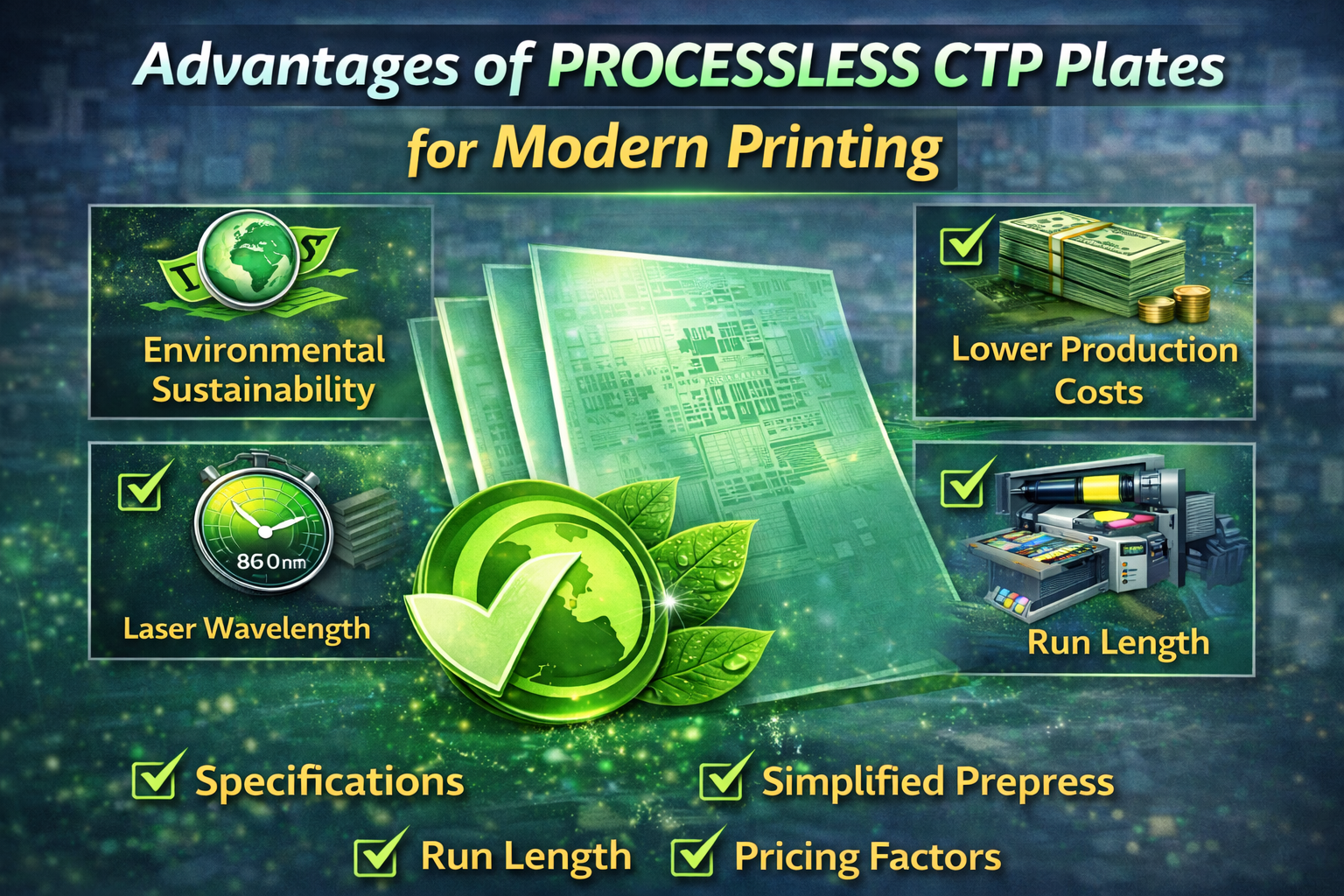
Advantages of Processless CTP Plates for Modern Printing
Printers increasingly request RFQ of Processless CTP Plates because the technology offers multiple operational advantages.
1. Environmental Sustainability
Processless plates eliminate the need for:
Plate developers
Replenishers
Wastewater treatment
This significantly reduces the environmental footprint of printing operations.
2. Lower Production Costs
Although processless plates may have a slightly higher purchase price, the total production cost is lower because printers save on:
Chemicals
Processing equipment
Maintenance
Water consumption
Labor
The overall cost reduction can reach 20–30% in prepress operations.
3. Faster Production Workflow
Without plate processing steps, the workflow becomes:
CTP imaging → plate mounting → printing.
This reduces production time and improves job turnaround speed, which is critical for modern printing businesses.
4. Simplified Prepress Environment
Processless plates eliminate several pieces of equipment:
Plate processor
Chemical tanks
Drying systems
This simplifies plant layout and reduces maintenance.
Common Mistakes When Sending an RFQ
Many buyers unknowingly make mistakes that delay the quotation process.
Incomplete Technical Information
Missing details such as laser wavelength or plate thickness can lead to incorrect product recommendations.
No Press Model Provided
Different presses may require different plate characteristics.
Ignoring Packaging Requirements
Export shipments require moisture-proof packaging and proper palletization.
No Trial Testing Plan
Professional buyers usually request sample plates for press testing before bulk purchase.
Tips for Choosing the Right Processless Plate Supplier
When evaluating suppliers after sending an RFQ, consider the following factors.
Manufacturing Experience
Choose manufacturers with strong expertise in offset plate coating technology.
Product Stability
Stable coating ensures consistent dot reproduction and plate durability.
Global Export Experience
Suppliers with export experience understand international logistics, packaging, and quality standards.
Technical Support
A professional supplier should assist with:
Press compatibility testing
Imaging parameter optimization
Troubleshooting during trial runs
The Future of Processless Plate Technology
As sustainability becomes a global priority, processless plates are expected to dominate the offset plate market.
Industry trends include:
Higher run-length processless plates
Faster imaging sensitivity
Improved scratch resistance
Compatibility with alcohol-free printing
These innovations will make processless plates even more attractive for commercial and packaging printers worldwide.
Conclusion
Submitting a professional RFQ of Processless CTP Plates is the first step toward building a reliable supply chain for modern printing operations.
By including detailed technical specifications such as:
Plate size
Thickness
Laser compatibility
Printing application
Run length requirements
printers can receive accurate quotations, compatible products, and optimal pricing.
Processless plates not only simplify the printing workflow but also reduce environmental impact and production costs, making them a key technology for the future of offset printing.
If you are looking for a reliable supplier, we are a professional manufacturer of Processless CTP Plates with extensive experience in global markets.
We provide stable quality plates, competitive pricing, and technical support for printers worldwide.
Feel free to contact us for RFQ inquiries, product specifications, or sample testing. Our team will be happy to help you find the best plate solution for your printing business.
Why Does a CTP Plate Scum on Press ? 9 Common Causes and Proven Solutions
Learn why CTP plates scum on press, the most common causes, troubleshooting methods, and practical solutions to improve offset printing quality and reduce downtime.
Which Offset Machine Is Best ? A Practical Guide for Commercial Printing
Which offset machine is best? Learn how to choose the right offset printing machine based on format, volume, cost, and CTP technology.
Where to Buy Thermal CTP Plates for Offset Printing | Best Supplier Guide & Expert Tips
Looking for reliable thermal CTP plates for offset printing? This expert guide explains how to choose a trustworthy supplier, compares global and Chinese manufacturers, and shares key quality criteria.