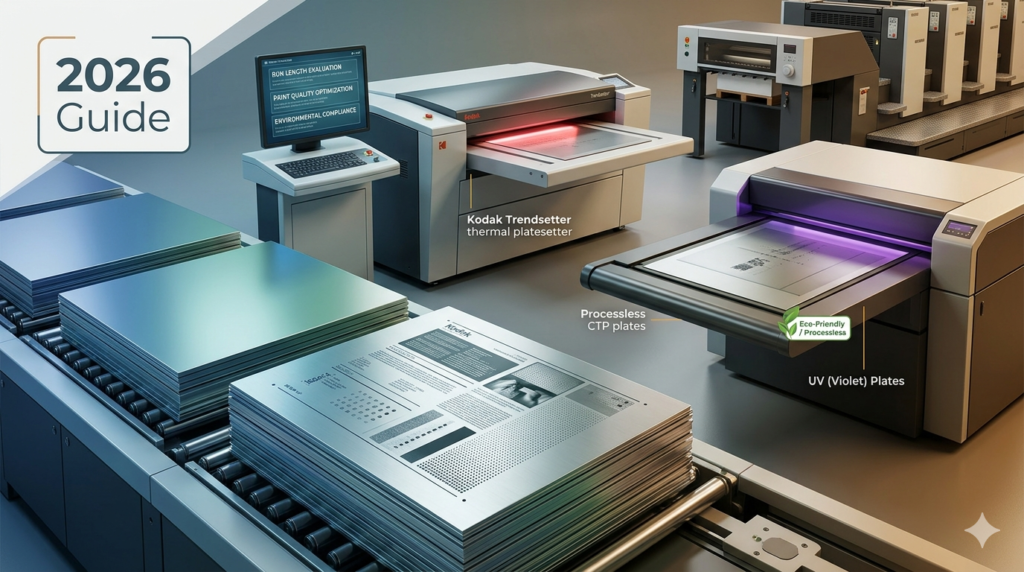
In modern offset printing, choosing the right CTP plate is no longer just a technical decision—it directly impacts print quality, production efficiency, operating cost, environmental compliance, and customer satisfaction.
With the rapid evolution of plate technologies such as:
- Thermal CTP plates
- UV (violet) plates
- Processless plates
- Chemistry-free plates
many printers are asking the same question:
How do you make the right decision when choosing CTP plate for offset printing?
This comprehensive 2026 professional guide explains everything you need to know—from plate types and compatibility to run length, workflow optimization, and cost analysis.
Whether you are a commercial printer, packaging manufacturer, distributor, or procurement manager, this article will help you make an informed choice.
1. Why Choosing the Right CTP Plate Matters
A CTP plate is one of the most critical consumables in offset printing.
The wrong plate selection may lead to:
- Poor dot reproduction
- Plate wear problems
- Ink-water imbalance
- Increased waste sheets
- Production downtime
- Higher operating costs
Meanwhile, the correct plate improves:
- Printing consistency
- Press efficiency
- Cost control
- Environmental performance
- Overall production reliability
That is why professional printers carefully evaluate multiple factors before choosing a plate.
2. Understanding CTP Plate Technology
CTP stands for Computer-to-Plate.
Unlike traditional film workflows, digital files are imaged directly onto aluminum plates using laser systems.
The basic workflow:
- Digital design preparation
- Plate imaging via CTP machine
- Plate processing (or processless workflow)
- Mounting on press
- Printing production
Modern CTP technology significantly improves:
- Registration accuracy
- Imaging precision
- Production speed
3. Main Types of CTP Plates for Offset Printing
Before choosing a plate, you must understand the available technologies.
3.1 Thermal CTP Plates
Overview
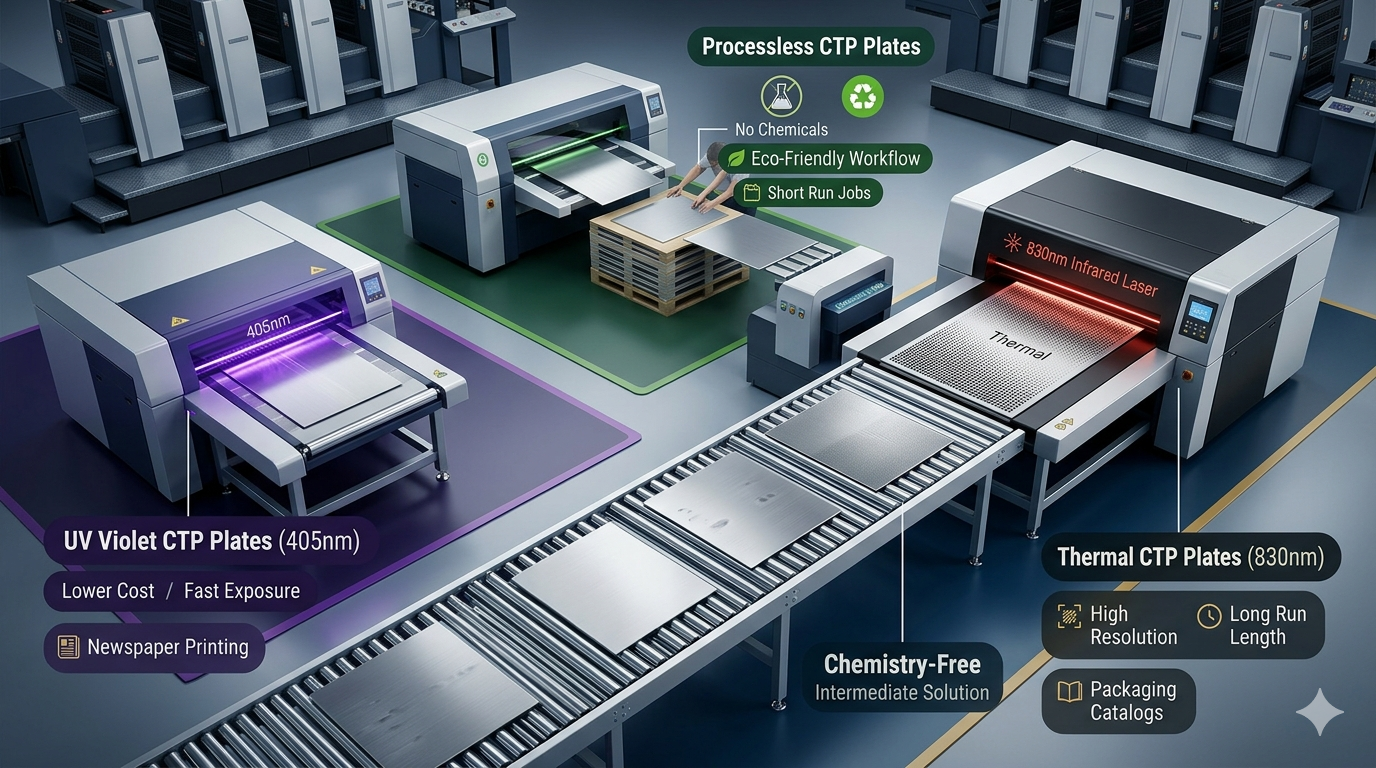
Thermal plates use 830 nm infrared laser exposure and are currently the most widely used offset printing plates globally.
Advantages
- Excellent print quality
- High resolution
- Stable imaging performance
- Long run length
- Strong daylight resistance
Best Applications
- Commercial printing
- High-end catalogs
- Packaging printing
- Book production
Limitations
- Higher equipment investment
- Most models require chemical processing
3.2 UV (Violet) CTP Plates
Overview
UV plates use 405 nm violet laser technology.
Advantages
- Lower equipment cost
- Faster exposure speed
- Good for newspaper workflows
Best Applications
- Newspaper printing
- Mid-range commercial printing
Limitations
- More sensitive to ambient light
- Lower durability compared to thermal plates
3.3 Processless CTP Plates
Overview
Processless plates eliminate chemical development entirely.
After imaging, plates go directly to press.
Advantages
- No processing chemicals
- Reduced environmental impact
- Faster workflow
- Lower operating cost
Best Applications
- Eco-friendly printing plants
- Commercial printing
- Fast turnaround jobs
Limitations
- Requires precise press calibration
- Slightly higher plate price
3.4 Chemistry-Free Plates
These plates require minimal processing but eliminate traditional developer chemistry.
They are often considered an intermediate solution between processed and fully processless technologies.
4. Key Factors When Choosing CTP Plate for Offset Printing
4.1 Printing Application
Different applications require different plate characteristics.
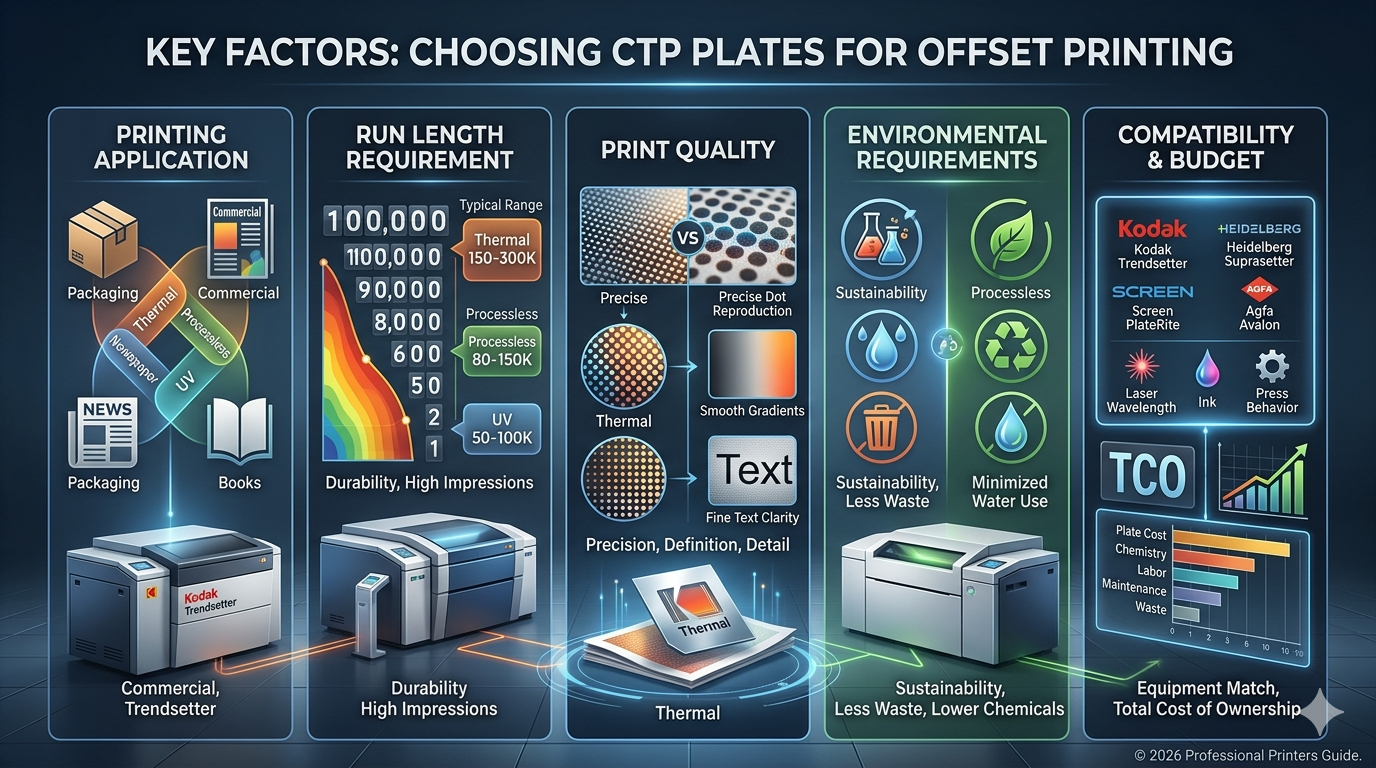
| Application | Recommended Plate Type |
|---|---|
| Commercial printing | Thermal or processless |
| Newspaper printing | UV plates |
| Packaging printing | Thermal long-run plates |
| Book printing | Thermal or processless |
Always choose according to production needs.
4.2 Run Length Requirement
Run length is critical.
Typical Range
| Plate Type | Typical Run Length |
|---|---|
| Thermal processed | 150,000–300,000 impressions |
| Processless | 80,000–150,000 impressions |
| UV plates | 50,000–100,000 impressions |
Long-run production requires more durable plates.
4.3 Print Quality Expectations
High-end printing requires:
- Precise dot reproduction
- Smooth gradients
- Fine text clarity
- Stable screening
Thermal plates are generally preferred for premium print quality.
4.4 Environmental Requirements
Environmental regulations are becoming stricter worldwide.
Processless plates help reduce:
- Chemical waste
- Water consumption
- Hazardous disposal costs
Many printers now prioritize sustainability during procurement.
4.5 Compatibility with Existing Equipment
Before switching plates, verify:
- Laser wavelength compatibility
- Processor compatibility
- Press behavior
- Ink system compatibility
Most thermal plates work with:
- Kodak Trendsetter
- Heidelberg Suprasetter
- Screen PlateRite
- Agfa Avalon
4.6 Budget and Total Cost Analysis
Many buyers focus only on plate price, but professionals evaluate total cost of ownership (TCO).
Consider:
- Plate cost
- Chemistry cost
- Maintenance
- Labor
- Waste sheets
- Water consumption
Sometimes a slightly more expensive plate reduces total operating cost significantly.
5. Plate Thickness Selection
Plate thickness affects durability and press stability.
Common Thicknesses
| Thickness | Typical Use |
|---|---|
| 0.15 mm | Small-format printing |
| 0.20 mm | Commercial printing |
| 0.25 mm | Large presses |
| 0.30 mm | Packaging printing |
Incorrect thickness may cause:
- Registration issues
- Mounting instability
- Premature plate wear
6. Positive vs Negative Working Plates
Positive Plates
- Exposed areas are removed
- Excellent detail reproduction
Negative Plates
- Exposed areas remain
- Better durability for long runs
The choice depends on workflow preference and production needs.
7. Common Mistakes When Choosing CTP Plates
Avoid these common procurement errors.
7.1 Choosing Based Only on Price
Low-cost plates may create:
- Higher waste
- Shorter plate life
- Poor consistency
7.2 Ignoring Press Compatibility
Not all plates behave identically on every press.
Always conduct testing.
7.3 Overlooking Environmental Costs
Traditional processing systems add hidden expenses:
- Chemicals
- Water
- Maintenance
- Disposal fees
7.4 No Trial Testing
Professional printers always conduct:
- Exposure testing
- Press testing
- Run-length evaluation
before large-volume purchasing.
8. Industry Trends in 2026
The offset printing industry is evolving rapidly.
Major Trends
Growth of Processless Technology
Environmental demand is accelerating adoption.
Higher Automation
Smart workflows require stable plate consistency.
Sustainable Printing
Chemical reduction is becoming a global standard.
Improved Coating Technology
Modern plates now offer:
- Better scratch resistance
- Faster imaging sensitivity
- Longer run length
9. How to Test a CTP Plate Professionally
Professional evaluation should include:
Imaging Test
Check exposure sensitivity and contrast.
Press Startup Test
Evaluate clean-up speed and ink balance.
Long Run Test
Measure durability over extended production.
Dot Reproduction Analysis
Verify highlight and shadow stability.
10. Future of CTP Plates
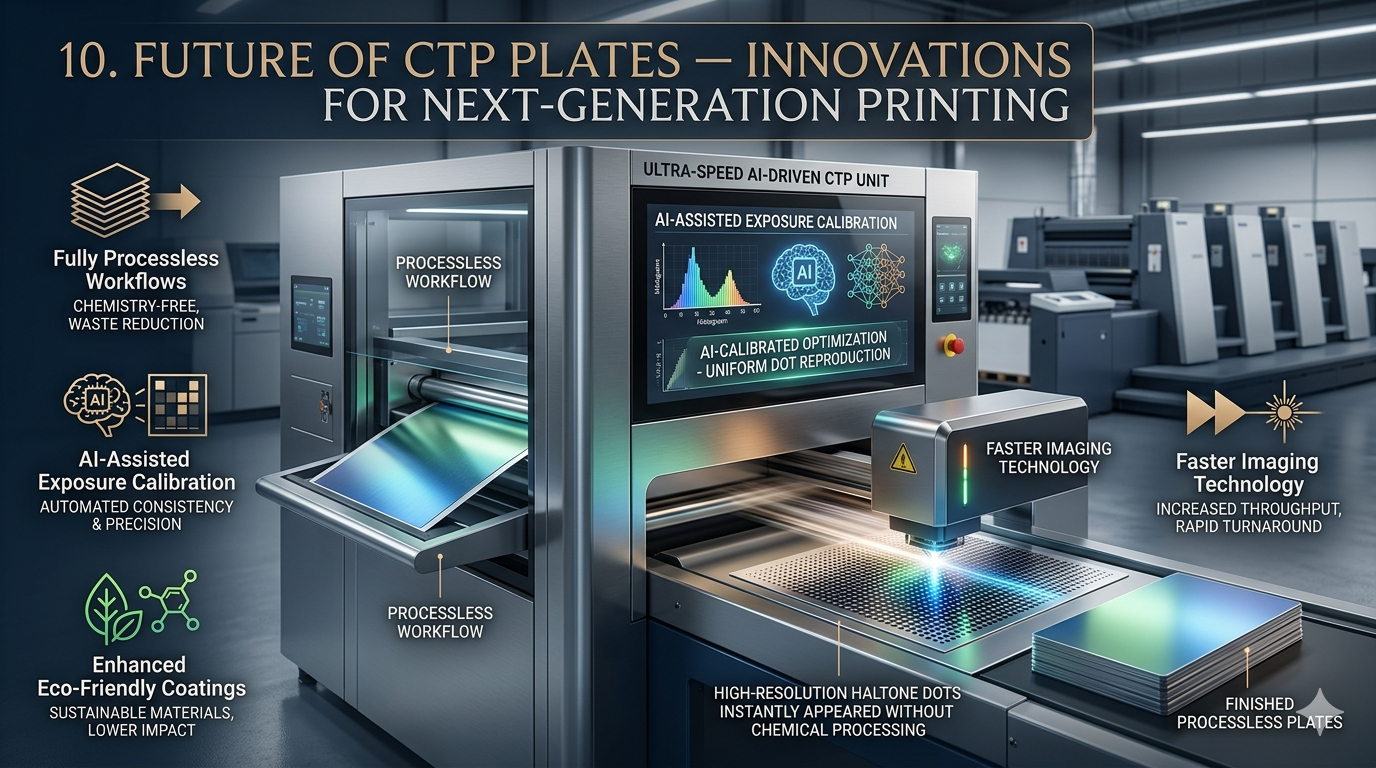
Future developments will focus on:
- Fully processless workflows
- AI-assisted exposure calibration
- Enhanced eco-friendly coatings
- Faster imaging technology
Processless plates are expected to dominate commercial printing markets in the coming years.
Frequently Asked Questions (FAQ)
Q1: What is the best CTP plate for offset printing?
There is no single “best” plate. The ideal choice depends on:
- Print volume
- Press type
- Budget
- Environmental goals
- Print quality requirements
For many commercial printers, thermal and processless plates are currently the top choices.
Q2: Are processless plates better than traditional thermal plates?
Processless plates offer:
- Lower environmental impact
- Simplified workflow
- Lower operational costs
Traditional thermal plates may still provide better performance for ultra-long-run jobs.
Q3: How do I know if a CTP plate is compatible with my machine?
Check:
- Laser wavelength
- Machine model
- Exposure sensitivity
Most manufacturers provide compatibility guidance.
Q4: What is the difference between UV and thermal plates?
Thermal plates provide higher print quality and durability, while UV plates usually offer lower equipment cost and faster exposure.
Q5: Why is plate thickness important?
Correct thickness ensures:
- Stable mounting
- Proper pressure balance
- Longer plate life
Q6: Are eco-friendly plates becoming mainstream?
Yes. Processless and low-chemistry plates are rapidly growing due to environmental regulations and sustainability goals.
Q7: Can one printing plant use multiple plate types?
Absolutely. Many plants use:
- Thermal plates for long runs
- Processless plates for short runs
- UV plates for newspaper printing
depending on job requirements.
Conclusion
Choosing CTP plate for offset printing requires balancing:
- Print quality
- Cost efficiency
- Environmental impact
- Workflow compatibility
- Production volume
There is no universal solution. The best plate is the one that matches your press conditions, business goals, and customer expectations.
As the printing industry continues evolving, processless and eco-friendly technologies are becoming increasingly important for future competitiveness.
We Are a Professional CTP Plate Manufacturer
We specialize in:
- Thermal CTP plates
- Processless CTP plates
- UV CTP plates
- OEM printing plate solutions
We provide:
- Stable quality
- Competitive factory pricing
- Technical support
- Global export service
If you are choosing CTP plates for your offset printing business, feel free to contact us for samples, testing support, and product recommendations.
Why Does a CTP Plate Scum on Press ? 9 Common Causes and Proven Solutions
Learn why CTP plates scum on press, the most common causes, troubleshooting methods, and practical solutions to improve offset printing quality and reduce downtime.

Which Offset Machine Is Best ? A Practical Guide for Commercial Printing
Which offset machine is best? Learn how to choose the right offset printing machine based on format, volume, cost, and CTP technology.
Where to Buy Thermal CTP Plates for Offset Printing | Best Supplier Guide & Expert Tips
Looking for reliable thermal CTP plates for offset printing? This expert guide explains how to choose a trustworthy supplier, compares global and Chinese manufacturers, and shares key quality criteria.