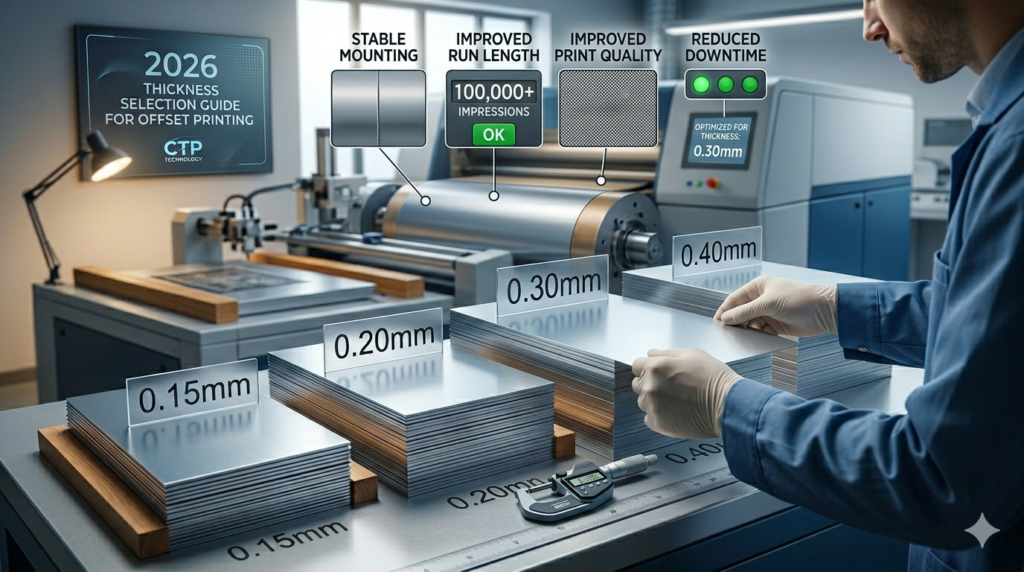
In modern offset printing, selecting the correct CTP plate thickness is just as important as choosing the right plate technology. Many printers focus only on plate brand or coating performance, but plate thickness directly affects:
- Printing stability
- Run length
- Plate durability
- Registration accuracy
- Press compatibility
- Production cost
One of the most frequently searched topics in the printing industry today is:
CTP Plate in 0.15mm, 0.20mm, 0.30mm, 0.40mm
Each thickness is designed for different printing environments, machine sizes, and production requirements. Choosing the wrong thickness can lead to:
- Plate cracking
- Poor registration
- Mounting instability
- Shorter plate life
- Increased waste sheets
This complete 2026 guide explains everything printers need to know about 0.15mm, 0.20mm, 0.30mm, and 0.40mm CTP plates, including applications, advantages, limitations, compatibility, and professional selection recommendations.
1. What Does CTP Plate Thickness Mean?
CTP plate thickness refers to the thickness of the aluminum printing plate used in offset printing.
The thickness is typically measured in:
- Millimeters (mm)
- Microns (μm)
Example:
- 0.15mm = 150 microns
- 0.20mm = 200 microns
- 0.30mm = 300 microns
- 0.40mm = 400 microns
Plate thickness affects:
- Mechanical strength
- Flexibility
- Cylinder compatibility
- Press pressure tolerance
2. Why Is Plate Thickness Important in Offset Printing?
Many printers underestimate the importance of thickness selection.
However, proper thickness ensures:
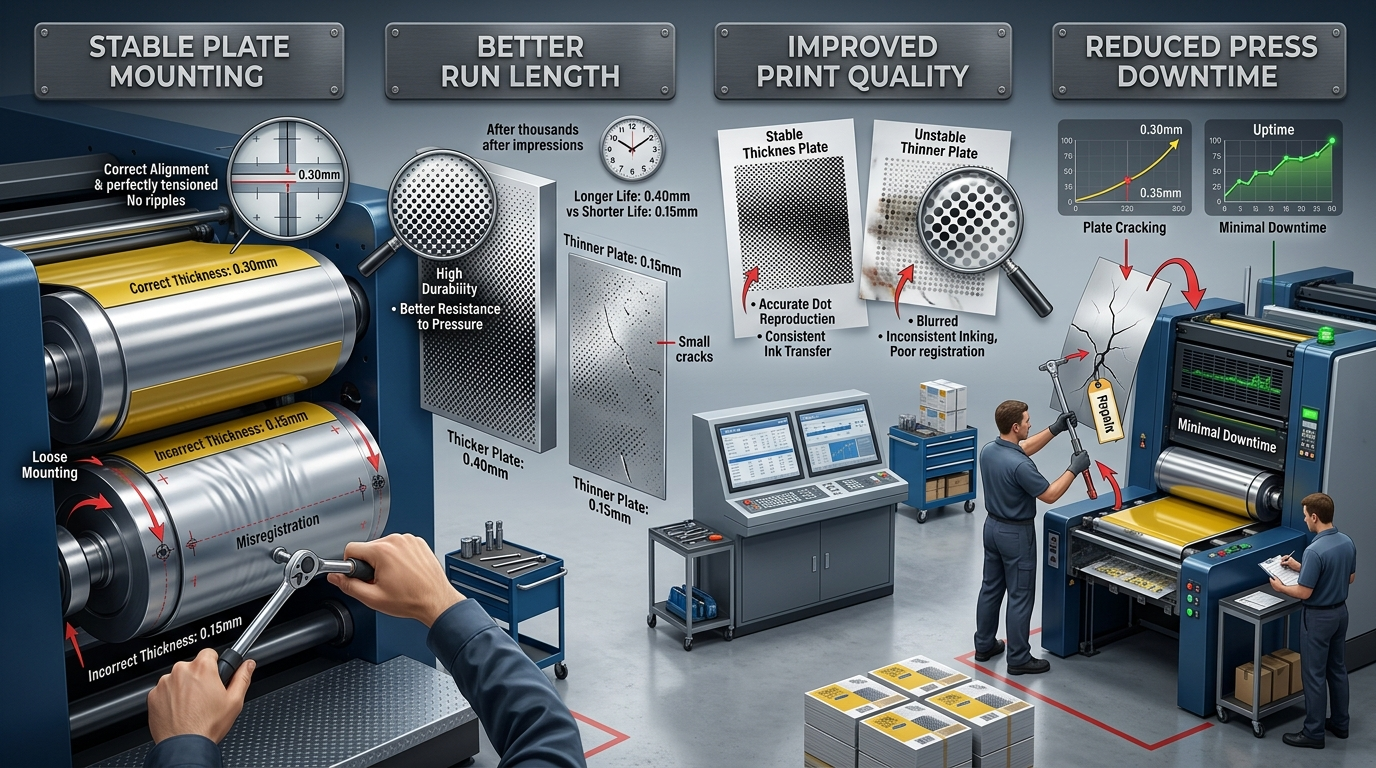
Stable Plate Mounting
Incorrect thickness may cause:
- Loose mounting
- Misregistration
- Vibration during printing
Better Run Length
Thicker plates generally provide:
- Higher durability
- Better resistance to pressure
- Longer production life
Improved Print Quality
Stable plates maintain:
- Accurate dot reproduction
- Consistent ink transfer
- Better registration control
Reduced Press Downtime
Correct plate thickness minimizes:
- Plate bending
- Cracking
- Mechanical instability
3. CTP Plate in 0.15mm
Overview
0.15mm CTP plates are thin, lightweight plates primarily used in:
- Small-format offset presses
- Quick commercial printing
- Light-duty applications
Advantages of 0.15mm Plates
Better Flexibility
Thin plates wrap easily around small cylinders.
Lower Cost
Less aluminum material reduces manufacturing cost.
Faster Mounting
Lightweight structure improves handling efficiency.
Limitations
- Lower run length
- Reduced mechanical strength
- Not suitable for heavy-pressure applications
Typical Applications
| Application | Suitability |
|---|---|
| Small commercial printing | Excellent |
| Short-run jobs | Excellent |
| Packaging printing | Limited |
| Newspaper printing | Moderate |
4. CTP Plate in 0.20mm
Overview
0.20mm is one of the most commonly used thicknesses in commercial offset printing worldwide.
It provides a strong balance between:
- Flexibility
- Durability
- Cost efficiency
Advantages of 0.20mm Plates
Versatile Performance
Suitable for many press sizes.
Stable Printing
Good balance between rigidity and flexibility.
Excellent Cost Efficiency
Ideal for medium-volume commercial production.
Common Applications
- Brochures
- Magazines
- Books
- Commercial catalogs
Recommended Press Types
- Heidelberg SM series
- Komori commercial presses
- Ryobi presses
- Mitsubishi medium-format presses
5. CTP Plate in 0.30mm
Overview
0.30mm plates are designed for:
- Large-format presses
- Packaging printing
- High-pressure environments
These plates provide significantly higher mechanical stability.
Advantages of 0.30mm Plates
Higher Durability
Excellent for long production runs.
Better Pressure Resistance
Suitable for difficult substrates and packaging materials.
Improved Registration Stability
Less deformation during high-speed printing.
Typical Applications
| Application | Suitability |
|---|---|
| Packaging printing | Excellent |
| Large-format commercial printing | Excellent |
| Carton printing | Excellent |
| Small presses | Poor |
Common Press Compatibility
- Large Heidelberg presses
- KBA large-format presses
- Packaging offset presses
6. CTP Plate in 0.40mm
Overview
0.40mm CTP plates are heavy-duty industrial plates designed for extremely demanding applications.
These plates are far thicker and stronger than standard commercial plates.
Advantages of 0.40mm Plates
Maximum Mechanical Strength
Ideal for extreme production conditions.
Superior Run Length
Excellent for ultra-long production runs.
Strong Resistance to Deformation
Maintains stability under high pressure.
Limitations
- Higher cost
- Heavier handling
- Limited compatibility with smaller presses
Typical Applications
- Metal decoration printing
- Heavy packaging production
- Industrial printing systems
- Specialized offset applications
7. Thickness Comparison Table
| Thickness | Flexibility | Durability | Cost | Main Application |
|---|---|---|---|---|
| 0.15mm | High | Low | Low | Small commercial printing |
| 0.20mm | Medium | Medium | Medium | Commercial offset printing |
| 0.30mm | Lower | High | Higher | Packaging printing |
| 0.40mm | Low | Very High | High | Industrial printing |
8. How to Choose the Correct Plate Thickness
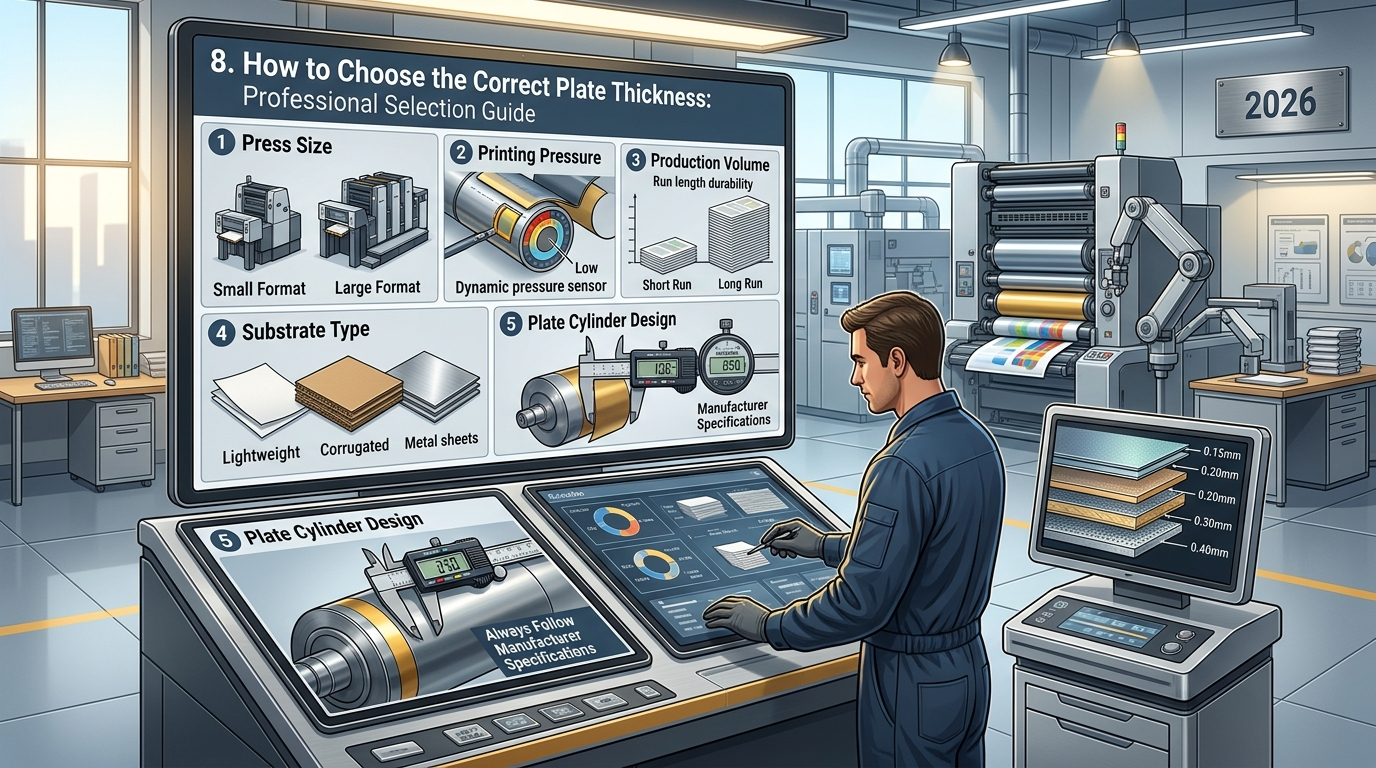
Professional selection depends on several factors.
1. Press Size
Small presses usually require thinner plates.
Large presses require stronger, thicker plates.
2. Printing Pressure
Higher pressure environments require thicker plates.
3. Production Volume
Long-run production benefits from more durable plates.
4. Substrate Type
Packaging materials often require thicker plates.
5. Plate Cylinder Design
Always follow press manufacturer specifications.
9. Common Mistakes When Selecting Plate Thickness
Choosing Only Based on Price
Cheaper thin plates may reduce durability.
Ignoring Press Specifications
Incorrect thickness may damage registration accuracy.
Using Thin Plates for Packaging
Packaging environments often require stronger plates.
Overusing Thick Plates on Small Presses
Excessive thickness may reduce mounting efficiency.
10. Future Trends in CTP Plate Manufacturing
Modern plate manufacturing is evolving toward:
- Higher-strength aluminum substrates
- Improved coating durability
- Eco-friendly plate technologies
- Processless plate systems
- Enhanced scratch resistance
Even thinner plates are becoming stronger due to advanced metallurgy and coating technology.
Frequently Asked Questions (FAQ)
Q1: What is the most common CTP plate thickness?
0.20mm is the most widely used thickness for commercial offset printing.
Q2: Is thicker CTP plate always better?
No. Thicker plates offer higher durability but may reduce flexibility and compatibility with smaller presses.
Q3: Which thickness is best for packaging printing?
0.30mm and 0.40mm are commonly used for packaging and heavy-duty applications.
Q4: What happens if the plate thickness is incorrect?
Incorrect thickness may cause:
- Poor registration
- Plate instability
- Press vibration
- Shortened plate life
Q5: Are 0.15mm plates suitable for long-run printing?
Generally no. They are better for short-run and light-duty applications.
Q6: Does plate thickness affect print quality?
Yes. Proper thickness improves stability and registration accuracy.
Q7: Can one printing factory use multiple thicknesses?
Yes. Many factories use different thicknesses depending on job requirements and press types.
Q8: Are processless plates available in all thicknesses?
Most processless plates are available in common thicknesses such as 0.15mm, 0.20mm, and 0.30mm.
Conclusion
Understanding the differences between CTP Plate in 0.15mm, 0.20mm, 0.30mm, and 0.40mm is essential for optimizing offset printing performance.
Each thickness serves different production needs:
- 0.15mm → lightweight commercial printing
- 0.20mm → standard commercial printing
- 0.30mm → packaging and long-run production
- 0.40mm → industrial heavy-duty applications
The correct thickness improves:
- Print quality
- Plate durability
- Production efficiency
- Cost control
Professional thickness selection is a key part of modern offset printing optimization.
We Are a Professional CTP Plate Manufacturer
We specialize in manufacturing:
- Thermal CTP plates
- Processless CTP plates
- UV CTP plates
- Multiple thickness options from 0.15mm to 0.40mm
We provide:
- Stable quality
- Competitive pricing
- OEM customization
- Global export support
If you are looking for reliable CTP plates for commercial or packaging printing, feel free to contact us for samples and technical consultation.
Why Does a CTP Plate Scum on Press ? 9 Common Causes and Proven Solutions
Learn why CTP plates scum on press, the most common causes, troubleshooting methods, and practical solutions to improve offset printing quality and reduce downtime.

Which Offset Machine Is Best ? A Practical Guide for Commercial Printing
Which offset machine is best? Learn how to choose the right offset printing machine based on format, volume, cost, and CTP technology.
Where to Buy Thermal CTP Plates for Offset Printing | Best Supplier Guide & Expert Tips
Looking for reliable thermal CTP plates for offset printing? This expert guide explains how to choose a trustworthy supplier, compares global and Chinese manufacturers, and shares key quality criteria.